Do you say ‘my kids’ or ‘our kids’? The difference is big

For those of you who have children:  when you talk about your kids to others, do you refer to them as “my kids” or “our kids”?noodleandboo1

It’s a major difference, and that distinction of one word says a lot.  The former connotes a more possessive or singular approach, whereas the latter sends a signal of togetherness and unity.  If you use the “my” term, it may seem harmless and might be completely unintentional, but it conveys a certain message – like it or not – to others and to your partner.

Take a look at Noodle & Boo, makers of luxurious baby and pregnancy skin care.  The product is found at high-end retailers, coveted by Hollywood stars, and it generally adheres to an impressive and upstanding company mission statement while supporting several charitable causes.

Now check out its latest ad, where it mentions “Only the best will do for her baby,” and the “first 100 mamas to follow @noodleandboollc and tag #mamaprofile with your favorite photo of you and baby…”

Isn’t the baby his, too?noodleandboo2

noodleandboo3Don’t dads use social media?

We can’t deny that some products and ads are marketed toward a certain gender, especially pregnancy skin care.  However, this ad was printed in a parents magazine.  And this particular product line it’s selling in this ad – it’s for babies.  That child is to be raised by parents, which includes dads.  No marketing piece should ever exclude dads and make them to be the lesser parent, as if they don’t matter.  Using the word “parent” instead of “mama” won’t make or break the business model, and it won’t make a female look away in disgust.

But it will make a dad feel included, feel like he matters to a company, and will make him take notice.

Believe us when we say dads notice.  Take a look on social media to find all the dads fully engaged in marketing messages and how they’re portrayed by retailers.  Old Navy, Huggies, Jif, Amazon – these are just a few of the companies that have been singled out by dads through viral campaigns to get them to change their ways.

It’s disappointing to see the exclusion in word choice and via advertisement photos, but that practice continues at its website, where a dad is nearly non-existent – save for a few celebrity dads it uses to sell its line of products.

When it comes to parenting, let’s hope Noodle & Boo acknowledges all the dads out there, because with Noodle & Boo, only the best will do, and dads count too.

The boldest prediction we’ve ever made

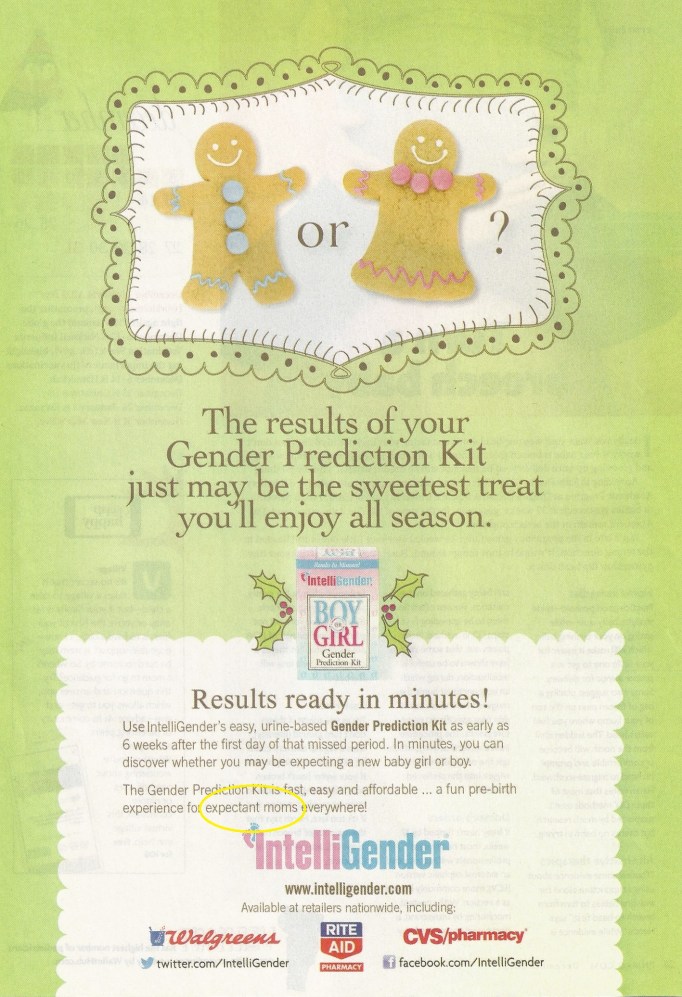
intelligender2When a child starts playing sports, parents will do everything imaginable to be a part of that child’s team.  Whether it’s organizing a booster club, volunteering at the concession stand, providing snacks, coaching, or simply cheering loudly from the stands, parents love to get actively involved.

Dads and pregnancy are often the same.  Aside from carrying out the actual birth, dads routinely like to get as close to the action as possible:  going to doctor appointments, prepping the baby’s new room, narrowing down baby names, shopping, and so on.  We’ve even met several guys, who like the mothers-to-be, will watch what foods they eat as a show of solidarity.

Alas, men love being team players and involvement, which makes this latest ad by IntelliGender all the more confusing.  Here it tries to take the fun of predicting a child’s birth away from expecting dads.

Why exclude them?

Men love predictions.  An entire month each year is dedicated to brackets and determining the outcome of basketball games.  Meteorologists take educated guesses at the weather daily.  Presidential elections are constantly forecast and polled.

Anytime a pregnancy is involved, that means incessant planning, waiting and predicting – and it’s exactly like the pregame!

If Fox Sports can precede a Super Bowl with six hours of nonstop banter trying to prophesy the winner and speculate on players who will make an impact, wouldn’t most guys want to turn a life-changing, baby-to-be moment into a fun pre-birth experience?

Doesn’t IntelliGender think that guys would want in on this action, rather than exclude them?

Just imagine the entertainment.  Want to wager on the child’s gender?  How about bracketizing your name choices?  What’s the over-under on its weight and height?

Think of the enjoyment that could be spread around, not just with dad-to-be, but with everyone.  IntelliGender’s own slogan is “Share the joy!,” but its marketing materials hardly want to divvy it around.

Let’s hope IntelliGender can start to include dads in its future messages, or odds are, another company will beat them to it.

Because dads are nurturers, too

armsreach1It’s a nice breath of fresh air when someone isn’t afraid to show a dad in a nurturing, or dare we say, snuggly position.  But that’s exactly the case with Arm’s Reach, who does what’s unfortunately the unthinkable for so many baby product companies – placing a baby carrier on dad.

It’s a sight we’ve all seen before, be it the park, library, or store. But for some reason, companies have a hard time going there.

Alas, the ad is great, where Arm’s Reach takes a small and brief moment to show a dad in a positive fashion, which validates that it must believe – on some level – dads do indeed shop and parent, too.

Last year, a Kansas City television station put the combination of dads and baby wraps in ksn3a less-than-flattering light while simultaneously making a mockery of fathers in other ways.  That station would do well to learn from this undertaking by Arm’s Reach, who isn’t afraid to put dad in an ad that also promotes a bassinet.
Anything placing dad in a position of nurturer is encouraging and needed.  Mother’s and Father’s Day occur in back-to-back months, yet you’ll be hard pressed to find many hearts on cards for dad – it’s more like neckties, easy chairs, power tools and beer mugs.

We say celebrate the love and warmth that comes from a father.

Keep up the good work, Arm’s Reach.  We’ve already heard from a few dads who appreciate the message you’re sending to America!

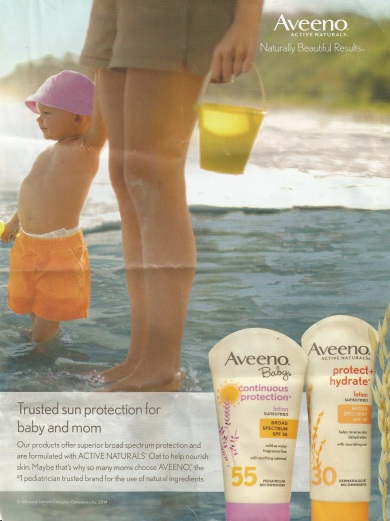
Can’t dads put sunscreen on kids?

aveenobaby2It’s ironic how there are some who admonish dads for their lack of parental involvement, and some who spend their time furthering that notion through advertising.

Take, for instance, this parent magazine ad for Aveeno Baby, produced by a company who believes that it’s only mom’s duty to handle a child’s skin protection.  That company may argue that “market research indicates…” or “readers prefer…” or “our focus groups suggest…” – but the fact is that it’s furthering a perception which is unfair, sexist and wrong.

Dads shop.  Dads parent.  Dads care.  And, well, dads apply sunscreen.

If you aren’t bothered by this chauvinistic ad, you should be for more reasons than one.  Not only does it disregard and intentionally exclude dads, it also uses the image of a boy to sell its product, the very product that will one day ignore this same boy should he become a father someday.  Spouses, too, should be bothered by this gender annexation:  that person they’re ignoring is your partner, your equal, your helpmate in this adventure called parenting.

Interestingly, last week we received a note from @KnowYourObama, who said, “Marketers don’t market to dads as parents because, mostly, they’re not.”

There’s no telling why this person believe this, but we wanted to chat a little more, and the following brief conversation ensued:

@dad_marketing:  “I think you might have offended Obama, plus a lot of other dedicated dads.”

@KnowYourObama:  “Obama’s a good dad, yes. But good dads – dads – are hard to find. Yay for the good ones.”

Here at DM Headquarters, we have no hard data to prove that there are more dedicated dads than uninvolved dads, but there should at least be some protection against libel, or perhaps some rules which guide what marketers can or can’t say.aveenobaby

Marketing departments have been saying or doing whatever they wanted for years, sometimes with little adaptation for societal changes – all in the pursuit of the almighty dollar.  It takes some real honorable companies to take a stand and do what is right and not just offer lip service (check out Jif-maker Smucker’s, and its “promise” page).

And who – you might ask – makes Aveeno Baby lotion?  None other than Johnson & Johnson, who has a history of waffling on gender equality.

To quote a word from Aveeno’s own ad, parents (dads included) have “trusted” Aveeno Baby and Johnson & Johnson for years.  When will that trust be returned?

This boy will someday be ignored by the very company using his likeness

garanimals4Do you see that cute little boy?  He’s been used.

Used by a company that was only in need of his smiling face, and then, will be ignored the moment he becomes a dad someday.

But don’t take our word for it.  Check out the Garanimals website, which uses parents and moms interchangeably like synonyms.  Of course, moms are parents, but one word refers to both genders of parents, the other only female parents; expressly mentioning moms and leaving out dads, as it did on its company website and in this print ad, purports mom to be the lead parent, the one who handles the shopping, the one who dresses kids, the one who takes care of kids alone.

That’s unfair.  That’s wrong.

It’s yet another unfortunate example of a company ignoring fathers as equal parents, and it has to stop.

Yes, that boy is smiling now, but someday he may be holding a child of his own.  He might even end up flipping through the pages of a parents magazine, encounter a Garanimals ad and then wonder, “I guess I only existed when that company needed something.”

And he might even use another company for his child’s clothes.

So in the end, this ad was not very, well, useful.

There’s no ointment that treats offensive marketing

drsmith5We’re seeing a striking similarity with Dr. Smith’s latest ad, and ads from yesteryear that would be deemed offensive today.
Why is it that Dr. Smith’s can get away with saying that only moms trust its brand? Why does it get away with saying that only moms love Dr. Smith’s?

In doing so, it’s clearly saying that dads don’t matter to Dr. Smith’s as customers.

Forget the fact that Dr. Smith’s might be targeting its product to a certain segment – the product has nothing to do with females. So, you have to consider one simple question: don’t dads parent, too?

That said, pause for a moment and check out this old-fashioned ad.

What might be wrong about running this ad in today’s world? Because people of all genders and ages would rightfully find it incredibly distasteful and insulting.

That’s kind of how we here at dadmarketing view this newest Dr. Smith’s ad. We’re not comparing the ad content — we’re comparing how the two ads make us feel. It’s a sad state when Dr. Smith’s can’t even consider dads enough to speak to them, declaring that only mothers tend to children. It’s insulting and it’s distasteful, to treat dads this way as parents and consumers.

Dads trust Dr. Smith’s. Why can’t Dr. Smith’s trust dads in return?

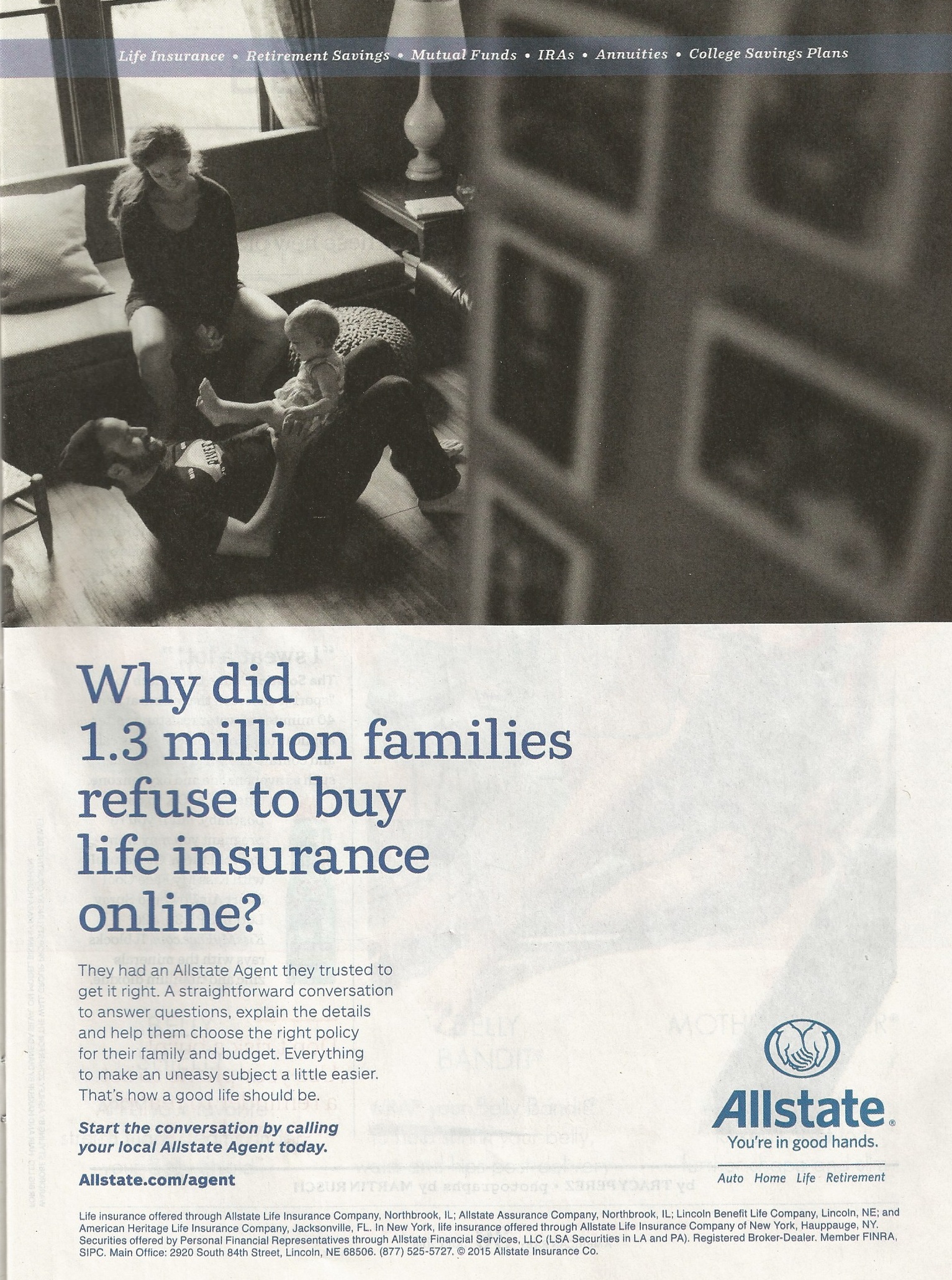
Which insurance company has dads in good hands?

If the basic definition of marketing is “to promote something in order to sell,” then there’s no question as to whom each insurance company presented here is trying to speak.gerber2

One featured ad is actually a direct mail piece from Gerber Life Insurance Company, who for years has been regularly sending this mailer with “See what Moms are saying about…” printed right on the front. And if you’re a dad who has been surprised to receive this in the mail, that’s not the only the only thing Gerber has jumbled; scroll about one-third down here to see another way this piece misfires.

allstate1The other featured is a display ad from Allstate found in the July 2015 American Baby magazine (click to enlarge). It not only addresses all of its potential customers by using the word “families,” but it includes a photo of a family where dad is holding the baby.

So, if you’re a dad and in the market for insurance, or even a college savings plan, where are you more likely to turn? To whom is Gerber and Allstate trying to “promote something in order to sell?”

Allstate’s approach is a positive one. Companies so often follow the supposedly “safe” marketing path, misbelieving that mom is the primary household decision-maker. Allstate knows that the days of “mom-stays-at-home, dad-goes-to-work” are ancient history. Indeed, caring for the family is a responsibility handled by both mom and dad.

Gerber, on the other hand, doesn’t want to change. Keeping an iconic, recognizable logo is a wise marketing move, but ignoring potential customers isn’t. Neither is having a college savings plan that gets dubious reviews.

Ever since our first post about Gerber in January 2014 (and again later in October), it began blocking us on Twitter. It’s the only company we’ve written about who has done so, proving that in Gerber’s world, communication is a one-way street.

Allstate, on the other hand, has won dads over. Dads are in good hands, indeed.

Curing the case of an upset stomach

tummycalm2We came across an interesting approach from Tummy Calm, who at one point was trying to play the “only-moms-take-care-of-kids” card.

Tummy Calm, distributed by TJL Enterprises of Long Beach, CA, is gas relief medicine for children.

The attached graphic appears in its tri-fold brochure, which judging by the tiny print, looks to have been produced in March 2015. (We can’t confirm this for certain, but it seems like a plausible deduction.)

However, over on the front page of its website, we find the word “mommy” removed.

The change is a positive one, as it should come as no surprise (it’s 2015, after all) that a website is a company’s primary communication piece.

But what’s with the sudden change?

Is the brochure targeting a certain segment? That’s conceivable. We came across this piece in a doctor’s office, and we all know that marketers don’t seem to believe that dads can actually transport children to appointments. Either that, or they believe that moms simply adore tri-fold brochures. Or, dads can’t read.

Is it a case of disjointed marketing-speak? That’s always possible. It wouldn’t be the first time we’ve noticed varying approaches – depending on the medium – by products marketed to children.

Could it be that the company is just being inconsistent, and simply forgot to use the word “Mommy” on the website? That’s less probable, especially since there’s unlimited space on the Internet, unlike tri-fold brochures.

Or, did TJL wise up in recent months after reading the latest news at dadmarketing.com?

If so, hats off to a marketing team that stopped exclusionary marketing dead in its tracks and recognized fathers for the work they do.

Keep an eye out for that newly revised brochure at a doctor’s office near you.

Welcome to the ‘hood

similac9Overly drenched in heaping layers of crippling irony is the headline from Similac’s latest display ad (right) which preaches, “There’s no ‘one-formula-fits-all’ for babies, or for parenting, either.”

Calling this marketing-speak odd would be an injustice to the word odd, instantly giving it a meaning never originally intended. It might just make something we all currently agree upon as odd, say, Miley Cyrus’ antics, seem almost girl-next-door normal.

Thus, we here at dadmarketing can’t call this latest advertisement odd. Rather, Similac’s ad proclamation is off-the-charts anomalous.

Here’s why: Similac, by way of its marketing message, slogan and ad copy (below), is saying that only moms are parents, yet its headline (above) tries to tell us something otherwise.

Again, did you notice the slogan from which it can’t seem to let go? “Welcome to the Sisterhood of Motherhood”? There’s nary a dad in the universe who can relate to that, and we’re talking about a product called baby formula, not breastfeeding, nor a feminine item. Dads should be every formula makers’ dream, a sure-fire built-in customer for life, but Similac doesn’t seem to want it that way.

Abbott, makers of Similac, has been touting this exclusionary “Sisterhood/Motherhood” slogan for several months now, and by it saying “there’s no one-parenting-fits all,” it sure seems to want it both ways: mild use of the word “parent” hidden behind its unilateral, sexist slogan.

Besides, check out the exhortation at the end of the ad: why would dads even bother taking Similac up on its invitation to visit Facebook?similac10

Dads aren’t moms!

It’s time to give this old-fashioned slogan a rest, and for Similac to consider that dads just might be part of its customer base, too. It’s no fun for dads to get ignored month after month. It’s campaign preaches a non-judgmental approach, but it has judged dads loud and clear:  they don’t count.

When it comes to taking care of babies, it’s not just a motherhood. It’s also a fatherhood.

And above all, it’s called parenthood.

Drefting away

When Similac unveiled its “Welcome to the Sisterhood of Motherhood” campaign this past January, there was a faction of dads and moms who lauded the inclusion of fathers in the commercial. It seems they were so ecstatic over not only actually seeing dads in a TV ad – but dads wearing babies – that they might have even been blinded by that awkward, old-fashioned tagline.

Alas, it’s doubtful there’s even one dad who can relate to “the Sisterhood of Motherhood.”

The video was only part of an exhaustive campaign over which we had even stronger thoughts, but unfortunately, Similac uses the same promo yet today as evidenced by its recent full page ad in the July 2015 American Baby magazine.dreft3

In that same magazine (page 41, to be exact), you’ll also find an ad for Dreft laundry detergent, which uses the slogan #AMAZINGHOOD.

That hashtag is a refreshing antidote to the exclusionary tagline used by Similac.

Imagine how different Similac’s campaign might have been if it – rather than using sister and mother – had simply used amazing, or even parent.

We’re not going to give Dreft a total free pass, as it still wants it both ways. Take a gander at dreft.com and click on “Our Story,” where it continues to believe that dads don’t exist. And its maker, P&G, has a steady practice of ignoring dads elsewhere, too.

But we’ll give credit where it’s due, because #AMAZINGHOOD is a fine word choice that doesn’t exclude dads – dads who care for their children and buy Dreft laundry detergent.

Dreft likes to tout that its product “has been trusted by moms for over 80 years,” but we suspect a dad or two has also placed its trust in Dreft over that time.

So, maybe in the next 80 years ahead, Dreft will finally begin to place trust in dads.

Now that would be #amazing.