
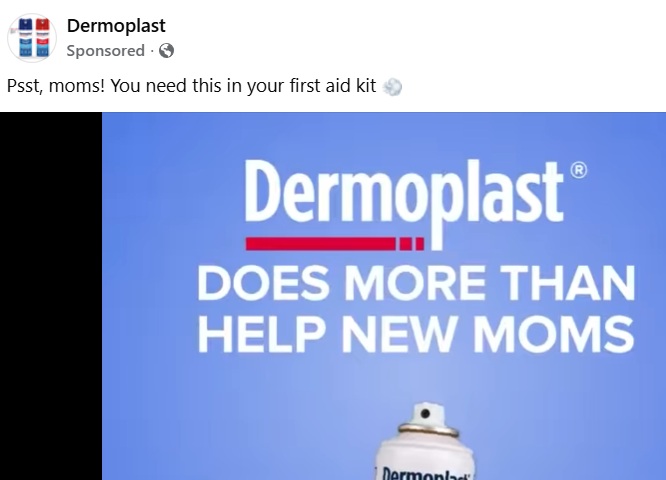
There’s a small line at the top of a Dermoplast ad that does a lot of heavy lifting: “Psst, moms! You need this in your first aid kit.”
That’s it. Ten words. Easy to scroll past.
But it quietly reveals something bigger about how parenting – and parents – are still being marketed to in today’s modern world.
Because here’s the thing: the product itself isn’t inherently “for moms.” It’s a pain relief spray. The larger message in the ad even says it “does more than help new moms,” which suggests broader usefulness. And yet, the hook, or entry point, is aimed squarely at mothers.
Not parents. Not families. Moms.
And this isn’t unusual. It’s the default.
For decades, marketing has treated moms as the primary (and often only) caregiver worth speaking to. Society is working hard at moving past this, but not marketing. Rather, it quietly reinforces a tired, old-fashioned narrative: when it comes to care, responsibility belongs to mothers first.
Which raises a question: where does that leave dads?
Because fatherhood sure doesn’t look like it used to. Dads are in delivery rooms. Dads are stocking first aid kits. Dads are doing late-night care, recovery support and everything in between. Not as “helpers,” but as parents.
And yet, they’re still largely invisible in moments like this.
To be clear, this isn’t about criticizing a single brand. Dermoplast is sadly doing what countless companies have done for years, and that is speaking to the audience they’ve been taught is “the buyer.” But, again, culture has moved faster than marketing.
The opportunity here isn’t just inclusion for inclusion’s sake. It’s accuracy. It’s relevance. It’s recognizing what families actually look like today.
Imagine the same ad reframed slightly:
“Psst, parents…”
or even
“For those first days home don’t forget this.”
Suddenly, the door opens wider. The message doesn’t lose clarity but rather gains truth.
The reality is simple: care isn’t a mom-only job. And the brands that start reflecting that reality won’t just be more inclusive, they’ll be more aligned with the families they’re trying to reach.
The question isn’t whether dads are part of the story.
It’s why they’re still being left out of the opening line.
 dadmarketing