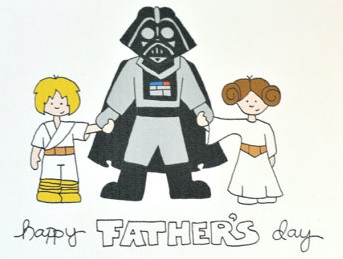
#FathersDay247365

Imagine for a moment, the thought of celebrating certain holidays every single day of the year. Halloween trick-or-treating would probably lose its thrill. Thanksgiving turkey would get a bit old. Christmas cheer would be a little less, um, cheery.vader

But Father’s Day? I suspect most dads would wish for it 24/7/365. Who can blame them?

Right now a dad somewhere in Maine is sleeping in. In Pennsylvania, two kids are serving daddy Lucky Charms, Pop Tarts and juice boxes in bed. In Michigan, a father and his daughters are going to the NASCAR race. In California, a dad and his dad are going out to eat. In Arizona, a group of dads are playing golf. In Nebraska, it’s pizza, ice cream and a bike ride for pops and the family.

That’s the beauty of this holiday. There’s no one way to celebrate it. Sometimes families make plans together, but many times it’s up to the dad – a day to call his own shots and do whatever he wants.  There’s no expected traditions and expectations, only the ones you set.

It’s nice to see one day a year dedicated to dads, but we here at dadmarketing think it should be year round. There have been plenty of store ads on TV this week devoted to dads. We’ve seen numerous media stories about more stay-at-home dads, or how dads help out more, or how dads have a big influence on lives.

Let’s celebrate the spirit of this day every day, not just once a year!

Let’s see it in advertisements and as part of long-term marketing plans. Let’s see brands embrace dads in everything they do.

But all you businesses can start thinking about that tomorrow. Today, give the dad in your life some recognition.

If you make it all about the dad today, though, you’re missing the point. Be sure to acknowledge the kids too, who made them dads in the first place. Without them, there’s no Father’s Day. And don’t forget moms, too, who make dads better men through their support and love.

You know who you are, and we salute you! Enjoy this day!

Coppertone deaf

We’re all in full summer mode, and that means spending more time outdoors. More time outdoors means we’re spending more time in the sun. More time in the sun means we’ll need sun protection.

As we do that, we reach for a brand we know and trust: Coppertone.

Coppertone’s name actually originated from its marketing, when in 1944, a pharmacist invented the lotion to darken tans (henceforth, a “copper”-colored skin “tone”). It really became famous in 1953 when the iconic Coppertone girl was created, whereby a dog pulls down her blue swimsuit and reveals her behind to have a lighter tone than the rest of her tiny body, all accompanied by the slogan, “Don’t be a paleface!”

If you think that slogan has an element of racist tinge, you are not mistaken. Coppertone’s original logo was the profile of an Indian chief. (Don’t feel too bad, Coppertone, you have company.)

Although it wasn’t a permanent fix at the time, at least Coppertone’s ancestors had the decency to lessen the nuances by replacing the Indian coppertonewith the girl. Eventually, the slogan was eliminated altogether, and even her “paleface” and bare bottom disappeared, too.

In later years, the Coppertone girl has been imitated, cartooned and parodied.

And somewhere along the way, I suspect someone – probably another pharmacist – realized darkening a tan isn’t the best thing for your health, so they developed a popular line of sunscreens to protect us. Coppertone was even named the #1 pediatrician recommended brand.

All seemed well in the slather-iffic world of Coppertone until their highly paid marketing geniuses decided to run an ad in the June 2014 American Baby magazine, and then let it fall into the hands of the dadmarketing headquarters.

Coppertone has a history of adapting with the times, but their latest magazine ad reeks of 1953. I love the opening two lines, “You want to let your kids be kids. But you still have to be the mom.”

Yep, if it weren’t for moms, kids would be dying of skin cancer everywhere because dads won’t do it; they’re lazy. That’s exactly the message Coppertone is sending, isn’t it?

But don’t take dadmarketing’s word for it, the rest of the world thinks dads are lazy, too. Go to Google Images and search “lazy.” You’ll find incessant pictures of men sleeping on couches, or watching TV.

Stereotypes die hard.

But then again, so does halfhearted, outdated, behind-the-times ad copy.

Now that’s what I call lazy.

If you abuse your power, do you have too much?

Who most influences your behavior and opinions?

Your parents? Your siblings? Your pastor?

Wrong on all three counts. And wrong on anything else you might think is the answer.

It’s the news media. The media has a power so strong they travel on the same plane as the President. It shapes much of public perception, and with smart phones, blogs and social media, nearly anyone can become an instrument for and with the media. You might not agree, but Donald Sterling does. And so do plenty of others.

Any PR firm will tell you that when utilized correctly, the power of the media can be a most valuable ally. When handled carelessly, it can be dangerous and harmful to one’s image. But just because the new media is all-powerful, doesn’t mean it’s all-perfect.media

In its most basic form, the media’s job is to report the news. However, more and more we witness the media injecting opinions into print stories, offering comments after reading the TV news script, and personal view sound bites that act as fillers in-between radio commercials. The Internet is responsible for much of this, where there is no time or page limit, allowing anyone to ramble on with whatever they want for as long as they want. There used to be separate news columns and opinion columns, but now you can hardly tell which is which.

The lines have been blurred. The gray area is grayer. The muck is muckier.

And now, what once was a factual reporting of events, has become a writing free-for-all where reporters can say and do whatever they want in the name of journalistic sovereignty.

This article, in yesterday’s USA Today, was tarnished early on through the irresponsible use of “Mr. Mom” in the first paragraph. What’s more, the story could have been accompanied by a photo of a dad caring for children, or working in the home. Instead, the newspaper chose to use a photo of Michael Keaton from the film “Mr. Mom,” where he’s drying a child’s bottom on a public bathroom’s automatic hand dryer.

Don’t get me wrong, I certainly find the image humorous. But it had little to do with the story, other than reinforce the unfitting perception that dads are bumbling idiots when it comes to raising their children. (And the least USA Today could have done was get the year of the movie right – it was 1983, not 1883.)

All of this is unfortunate, because otherwise, the story was well done and interesting. Nevertheless, “Mr. Mom” is now three decades old, and the connotation falsely assumes that societal norms never change, leaving the reader lost at best, and offended at worst with this poor choice of association.

The news media wouldn’t be so powerful if we would only consume it, not overindulge on it.

The Grinch who stole Father’s Day

No matter how long we live, we all have this same statistic in common: we got to spend (roughly) nine months being held exclusively by our mothers. Life expectancy aside, and speaking solely in general terms, mothers will have always had at least nine more months than fathers to hold their children.

During pregnancy, of course, fathers have the chance to touch the belly, but there’s a barrier in the way. Fathers can experience a baby kick, but the sensation for the mother and child are one and the same. Fathers can talk and sing to the infant inside the mother’s womb, but babies not johnson&johnsononly hear the mother’s voice – they feel it.

I once heard a woman tell the story how their child died upon birth. She asked the nurses to let the dad, not her, be the first to hold their child, because he naturally never got to during the pregnancy. Besides, it was the first, only, and last time he would embrace their child all in the same instance.

Mothers have the exclusive, honored gift of carrying children. That’s special. That creates a bond with every child that doesn’t make it more superior than with a father, just unique.

And it should be treated with uniqueness, even in marketing.

However, Johnson & Johnson’s latest ad artlessly exudes and radiates exclusion. It doesn’t take a deep thinker to see that dads, plain and simple, are crudely left out of this marketing message. What’s more, the advertisement is ironically straight out of the June 2014 Parents magazine, which includes a special reading section specifically for dads, timed knowingly for Father’s Day.

That’s some holiday present from Johnson & Johnson, huh dads? A sucker punch below the belt, followed by a kick in the teeth, finished off with salt in the wounds.

I expected more from this company so synonymous with baby care. No head-to-toe wash around is going to clean up this mess.

Burned by Texas Toast

“Do you realize that toilet paper has not changed in my lifetime? It’s just paper on a cardboard roll, that’s it. And in ten thousand years, it will still be exactly the same because really, what else can they do?”

– George Costanza on Seinfeld

Later in this same episode, George’s friends Jerry and Elaine point out that toilet paper has become softer, there’s more sheets per roll and it comes in a variety of colors. Nevertheless, George is ultimately right. Despite some minor tweaks, there’s really not much that can be done with toilet paper; the basic concept has remained the same.

A magazine ad, however, has no limitation when it comes to creativity and reinventing itself. The beginning canvas of an advertisement starts as blank as Puddy’s mind, and the advertising agency has complete control to design and say whatever it pleases.

Why then, have we not advanced further when it comes to the way retailers sell their products?

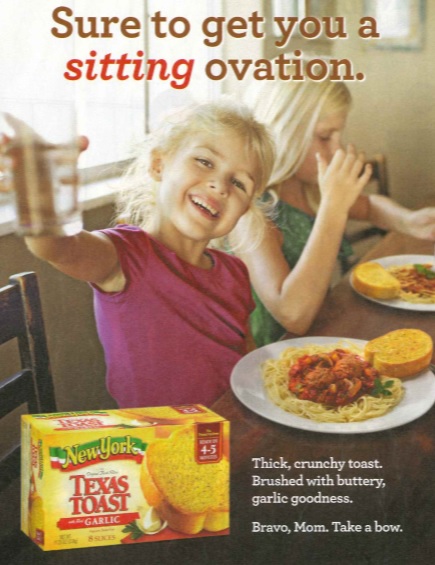
Take, for instance, the two ads featured in this entry. The tie ad might have been socially acceptable at one time, but it is taboo now. If used texastoast vanheusentoday Van Heusen would surely get some icy stares from the media, public, and anyone with a pulse. That ad today might even be deemed illegal.

But what about Texas Toast’s humdinger? Just a harmless ad with cute girls giving thanks to mom for the delicious Texas Toast on their plates?

Hardly. The ad perpetuates the same stereotype existing at the time of the Van Heusen ad, that moms are the ones who take care of their kids. Why isn’t it taboo?

It’s because ad execs are still trapped in a bygone era where market research tells them moms buys the Texas Toast, not dads. Even if that were true, why slight dads and propagate the stereotype?

The NFL has only four black head coaches out of 32 teams, but does that mean blacks can’t coach? Of course not! And in other news, dads have reportedly been seen at grocery stores from time to time.

We here at dadmarketing think Texas Toast needs to revise their ads in the future, or we’ll tear them out of the magazine, and promptly put them in the same place we do toilet paper.

Capri Sun drops the ball

caprisunThere are three certainties in life: death, taxes, and Capri Sun after kids’ sports games.

I mean, seriously, have you ever been to a soccer field and noticed what kids drink? How about a baseball diamond? The pool?

Capri Sun’s silver juice pouch is a staple in every kid’s gym bag. If the company was smart, it would skip the middleman and just sell it directly at the games, because that’s where all of it ends up once it’s bought in stores anyway.

But the company isn’t smart.

I knew this the moment I saw their ad in Scholastic Parent & Child magazine. Yes, you read correctly, its title is Parent & Child magazine, not Mom & Child magazine. That was a relief in itself; but I’m not letting Parent & Child completely off the hook, because they should screen their advertisers to ensure consistency with their magazine’s mission and target audience – and name.

Capri Sun’s ad contains the line “Good for moms. Awesome for kids.”

Perhaps if Capri Sun were selling their goods at the games they’d realize that often it’s the dad who lugs them by the case – sometimes in coolers on ice – to thirsty kids. Capri Sun might figure out that it’s many times dads who are coaching these thousands of parched kids.

But Capri Sun won’t. Their marketing gurus are sitting somewhere confused, thinking that “soccer mom” is a literal term, and believe every dad is currently on the golf course with his college buddies. That’s the only way I can figure that they’d have the nerve, or ignorance as it may be, to run this ad in Parent & Child magazine.

Giving Capri Sun some time to visit sports fields and get to know their consumers is a reasonable goal.

After all, if kids can score goals, the adults of Capri Sun can certainly set some.

If everybody else gets to write a list, we can too

Why bother?

ImageWhy would any company waste time marketing to dads?

Marketing to dads matters. Let us count the ways, and since lists seem to make the Internet go ‘round, here’s ours:

  1. It’s not about who uses the card, but about everything before the credit card is swiped – Anybody can put a Star Wars t-shirt in a shopping cart, but more went into that decision than you think.  What, or who, influenced it?  Maybe it’s dad’s love of the movie franchise that rubbed off on their kids.  Maybe it was a commercial the family saw while watching a hockey game together.  Maybe it is dad’s influence on a certain store the family frequents.  Maybe dad researched everything about the product online for the mom.  Maybe dad simply looks good in the shirt.  Any marketer can sit all day long in a store and prove that it was mom after mom who swiped that credit card in Target, but a wise researcher will investigate the whole story.
  2. No matter how small the slice is on the pie chart, it’s still a slice, and it still tastes like pie – I heard a weathercaster once say, “Even though there’s a 70% chance of rain today, remember that there’s a 30% chance it won’t.”  So, let’s say for example, that moms handle 70% of the purchasing.  Is a company really doing to ignore that potential 30% of dads who buy stuff?  Cereal makers do all the time, and if I was their CEO, I’d start looking for a new marketing team, and fast.
  3. Isn’t equality a goal? – When you alienate someone and make them feel left out, you’re bound to really turn them off.  What’s wrong with marketing to both mom and dad at the same time?  Nothing!  You’ll still have the mom in your good graces, and the dad will feel like he was included, too.  The good baby websites, I’ve found, are the ones that use the word “parent” and have photos of the newborn baby with both mom and dad.  Isn’t that a cool thing to see?
  4. Loyalty is king – If you become friends with someone at work or school, that’s nice.  If that friend invites you to their home, your friendship suddenly deepens, and you’ve formed a bond that makes you feel even more connected.  You’ve become loyal to them.  The same connection happens with retailers, and it means far more than customer satisfaction.  Dads are loyal people.  As author and speaker Jeffrey Gitomer once said, “Customer satisfaction is worthless.  Customer loyalty is priceless.”
  5. The Internet still is a game changer – Unless you’ve been living under a rock for say, the past 25 years, you’ve heard of the Internet.  It’s a marvelous tool used to gather information fast from all around the globe.  As far as I know, dads have used it to gather information, read and write reviews, and purchase things.  Lots of things.  Take the “zo” out of Amazon and you have “A man.”
  6. Look no further than sports – If you don’t follow sports, check out the power of the NFL, NASCAR, or any other sports league, and you’ll find it dominated by dads who have an allegiance to athletes and their games like no other.  It’s a gazillion dollar industry that continues to grow and expand with time.
  7. Dads eat and buy cereal – I think June Cleaver gets a bum rap.  Everyone likes to make her the poster child for old-fashioned, outdated behavior. Leave it to Beaver was a good show with wholesome characters, simply a product of its times.  Cereal is notorious for neglecting dads.  Kix is a product of its times too, but even a Beaver sequel in the ‘80s didn’t keep using the same formula – it updated for the times.  Read our December 17, 2013 entry if you want to learn more about Kix’s useless and archaic orange box.  It really isn’t the 1950s anymore, Kix, so hop on board the 2014 bus with the rest of us.  If I was Doc Brown and I had some plutonium, I’d so throw you into a DeLorean and send you “Back to the”…well, you know where.
  8. Credit card companies know better – Credit card companies know that their pocket-sized flat payment tools are used by dads, too.  That’s why they have dudes in their ads.  I’d even go as far to say that credit cards were inherently designed for dads:  they’re lightweight and flat since dads don’t like to carry things; they have cool pictures on them; they’re durable; they’re largely free to get (dads like free things); even acquiring one is easy to do.  Leave it to Jedi Master tough guy Mace Windu to set the record straight:  men do indeed use credit cards as he asks the question to which he already knows the answer, “What’s in your wallet?” Dads carry wallets.  Moms carry purses.  Closed, the case is.
  9. Dad, meet Internet; Internet, meet Dad – Dads and computers met a long time ago, and they realize how to use them.  Even if dads don’t always make the final purchase, they’re surely reading about the product beforehand.  They’re commenting on it.  They’re reviewing it.  And did you see that Amazon is starting an online grocery store?  Frankly, dads are probably purchasing things more and more off the Internet, because every good marketer claims knows that dads don’t like to shop in stores, right?  So, watch it marketers, because the slightest misstep and you’ll have more than one dadmarketing site broadcasting it to the world.
  10. Step up right here and behold, the spectacle! – The way dads get dissed everywhere, it seems like marketers make them out to be some kind of mythical creature that doesn’t exist.  In that vein, I have channeled my inner Dr. Seuss:

Dads move, dads think, they eat, they blink.

Dads stand, dads sit, they throw, they hit. 

Dads run, dads fly, they drive, they buy. 

Dads can do lots of things, you see. 

So don’t deny their authority.

I don’t cheer for Cheerios

The phrase “to those whom much has been given, more is required,” is best known for its origin in the Bible.

I think it applies to cereal, too — specifically, Cheerios — and we’ll get to that connection in a minute.cheeriosfrown

But let’s think about Cheerios first.  It’s one of the strongest brands around.  Its no-nonsense black serif font on the plain yellow box is iconic.  The circular shape is basic, pure and often imitated.  Its ingredients include whole grain oats and just one gram of sugar.  Nearly every off- and store-brand has made a knock-off version and given it a similar name.  The taste is simple and unchanged virtually since the beginning, unless you count the explosion of its flavored offspring, such as Reduced-Fat-Yogurt-Berry-Blast-Cinnamon-Coated-Sprinkle Cheerios (seriously, do we need this much variety?).

I would argue that Cheerios has been in every American home at least one point in time since its inception, and I doubt many brand names can proclaim that.  We eat it.  We make snack mixes with it.  We feed it to babies.  We feed it to birds.  We make crafts with it.  We give it to kids in church to keep them quiet.  We string it on Christmas trees.  We love it.  We trust it.  Its wholesome.  It sticks on noses (try doing that with Kix).  It’s certified by the American Heart Association!  It’s genius!Image

It’s just plain…perfect!

Or is it?

Their marketing folks nearly had me at hello, but as I went further into their website, discovered that it’s Mom’s Choice.  And that’s when I started thinking about the phrase, “to those whom much has been given, more is required.”

You see, we’ve made Cheerios a part of our lives and trusted it for years, and I always thought it was a decently mutual relationship:  General Mills kept making it, we kept eating it and everyone was happy.  But then they started saying that it’s the cereal which mom’s choose, and dads instantly became alienated and left out.  More should be required of one of the top cereals around.  They’re supposed to be an example for everyone else.  Do you ever see the NFL say, “It’s the sports league more dads watch with their boys than any other”?

Cheerios, I thought you were better than this.  We’ve all given you so much, and more should be required.

I have the last box I’ll ever buy in my cupboard, and I’m not even going to eat it.

But the birds will.