I don’t wanna taco about it

Now we’re really confused. El Monterey, makers of authentic Mexican frozen foods, has a Twitter page that outright discriminates against dads, yet it was founded by a father and his son.elmonterey1

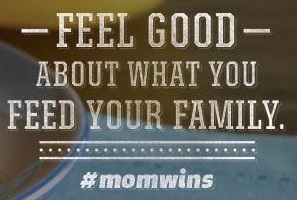
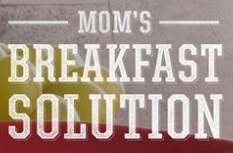
Don’t believe us? Check out twitter.com/elmonterey, which has a bio reading, “We’re a family owned company dedicated to helping mom conquer her day,” and also includes a #momwins campaign.

If the bio wasn’t exclusionary enough, the #momwins hashtag certainly creates a senseless rift. After all, if mom wins, then where does that leave dad?

We know, we know, its marketing department would tell us that dad wins, too, by way of the delicious food served, but that age-old corporate speak would be missing the point.

elmonterey2This sort of old-fashioned marketing is a tired approach that’s sure to make dad feel left out. If this company really believes the fallacy that dad doesn’t handle kitchen duty (which in turn implies that mom’s place is squarely in the kitchen — ouch), wouldn’t it be all the more reason to promote its easy-to-make, freezer-to-oven products directly to dads themselves?

elmonterey3Oddly, #momwins doesn’t appear on its website, but is used more regularly on Twitter, Facebook and Pinterest — all of which could be correctly rather easily.

Many here at dadmarketing headquarters have purchased and enjoyed El Monterey products in the past, but that practice is coming to a sudden stop. Instead of #momwins, it’s now #everybodyelseloses. Isn’t that a calamitous case of marketing gone awry?

Let’s hope its marketing department can make a change for the better, as it reflects on its “family owned” slogan, knowing that dads count as part of the family, too.

Marketing to both parents, at its finest

It would be pretty easy for the marketing team at Cord Blood Registry to feature only a mom in its latest magazine ad. Dads can do anything for a child that a mom can do, except give birth and naturally breastfeed.cbr

So, yes indeed, that umbilical cord is unmistakably a mom-child connection.

However, marketers often like to turn that precious link into some sort of divide, and use it as validation to justify its belief that moms have a stronger bond with children which dads can never match.

Nothing could be more untrue.

We’re here to tell you that moms and dads are equals. The parent-child bond isn’t meant to be something that moms dominate, or hold deeper. Mothers enjoy the absolute honored gift of carrying children – and that’s special. It creates a bond with every child that doesn’t make it more superior than with a father, just unique.

And it should be treated with uniqueness, even in marketing.

Dads and moms are different people, and can parent different, but dads are full, rightful owners of the parental bond every bit as moms. That’s a wonderful thing!

CBR says that too, and it even references the umbilical cord, in its latest powerful ad.

Something as important as cord blood banking deserves marketing treatment without any missteps or miscues, and CBR delivers the goods in pictures and words.

The rest of America would do well to learn from CBR’s fabulous marketing team, who confirms that parenting involves both moms and dads equally.

ig·nore (ĭg-nôr′) – To refuse to pay attention to; disregard

A few days ago we were fortunate to have a nice conversation with Proctor & Gamble regarding an exclusionary p&gapproach.

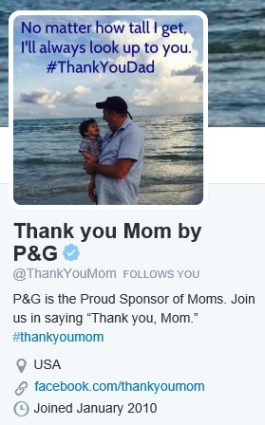
The talk began when we noticed its Father’s Day plug, awkwardly matched with a Twitter handle which only thanks moms (right). Here’s how it went:

  • Thank you Mom:   It’s #ThrowBackThursday! We love pics with dad! #TBT #FathersDay
  • dadmarketing:       This is awkward.
  • Thank you Mom:   Not at all. We love dads too! #ThankYouDad
  • dadmarketing:       That’s great, but your Twitter handle doesn’t really say that…
  • Thank you Mom:   Did you see our profile? I hope you’ll join us on the 18th 8-9pm for our 2nd annual #DadsJourney Twitter party.
  • dadmarketing: ‏       Love it! But again, the Twitter name…
  • Thank you Mom:    Our ‘brand’ is #ThankYouMom. Just like yours only mentions dad 😉
  • dadmarketing:        We’re a site exploring how companies market to dads, not selling a product both parents can equally buy; it’s exclusionary mktg

We want to emphasize how P&G’s use of Twitter to communicate is so impressive, and it was a true pleasure to chit-chat with a friendly social media team. However, it’s more than disappointing how companies – major companies like P&G – still ignore dads when it comes to parenting.

Now let’s take a look at the ads featured here (click to enlarge), found on back-to-back pages of a parenting magazine this month. What’scbrjohnson&johnson3 the difference between them? One includes only an image of mom, which would be fine enough on its own, but then it reinforces the mom’s-the-lead-parent-when-it-comes-to-babies agenda with accompanying ad copy that reads, “He feels Mom’s gentle touch.”

The other ad shows both mom and dad, with text that reads, “Cord blood banking isn’t just for your newborn, it’s for your whole family.”

In short, one ad speaks only to mom as a parent, another speaks to both parents – and the former is lot like P&G’s Twitter site and Olympic campaign.

Let’s say you’re at a party with your spouse, where you’re meeting lots of new people. If one of these new acquaintances is only speaking to your spouse, and not involving you in the conversation whatsoever, how might that make you feel?

It’s going to make you feel like dads feel after seeing the Johnson & Johnson ad, which make them look for a different baby soap on the store shelf. Sadly for J&J, it has a history of negating dads as parents.

Well done, CBR. As for J&J, you have some work to do.

A quiz: what kind of magazine will it be?

whatkindofdad1Just when we think American Baby magazine is leaning toward doing something right by placing a dad on the cover of its June 2015 issue (no doubt a gratuitous Father’s Day nod), we turn inside to find an article trying to be humorous, and rather offends.

First of all, we know ABM is geared toward mothers, despite its name. The advertising and writing all fuel the bias that moms are the lead parent, and that dads don’t count. For a magazine to continue with a title name that truly suggests nothing otherwise (yes, both women and men have the ability to care for babies), this is wrong – but you have to remember this magazine’s mission as you proceed with this piece. After all, a quick flip through ABM’s pages indicate the heavily unbalanced photographic tally of 44 images of moms, compared to just 11 dads. It’s like this every month.

If language expresses intent, then what does that lopsided ratio suggest?

In case you still had some doubt in your mind, the article titled “What Kind of Dad Will He Be?” (available online here), should cement the fact that ABM disregards dads with nearly every step it takes. Again, we know the magazine and this particular story favors moms – of course, there’s a need for that in this world – but why not within this same issue or another one, have a similarly titled story written for dads asking “What Kind of Mom Will She Be?”

The flimsy bone that ABM offers dads on the cover is forcefully snatched away on page 3’s table of contents, after one quickly realizes that there’s not a single article in its so-called “Father’s Day issue” offering dads a way to better themselves as fathers, or why dads mean something to families, or how to plan for a fun Father’s Day, or even the social media loving “dad bod.”

We can even look past Sarah Schmelling’s humorous tone, which somehow finds a way to dig at men by using every possible sexist connotation imaginable. By comparison, do women really find it funny when men try to be comical and use the, “a woman’s place is in the kitchen” line?

Let’s forget all that for now, though, and look at two inconspicuous items of note:

  1. Check out the photo caption at the top of page 56 (pictured above). “He may not even need coaching to become your parenting team’s MVP!” Talk about incongruous writing – first AMB is acknowledging that dads are on the parenting team (and the possible MVP, no less!) – yet the rub is in the first six words:  “He may not even need coaching”?  That’s some seriously curious language, because mothers bear no more instinctive abilities to parent a child than fathers.  One can argue whether being a parent is an instinct or an acquired skill, but one parent doesn’t possess the skill more than the other simply by way of gender.  Although this website talks about a slightly different but related topic, here’s what one wise, hipster homemaker has to say about dads and babysitting.
  2. In the last section of the article under “MOSTLY C’S,” the author uses the phrase “Mr. Mom.”  Don’t get us started on the use of that term (because we already have), but in short, would anyone dare call a working mother “Mrs. Dad”?

It’s hard to give the author kudos for the wonderful, cute ending, “Few things are more fun for a child…” when the previous sentence exhausts the last of several tired, unflattering stereotypes, suggesting that every dad must live “The Hangover” lifestyle every weekend.

C’mon dadmarketing, you might say, have a sense of humor.

It’s scarcely amusing when ABM pushes the dads-don’t-matter-to-us agenda every month, and it’s in a supposed Father’s Day issue. Imagine if, for example, there was a dad-related food story with a photo caption that offered, “She may not even need coaching to start cooking like your own mom!”

With stereotypes, there’s always someone who isn’t laughing.

Hopefully by the next time ABM releases next year’s Father’s Day issue, we’ll have a magazine that helps celebrate, appreciate and thank dads for all they do, rather than create an unnecessary divide on the parenting team.

Continuing the Super Bowl momentum

If you were like the rest of the nation, glued to your TV set this past February 1 during the Super Bowl, you probably noticed that dads played a significant and positive role in several commercials. This was big news – as big as Tom Brady’s heroics – because we all know the commercials are nearly as important as the game itself, and judging by the price tag for 30 seconds of air time, it’s as substantial as TV ads get.subaru

Fast forward to today, and companies are continuing that momentum of solid sales, realizing that speaking to dads makes common business sense. They realize that dads matter – that dads count too – and that they’re speaking to them as the equal parents they are, and it turns the tide from a generation of stuck-in-time, old fashioned marketers which used to remain convinced that only mom made the family purchasing decisions.subaru2

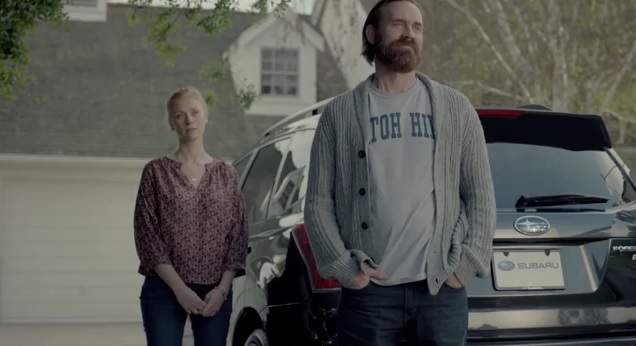
The ever-excellent honordads.org pointed us to an ad so good it seems a crime to get up during a commercial break and miss it. Indeed, Subaru knocks it out of the park with this latest TV ad, which features a father cleaning out the family’s Forester as he prepares to pass it on to his now-grown-up daughter.

We admire the bold approach by Subaru, which proves with a soft and elegant touch that there’s more to parenting than the fallacy of dad merely acting as mom’s right-hand-assistant.

You may want a tissue while watching it, but we weren’t crying – we just had some dust in our eyes.

Dads have a fever, and the only prescription is a new thermometer

Somebody may want to tell the marketing team at Exergen that there’s something unique about its product which it clearly didn’t realize before sending out its latest rebate offer via email: dads can use thermometers, too.exergen

I know, I know, this may seem hard to believe. We all know there’s certain things each gender can’t do: women don’t know how to use power tools; men can’t become nurses; women can’t play sports; men can’t cook.

But we’re here to say that despite these gender inadequacies, it’s entirely plausible that dads may be able to hold an instrument – and a baby! – and measure its fever. Why? Because they care. Because they count. Because they’re parents, too.

You’ll have to forgive us for our heavy dose of cynicism, but we’re living in a world where companies are spending so much money on making its creation the absolutely best it can be (or as Exergen puts it, “changing the way the world takes temperature”), and remaining so wrapped up in product development, that they tend to overlook one key component: to whom they’re selling.

exergen2That a classic marketing misstep, because there are a lot of thermometer companies out there. Perhaps Exergen offers the world’s finest thermometer that will ever be made, and no other product on the market can compare.

But if it isn’t speaking to dads, they why would the “other half” of its customer base listen?

Spilled juice

juicyjuice

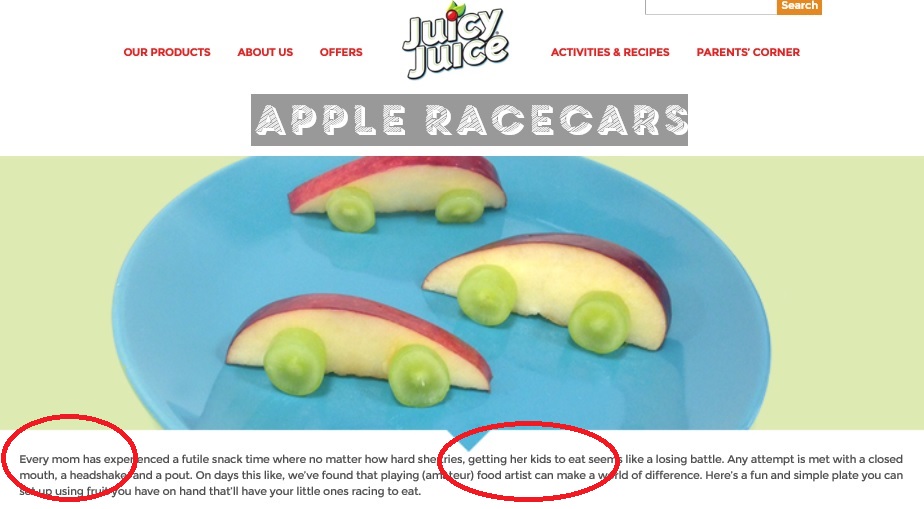
What do you get when you cross two perpetual so-called “mom” territories: juice boxes and snack time? You get yet another dad exclusionary, old school approach to marketing from none other than Juicy Juice.

We’ve seen this juice box predicament before.

But this time it seems to hurt a bit more, as Juicy Juice is a relatively newer product (when compared to, say, other stodgy brands), and Juicy Juice even professes to have ads that have “changed over the years.” Note that it didn’t say changed for the better.

Another sad aspect is that this is another company who apparently likes to negate dads and all the fun they provide at snack time. We personally know many dads who love snack time, and have even given names to the creations they make for their kids: Quesa-daddies, Daddy Cheesy Melters, Sugar Daddies, Father Son Buns.

Those sound like some fun creations! Who knows how many untold, unrecognized culinary dads out there are shaping their kids into fantastic human beings one snack at a time?

Juicy Juice provides another bit of smack-in-the-face irony when it exclaims on its website: “One of the greatest gifts of parenthood is being able to relive those wonderful experiences with your child. That spirit inspires every product we make.”

Apparently, that spirit is only being doled out only to mothers and turning its back on dads.

Give it another try, Juicy Juice – dads are listening.

Are dads on the go?

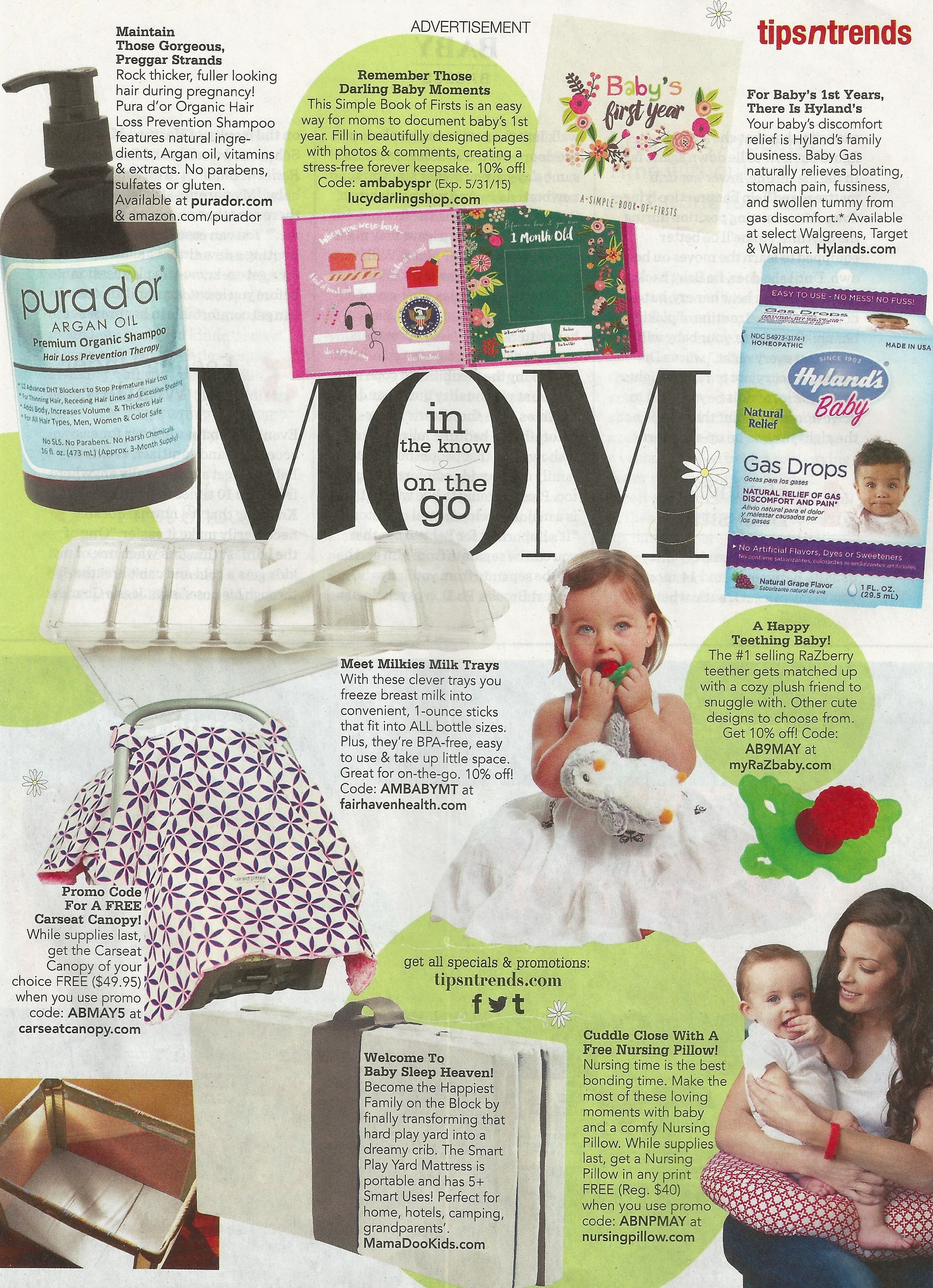
One must wonder what Ashton Kutcher might think of the latest American Baby magazine ad supplement titled, “Mom in the know, mom on the go.”americanbabymag4

It reminds us of the world he rightfully bemoans, where changing stations remain plentiful in women’s restrooms, yet not in men’s.

Mirroring this is the myopic American Baby magazine again pushing the dads-don’t-parent envelope, making fathers to be the second class parental unit through an advertising page that suggests dads don’t buy baby products.

We beg to differ.

We’ve said it before, and we’ll say it again: American Baby magazine should consider a name change if it’s going to continue the practice of deliberately avoiding its dad readership. The chain reaction of support Kutcher received from his Facebook post, including from state legislators, validate what we’ve been saying all along: dads care.

The days of hands-off fathers who watch mothers raise children are ancient history. That was generations ago. Today, dads have never been more active, and more vocal – and they shop, too. Just ask Ashton Kutcher.

If American Baby magazine doesn’t start altering its ways and incorporating more dads in its magazine, it would only take only one tweet from @aplusk to let his 16 million followers know just how he feels.

Plum Organics shows why every parent should buy Plum Organics

Marketing is, in a way, a lot like baseball.plumorganics2

One good at-bat can erase a bad one, and in the world of marketing, companies get plenty of turns at the plate. Those at-bats can come in the form of television advertising, display ads, billboards, radio ads, promotions, Internet, social media, and on and on.

In our view from the dadmarketing dugout, we’d like to say “we’ve seen it all,” but we all know that’s not true.

For every mainstay like Jif Peanut Butter – who can’t seem to make any hitting adjustments despite facing different pitchers (customers) which it used to encounter decades ago – we find new players and new attitudes infusing the marketing game.

Those fresh approaches to the game are called game changers, and our latest marketing discovery (right) could be the best magazine advertisement of all-time, but at the risk of hyperbole, let’s at least declare it a solid walk-off homer for the ages.

Let us reintroduce you to Plum Organics, a company who competes in the Baby Division.

For most teams in this group, marketers commonly like to play defense, or at least conservatively at best, by only dialoguing with moms in its messaging. Rather than taking new, inventive approaches to the game, these teams recoil, shy away and almost shrink when it comes to the plausible notion that dads raise children in today’s world. Most of these teams would rather play the game the same way it has always been played, and stick to a formula that it believes is safe.

We wrote about Plum Organics back in January and it wasn’t all favorable. But today, after we encountered its latest magazine display ad, we found it has unveiled a renewed swing with an energetic approach that finally matches its overall fashionable style.plumorganics1

Concerning its website, plumorganics.com, you’ll note that we penned: “Based on its website, the company actually seems fairly admirable. We love its charitable efforts, admire its refreshingly generous use of dads in photos, and dig the story of how Neil Grimmer founded the company.”

In our general assessment of marketing to dads, we’re not looking for total dad inclusion to the point of mom exclusion – only equality in parenting to where no one is left out. Neither gender should be discriminated against. Both parents count.

Plum Organics’s latest ad, where a dad is prominently featured, pulls off a clear message that dads unequivocally are parents, too. Take note that another parent, presumably mom, is also featured in the background holding a child. But in this ad it’s dad who takes the spotlight, and it works. Wonderfully.

In fact, we love everything about this advertising masterpiece: its layout, its font selection, its soft feel, its simplicity, its captivating photo upon which nearly any dad can relate. We embrace it all.

The continuity continues on its website (it always has), as well as robust use of the ever-nifty, super-solid #ParentingUnfiltered hashtag. Why couldn’t Similac use such an inclusionary hashtag? Why can’t Amazon Mom consider a unified name? Why can’t Jif step up to the plate with a new attitude?

Here’s to the marketers of Plum Organics, whose sweet swing instantly put it among the very elite of Major League Marketing, ensuring optimum business operations where it counts, making it attractive to buyers of all shapes and sizes – and genders.

Ashton Kutcher: a dad’s best hope

They say ‘good things come to those who wait,’ but it’s likely Ashton Kutcher never listened.kutcher

Upon leaving the University of Iowa in 1996, Kutcher rose to meteoric fame by immediately modeling, and then landing on Fox’s long-running “That ‘70s Show” by 1998, where he gained his instant stardom.

He appeared in his first film by 1999, and deftly spread his wings by starring in and producing a varied mix of shows, including the clever “Punk’d,” the cult film “Dude, Where’s My Car?,” and the psychological thriller “The Butterfly Effect.”

And his acting accomplishments may seem like nothing compared to his prowess on social media, particularly Twitter, where he became the first user to reach one million followers in 2009.

Yet as he reaches a nearly 20 years of work in Hollywood, Kutcher is taking on his biggest role yet: dadvocate.

Last October, he and Mila Kunis gave birth to daughter Wyatt, and just a few months later, Kutcher had become victim to dad exclusion like so many fathers before him. So, this past March, Kutcher complained about the lack of pubic diaper changing stations on his Facebook page, a post that went viral and caught the attention of a New York state senator, Brad Hoylman (D-Manhattan).

Hoylman’s proposed an amendment would change the New York Civil Rights Act and require many newly constructed or renovated public buildings to provide diaper-changing rooms in men’s rooms where they are also present in kutcher2women’s rooms.

Kutcher, meanwhile, launched a change.org petition intended to have Target and Costco offer changing stations to both moms and dads in their stores.

How this plays out remains to be seen, but for now, both Kutcher and Hoylman should be enthusiastically lauded for their efforts.

With all due respect to our lawmakers and government, Kutcher, in particular, carries a lot of weight and power, and he may be a key figure in putting dads on a rightful equal ground.

However, real change isn’t going to happen in a restroom, it’s going to happen when perception shifts – and that can only occur when principal influences begin to treat dads like they count as much as moms when it comes to parenting.

Those influences are in the marketing and advertising of the products and services we use, in the media which shapes our attitudes, and in how Hollywood portrays the dad character.

As long as Jif Peanut Butter trumps its one-sided marketing slogan, and Kix cereal speaks only to moms, and American Baby magazine employs old fashioned writing that ignores fathers, and writers slap unfair and embarrassing stereotypes on dads which only apply to a minority – and thus we keep reading, and buying and using these products – diaper changing stations for dads will be merely pacifistic tools demanded by law.

And only fathers would see the change anyway; indeed, it would be a welcoming and needed change in law, but only dads would benefit and see the restroom modification.

Instead, if Kutcher could really get to the heart of the matter, and use his influence to encourage others to include dads in positive ways through marketing, media and entertainment, the “#1 Dad” mug he receives from his daughter on his first Father’s Day this June will be more valuable than any acting honor he’s ever accepted.

And letting everyone see it would make for the best tweet ever.