This is weird: a dad can buy Desitin at Amazon Mom

Johnson & Johnson, makers of Desitin, is at it again.

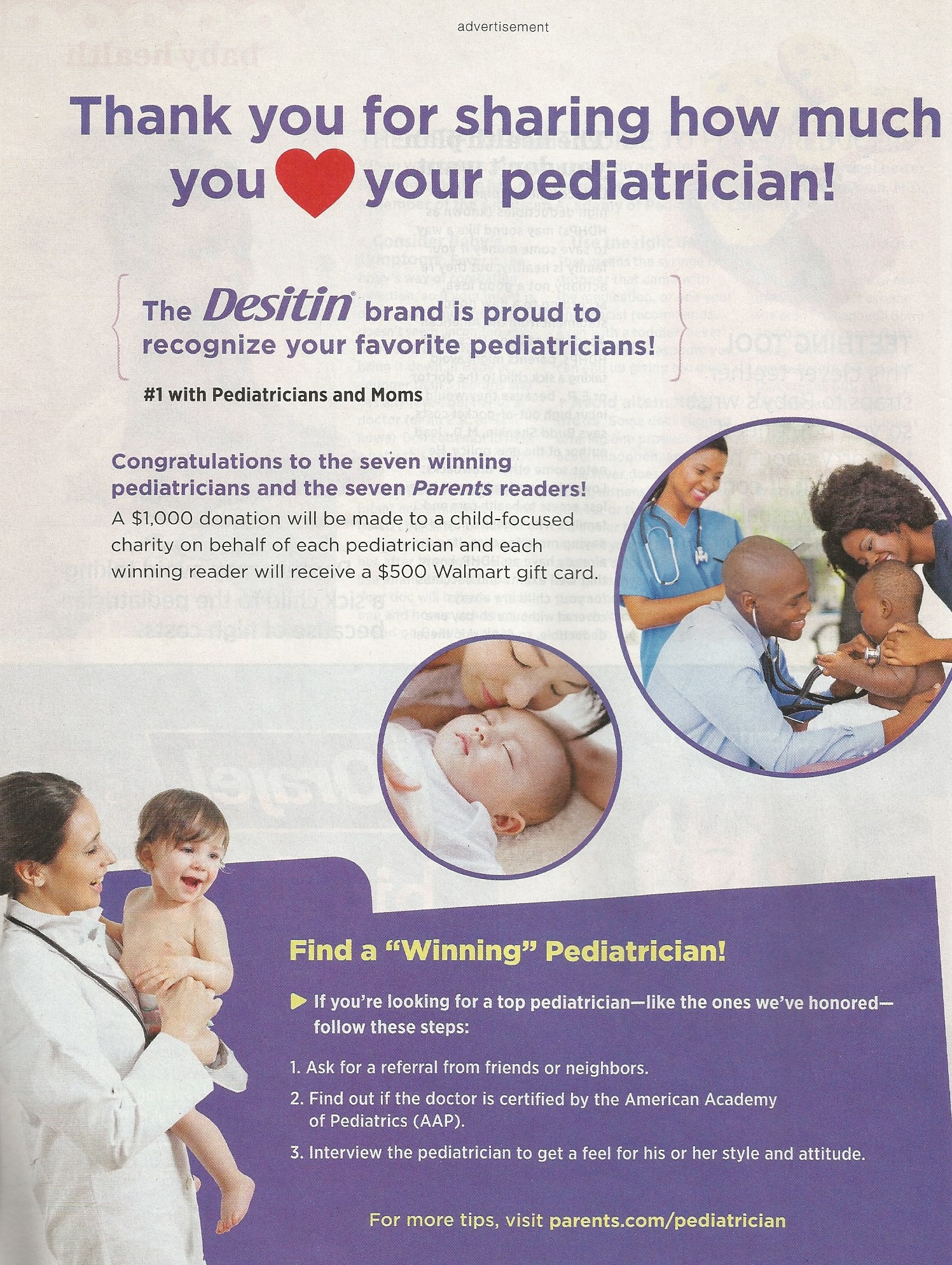
It puts dads in a box, seeing dads as the way it has always seen them, no matter how much times have changed.desitin2

You’ll find its latest ad and subsequent slogan, #1 with Pediatricians and Moms, is repeated twice on its latest two-page spread, featured where else but American Baby magazine, as well as highly visible at the top of its website — with its own separate “seal of approval” logo to boot.

And dads?

Completely nonexistent, from the print ad and all the way through every single web page at desitin.com.

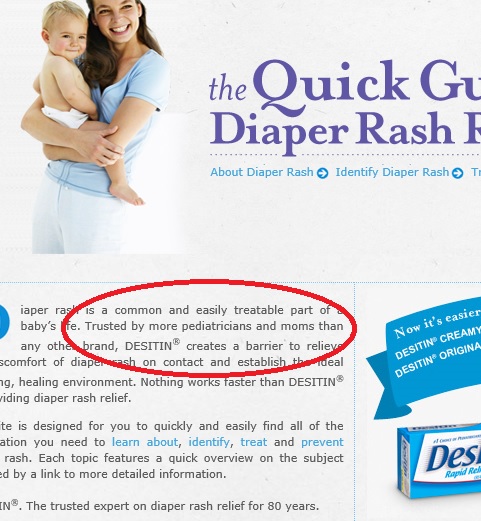
Even though J&J/Desitin totally ignores dads, I still find it slightly odd that – through applying the troubling “dads don’t know how to handle babies” approach – it wouldn’t even seize that as an opportunity to highlight at least one dad on its website.

After all, with menu tabs like, “What is Diaper Rash?” and “Identifying Diaper Rash,” and having an only-moms-care-for-kids approach combined with a boxed-in, close-minded attitude toward fathers, you’d think Desitin would take the opportunity to feature that other, less involved “assistant” parent – you know, dads.

desitin4

Screen shot from desitin.com

We offered a review of a similar Desitin ad 9 months ago, and now here we are today, and it’s the same problem.

Isn’t that how some define insanity: continuing to do the same thing but expecting to get different results?desitin3

Good marketers can let go of the past and move on to a new future, growing the brand and branching out into other market segments.

Look at this past Super Bowl to see how much big-time marketing departments value fathers.

But doing the same thing over again results in a stagnant approach.  It may not translate directly into sagging sales today, but over time, and generations, it’s a surefire way to kill a brand.

Is J&J/Desitin up to the task?

Only time will tell.

But if it is, I suspect like diaper cream, it would see instant results.

Why Amazon Mom is like a misshelved library book

A trip to the library is a lot like driving on a long-distance vacation.

It’s fun and fascinating, and whether you’re looking for a particular book or just browsing for whatever meets the eye, it’s a pathway to enjoyment that makes the journey as fun as the destination.amazonmom

One time, though, a friend of mine was cruising through the library, and on a mission.  He was looking for a particular book, and nothing else would do.  He visited the right floor, the right section and the right shelf.  The system said it was available, but it wasn’t.  Even the help of a kind librarian was to no avail.

As it turns out, he eventually found that book.  He said he remembers happily holding it, but also scolding it, as if to ask, “If I didn’t know where you were, how could I find you?”

A recent retail experience again reminded him of that misshelved book.

Amazon knows a thing or two about books.  It started as an online bookstore, and eventually diversified to sell nearly anything that can have a price tag placed on it.  It is the largest Internet based company in the United States, and it’s often our first stop shopping destination.

We love Amazon, and it loves us back.  With regular enticements like free shipping, discounts, Black Friday sales, and rewards programs, it’s everything we’d want in a shopping experience, even if we can’t touch and smell the item first.

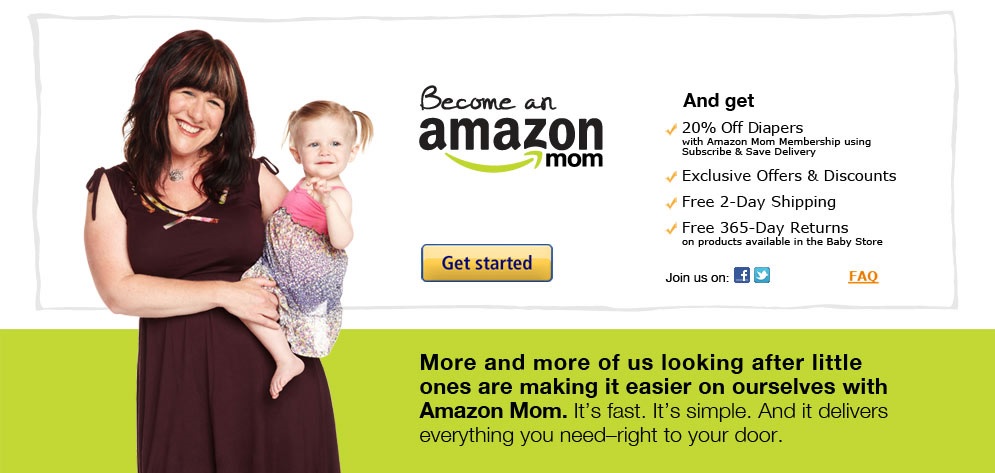
Then, several years ago it introduced Amazon Mom.amazonmom2

For years, dads have been unfairly mislabeled “Mr. Mom” – a name they find both offensive and erroneous (would anyone dare call a working mother, “Mrs. Dad”?) – so it’s easy to make a sophisticated deduction about what Amazon Mom might entail.

But we don’t want to spoil the fun; here’s Amazon Mom’s own curious self-description:  “(It) is a prime membership program aimed at helping parents and caregivers in the prenatal through toddler years use Amazon to find and save on products that families need.  Amazon Mom is open to anyone, whether you’re a mom, dad, grandparent or caretaker.”

So let’s get this straight:  a dad can join a mom program?  The word mom has become a generic term for parent, like Kleenex is for facial tissues?

And then dads must stop to think:  realistically – as a dad – is Amazon Mom speaking to you?  Does this program’s name suggest something that you would want to browse?  Would you walk into a “mom” retailer, or down a “mom” aisle in a bricks-and-mortar store?

Also recently, we had a pleasant 140-character conversation with the friendly folks at 4moms, a baby robotics company founded in March 2006 which makes high-tech baby gear.

4moms enlightened us that its company name is derived from an initial focus group held that consisted of four mothers.

Cute and unique, indeed, but in a baby world where businesses purposely leave dads out of the parenting mix, it’s a saying that’s well-worn.

Had the name been 3moms or 5moms, we would have never taken issue with anything.  But imagine that the wildly-successful burger-maker franchise Five Guys had been named 4Guys – that means something else entirely, doesn’t it?  We’d all perceive them differently, and wouldn’t women be deservedly up in arms?

We’re sure the desire of 4moms to match true company history with the play-on-words was too good for them to pass up, but you know who gets passed up in the process?

Dads.

Dads are parents too, and it’s time businesses start listening to fathers everywhere.

Judging by its products alone, 4moms seems to have a bright future ahead.  And with a financial backing like no other in cyberspace, Amazon will probably carry on for a long time, that is, unless the recent uproar forces at least an overdue name change.

But like that lost library book, if my friend doesn’t know where these companies are or doesn’t notice them because they’re not speaking to him (he’s even a dad), then how can he find them?  They must not care about dads as customers, right?  If a product is not categorized and shelved properly like that book, do consumers stand a chance at ever finding it, enjoying it, or even using it?

If these companies really cared, perhaps they could start marketing their products to its true customers.

As in, all of them.

Keeping baby safe at home involves everyone

You may have noticed the wonderful and much needed t-shirt now available from the fine folks at the National At-Home Dad Network.

American Baby magazine apparently has not.

Once again we turn to a misguided ABM headline that reads, “The number every mom should know.”americanbabyagain

The blurb talks about the importance of knowing the phone number of the national poison control center, and having it readily available. This wasn’t a case of a headline alone speaking to the mom, the story fortifies it by imploring mom to program that number into everyone’s cell phone – dad’s too, because not only is parenting evidently beyond his scope, so is technology.

This forced snub is another example American Baby magazine – and much of the mom-obsessed media – simply not speaking to dads. The powerful role the media plays in our culture then spills into our psyche and eventually into marketing, where so many unfairly assume that dad plays the part of babysitter when mom isn’t around.

Marketing personnel love playing into mom’s ego as the lead parent, a brutal, old fashioned assumption that she must carry the cash and handle all the shopping because dad is at work.

That notion may have been valid many decades ago, but we all know that’s not true today.

If by chance ABM is reading along here, don’t sit at the next editorial meeting and decide to make a gratuitous “for dads” section a permanent feature of your publication.

Instead, try doing something you’ve clearly never done before: talk to dads.

You’ll be a stronger magazine for it, because we know a few American babies who happen to have dads, and those men deeply care about the safety of their children, too.

Give it a rest

I feel pretty confident in knowing that if I open a copy of Newsweek, that I’ll be able read about the news. If I pick up TV Guide, it will cover the topic of television. Sports Illustrated, naturally, deals with sports.

What about American Baby magazine? Well, as you might imagine, it discusses babies and parenting. Since most babies aren’t prone to pick up magazines and read them, you would think its primary audience would be parents.

And you would be wrong.

It’s moms.

American Baby magazine, and others like it – Parents, FamilyFun, Parenting, Babytalk – all seem to think that dads don’t count, and don’t exist.

In the November 2014 issue of American Baby magazine, for example, I counted images of 29 moms. And how many dads?

Zero.

Fifty-three pages and not one single dad (note: there were a few male doctors, but no dads).

But the ban on dads doesn’t stop there. It was the tiny little headline (pictured) that makes dads feel useless: “Better rest for you, mom.”americanbabymag2

That also evidences a slight tinge of narcissism. C’mon, don’t dads need rest, too? Don’t dads have a hand in taking care of kids? Just because the baby actually comes forth from a female, doesn’t mean that moms are instantly able to nurture better than dads, or that they must care for them more. Since these magazines believe the falsity that dads are less competent, shouldn’t that be all the more incentive for editors to have some articles scripted specifically toward fathers?

We all know that media has a heavy hand in shaping public perception. If it really wants to be a trustworthy source for news and information, and genuinely speak to all of its readers, then it should live by the adage that parenting involves fathers.

American Baby magazine wants to give mom better rest.

All dad wants is some respect.

Baby magazines don’t get dads

Imagine you’re in grade school, and despite having done nothing wrong or not having changed one bit, suddenly a group of people you thought were friends stopped involving you, inviting you and talking to you.americanbabypromo

Besides the obvious hurt, you’d probably need to look for a new set of friends. Like it or not, they don’t want any part of you, and you can’t force someone to do something.

Dads have seen this kind of event play out before. It’s exactly what parent and baby magazines do to them all the time.

In the official Dads Don’t Exist publication, otherwise known as American Baby magazine, we found a full page advertisement titled “Baby Registry,” which showcases eight different advertisers. There you’ll find perennial dad snubbers Boppy and Dreft telling readers that dads don’t care for their kids, buy things for their kids, or shop.

It’s no wonder we find skewed, short-sided propaganda like this, because dads are repetitively being told by marketers that they aren’t supposed to be caring for their kids.

And we’re not trying to take sides, but look what kind of mess was created in New York City when its Mayor did. He started a firestorm, creating instant tension by speaking out against the very people in charge of maintaining safety and order. The city had senseless strain (and probably still does) all because one person turned his back on a group of people.

American Baby magazine takes sides in nearly every issue by turning its back on dads, telling them they’re not valid parents.

In the case of dads, they can easily take their business elsewhere without saying a word. So imagine how much even more successful these businesses could be if they started involving, inviting and talking to dads.

Not the earth’s best advertisement

A friend of mine once had an unsettling experience at her job.

It was during a typical end-of-year holiday luncheon when the boss praised a group of workers for a successful project. The cantankerous male boss, however, had a rather old-fashioned attitude toward women in the workplace. He reluctantly accepted females, but didn’t see them as equals to males.earthsbest

Nevertheless, my friend had an equal part in helping this particular project reach its fruition.

At the luncheon, the company chief praised a group of male colleagues for their project work, while intentionally omitting my friend’s name.

She took the high road and never said a word about it again, but being left out really hurt her.

In fact, that same episode has sadly been replayed a few times since, yet she keeps silently marching on and doing her part. She really doesn’t want or need any praise, but rather, just wants to be acknowledged that she’s a part of the team.

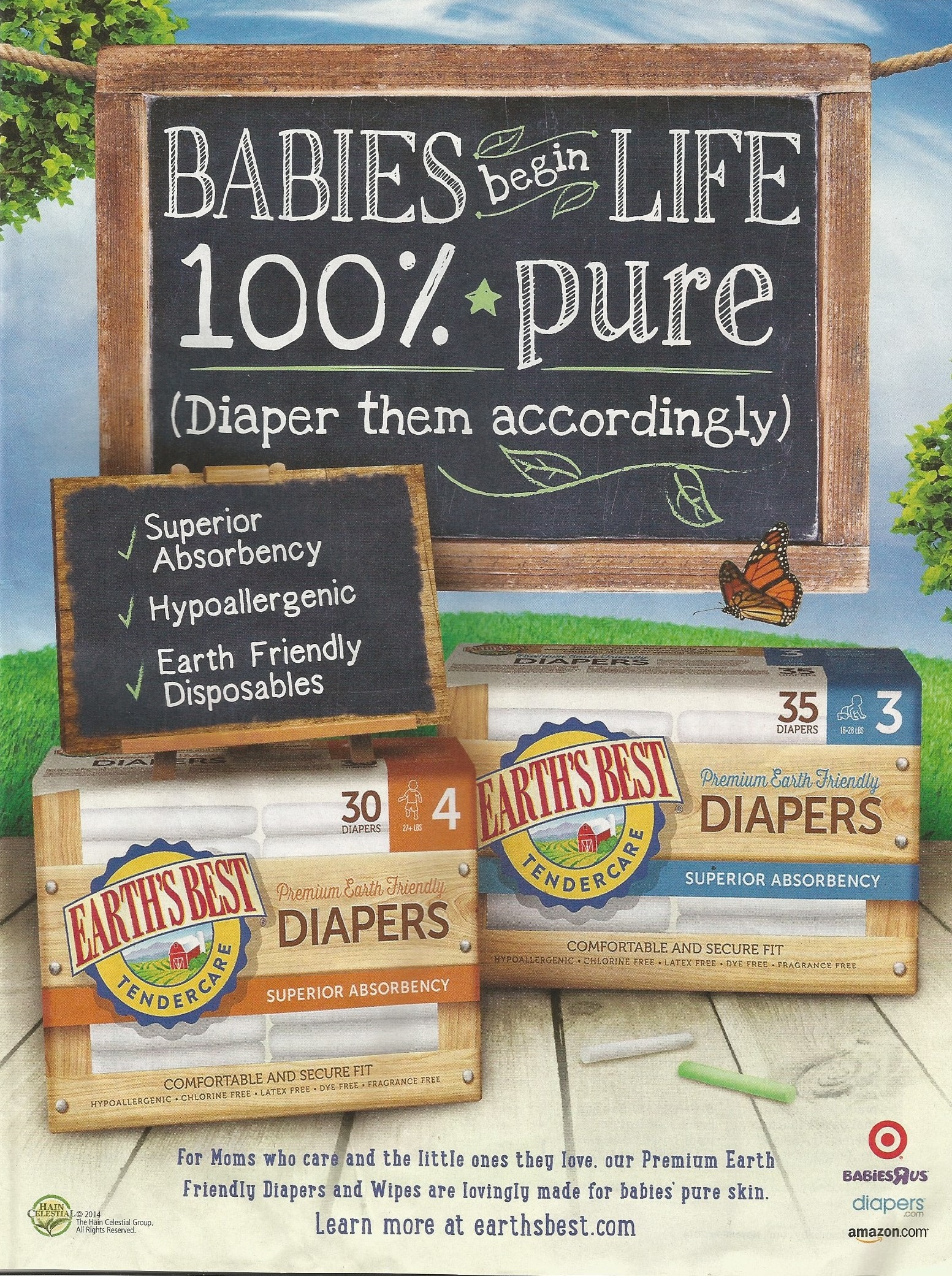
This story bears a striking resemblance to the latest ad from Earth’s Best (featured), makers of earth friendly disposable diapers and wipes.

Note the small-in-print, but large-in-scope exclusion from the bottom of its American Baby magazine ad.

Don’t dads care? Don’t they love their little ones?

Not so, says Earth’s Best, who exhibits the identical uncomfortable and disconcerting conduct of my friend’s boss.

The dad exclusion continues on over at earthsbest.com, where it features a “For Mom, By Mom” section, leaving dads in the cyberspace dust.  It’s a not-so-subtle way of Earth’s Best saying that it doesn’t expect dads to visit its site, almost as if they aren’t able to point and click.  Very disturbing, indeed.

And while we’ll continue to take the high road, we won’t be silent – dadmarketing is here to call out advertising excluders like Earth’s Best and ask it to change.

Dads count too, and if Earth’s Best wants dads to buy its products, it should market them accordingly.

They did produce some change

When companies receive customer inquiries, they have three basic communication options: 1. Ignore it, 2. Auto-respond, 3. Converse/engage.

We’ve experienced all of these as consumers, and equally so here as dadmarketing employees.

Ignoring the customer contact is the peculiar, and unfortunately all-too-often, approach. Many of us make contact with businesses quite frequently, sometimes without even realizing it, and it’s so often we never hear a thing. That’s troubling for those of us as customers, and potentially terminal for the company. Look at it this way: do you like being ignored by family, friends or co-workers?

Auto-responses can certainly serve their purpose. Sometimes it’s nice to know the company received our email when we send it at 6 a.m. At the same time, the company isn’t fooling anyone; auto-responses feel distant, robotic and forced at times, leaving customers to feel like numbers. It makes the business feel like they’re all about busyness.

Those companies who invest in people, however, and choose to converse and engage with its customers truly get it. Sure, it costs more to devote precious dollars to one-on-one interaction, but it’s totally worth it. Finding that level of interaction is rare, but it’s what separates the companies who care, from the ones who could care less.

On Wednesday we received our regular email newsletter from Produce For Kids, a web resource created in 2002 by Shuman Produce, Inc., who grows and ships Vidalia sweet onions. Its website, produceforkids.com, is dedicated to educating families on the benefits of healthy eating, providing simple meal solutions and raising money for children’s non-profit organizations.

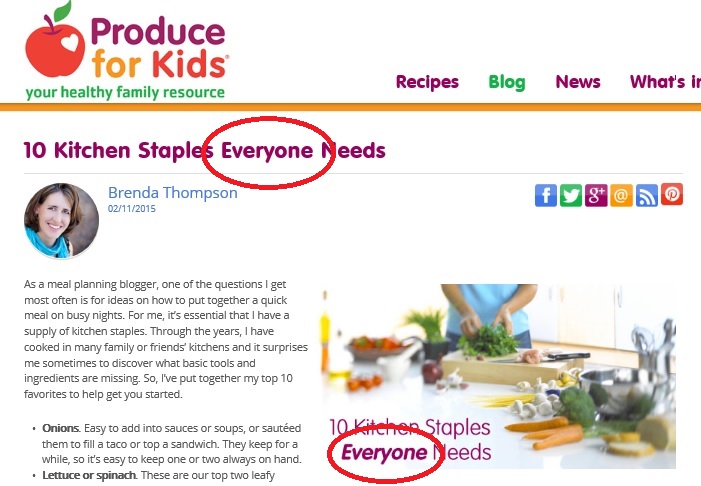
The email newsletter, however, carried a headline that troubled us: “10 Kitchen Staples Every Mom Needs.” We immediately wrote about it, and tweeted Produce For Kids about our post.

Guess what happened?

They listened. They responded. We conversed. They made something wrong, right.produceforkids2

In fact, they made the edit to the headline and photo graphic in a matter of minutes, something completely unheard of in a world of marketing that loves to exclude fathers from messages. Usually that kind of change, simple as it is, must swim through a lot of red tape and organizational bureaucracy.

Cheerios is another story who turned around something negative into something positive, but that quest took several months.

Produce For Kids turned righted the ship over the lunch hour.

For an organization whose efforts revolve around food, produce, shopping, kitchens – it would be easy for it to fall into the dad-exclusionary trap and squarely ignore fathers like so many other businesses and organizations in the same arena. Instead, they have been one of the more stand-up groups, not using a slogan as mere lip service, but rather living by it. Check out its “About Us” page: it could have employed the stereotypical mom-child-kitchen photo, but it didn’t – they gave dads their due.

Here’s to Produce For Kids and its dedicated work at including everyone in the family in its mission — you have dadmarketing’s highest Seal of Approval.

Produce some change

I thought we were past the whole “dads don’t cook” thing.

Sure, we still have a strong dose of stereotypical, old fashioned marketing out there via Betty Crocker, Texas Toast, Jif, and others, but I wouldn’t have expected this kind of a headline from a young, modern mom and a website promising to be “your healthy family resource.”produceforkids

Besides, this kind of old school caption is a tremendous disservice to moms, which still assumes mom’s place is in the kitchen. It also assumes that dad’s don’t help in the kitchen; for the majority of families 70 years ago, that might have been true, but not anymore.

Women work outside the home now, and more and more, duties are shared. It’s not perfect in every home, but dads and moms are both taking on roles they never would have considered back in the day.

Produce for Kids has an impressive reputation for using the word parent as much as possible, and not often excluding dads. Its blog author lineup is rather imbalanced by using only two dads, but at least the site has been fairly good about including fathers in photos, proving that they’re parents, too. Still ,we’d like to see them employ a more fatherly perspective from its writers, proving dad’s worth as a parent who cares about his kids’ nutrition.

I’ve even seen dads in grocery stores.

The least Produce for Kids could do is revise the headline – a simple fix – and thus make dads feel like PFK is talking to them, too. If this was a newspaper, it’s in print forever, and there’s no changing it. But the wonder of the Internet lets its authors/editors make changes whenever they want.

Indeed, no one likes to be ignored, and dads are also looking for ideas on how to put together a quick meal on busy nights.

How to show favoritism, and then pass the buck without anyone realizing what you did

Did someone in your life ever play favorites?americanbabymag

It could have been your teacher, your uncle, or your parent. No matter who does it, it’s no fun, and it’s wrong.

American Baby magazine is guilty of that, and more, in its latest ad promotion. Once again, we fine a parent-type magazine believing the word mom is a synonym for parent, and ignores dads unequivocally.

We have no issue with a mom-only ad, although, it would be nice to see an accompanying dad-focused ad for once. But we do take exception to the “moms know best” headline.

That’s one serious slap in the face to dads, and frankly, it’s hard to believe its editors let this one slip.

Ahhh, but there’s a catch – American Baby magazine doesn’t really say it.

Rather, it gets away with a fast one by shifting blame when it exclaims, “They say moms know best.”

It’s like American Baby is expressing, “Hey, it’s not us, it’s others. We’re just telling you what we’ve heard others say.”

Yeah, well, those people out there, they say lots of things:

  • A woman’s place is in the kitchen.
  • Girls can’t play sports.
  • Women can’t drive.
  • Females should be seen and not heard.
  • That woman needs to man up.

We all know these sayings are wrong, and so is saying that moms know best; doing so makes dads feel like assistants, like they’re second best. Parenting isn’t about one gender knowing better than the other, or about one person having more control.

This has to stop!

Cheris Kramarae and Paula Treichler are both quoted as saying, “Feminism is the radical notion that women are people.”

Well put.  And fatherism is the radical notion that dads are parents.

Nissan scores Super Bowl touchdown #withdad

Although Fred Diaz won’t be at this weekend’s big game in Arizona, he attended a Super Bowl once.

While surrounded by the pageantry, media, stars and excitement of the biggest event of the year – no doubt the envy of everyone who knew him – Diaz actually wished he was someplace else.

“I found myself wishing that I was with my family watching the game with my kids,” said Diaz, Nissan USA senior vice president, sales & marketing and operations. “So, I promised myself that I would never go back, and instead just watch it with my family.”

And that is the endearing message of Nissan’s latest marketing venture.nissan2

It returns to the Super Bowl for the first time since 1997, and is garnering some extra attention for employing not a celebrity, model, or puppy, but rather a character which other products and services tend to exclude: dad.

“Our research says dads are creative, but we also wanted to make sure we showcased mom as a hero,” said Diaz, in an exclusive interview with dadmarketing.  “Looking at concept after concept, the direction I gave the team was to find in some way a moment and a story that we could share with America that was real, true and authentic, and that we have a connection and that we understand. I had no idea where it would go.”

What developed was a full-blown campaign centered on a two-word relationship, simplified with a social media call to arms: #withdad.

Nissan recognizes that parents need to work, yet their families ultimately come first. So, its campaign brings this necessary struggle to life through a 90-second Super Bowl commercial so special, Diaz says, that a 10-second teaser was created to give viewers a taste of what’s to come, unlike many advertisers who tend to showcase the entire ad on YouTube several days prior.nissan3

“Our strategy was not to show the spot until the Super Bowl,” Diaz said. “Airing it (in entirety) takes away the magic of seeing it live. But just like a movie trailer, it immediately catches your attention and says, ‘I want to see that movie.’ We had always intended to show a teaser 2-3 weeks before the Super Bowl to give (viewers) a taste to whet their appetite.”

Although Diaz couldn’t reveal the entire cost of their #withdad campaign, some media reports have suggested a 30-second Super Bowl spot alone costs around $4 million. With that kind of likely investment, Diaz and his marketing team have gone all out with a plan to extend its #withdad message well beyond the Super Bowl, focusing on digital resources, social media and other extensions.

“Originally we bought 60 seconds, but when we saw the footage and spot, we just felt like it needed to have more time to breathe,” Diaz said. “We decided to go the extra mile.”

But why dads, and why now?

“When (the team) brought it to me, it just immediately connects,” Diaz said. “It was 100% that this was the way we were going to go. Whatever your family unit is, we get it. Nissan understands that you struggle with the work-life balance. That’s basically the message, ‘that we get you America.’”

While it’s refreshing to see a focus on dads, Diaz insists that Nissan’s message is all-inclusive, and that the TV ad gives proper credit to moms, as well.

“We went through great pains that mom was shown as a hero in our spots,” Diaz said. “She’s a hero and caretaker, too. She’s got to be there, too. I know very well from dad analytics that women as just as an important part of decision makers for cars, SUVs, or trucks.”

While Diaz acknowledges that there sometimes can be a negative portrayal of dads in the media and advertising world, he assured that, “I would never let this company go in that direction.”

Nissan’s #withdad campaign heartily embraces social media, currently employing several YouTubers to help send its message with creative, funny, heartwarming tales about spending time with dad.nissan1

Diaz relates to #withdad using his own personal experience as a dad of two adult sons, one in college, and one who started marine boot camp last week, where he felt a constant longing and struggle to spend time with his family, despite needing to leave for work every day and make a living.

Knowing its marketing splash is costly, Nissan felt its investment would be empty if there was not a call to action beyond cars and its message’s emotional pull. It has partnered with Wounded Warriors and Habitat for Humanity, donating $1 million to each as part of the Super Bowl promotion.

“The two are just a beautiful combination together, and we couldn’t go (back to the Super Bowl) in good conscience without giving back to America,” Diaz said.

All in all, Diaz is excited to see the #withdad commercial air in its full glory on Super Bowl Sunday from the comfort of his home, but the moment will be bittersweet: it’s the first game he and his wife will watch as empty nesters.

“When you see the full spot, I think what you’re going to see is a father who genuinely loves and cherishes time spent with his family,” Diaz said.