Plum Organics shows why every parent should buy Plum Organics

Marketing is, in a way, a lot like baseball.plumorganics2

One good at-bat can erase a bad one, and in the world of marketing, companies get plenty of turns at the plate. Those at-bats can come in the form of television advertising, display ads, billboards, radio ads, promotions, Internet, social media, and on and on.

In our view from the dadmarketing dugout, we’d like to say “we’ve seen it all,” but we all know that’s not true.

For every mainstay like Jif Peanut Butter – who can’t seem to make any hitting adjustments despite facing different pitchers (customers) which it used to encounter decades ago – we find new players and new attitudes infusing the marketing game.

Those fresh approaches to the game are called game changers, and our latest marketing discovery (right) could be the best magazine advertisement of all-time, but at the risk of hyperbole, let’s at least declare it a solid walk-off homer for the ages.

Let us reintroduce you to Plum Organics, a company who competes in the Baby Division.

For most teams in this group, marketers commonly like to play defense, or at least conservatively at best, by only dialoguing with moms in its messaging. Rather than taking new, inventive approaches to the game, these teams recoil, shy away and almost shrink when it comes to the plausible notion that dads raise children in today’s world. Most of these teams would rather play the game the same way it has always been played, and stick to a formula that it believes is safe.

We wrote about Plum Organics back in January and it wasn’t all favorable. But today, after we encountered its latest magazine display ad, we found it has unveiled a renewed swing with an energetic approach that finally matches its overall fashionable style.plumorganics1

Concerning its website, plumorganics.com, you’ll note that we penned: “Based on its website, the company actually seems fairly admirable. We love its charitable efforts, admire its refreshingly generous use of dads in photos, and dig the story of how Neil Grimmer founded the company.”

In our general assessment of marketing to dads, we’re not looking for total dad inclusion to the point of mom exclusion – only equality in parenting to where no one is left out. Neither gender should be discriminated against. Both parents count.

Plum Organics’s latest ad, where a dad is prominently featured, pulls off a clear message that dads unequivocally are parents, too. Take note that another parent, presumably mom, is also featured in the background holding a child. But in this ad it’s dad who takes the spotlight, and it works. Wonderfully.

In fact, we love everything about this advertising masterpiece: its layout, its font selection, its soft feel, its simplicity, its captivating photo upon which nearly any dad can relate. We embrace it all.

The continuity continues on its website (it always has), as well as robust use of the ever-nifty, super-solid #ParentingUnfiltered hashtag. Why couldn’t Similac use such an inclusionary hashtag? Why can’t Amazon Mom consider a unified name? Why can’t Jif step up to the plate with a new attitude?

Here’s to the marketers of Plum Organics, whose sweet swing instantly put it among the very elite of Major League Marketing, ensuring optimum business operations where it counts, making it attractive to buyers of all shapes and sizes – and genders.

Johnson & Johnson: taking cues from Amazon Mom

Last May, we wrote about a Johnson & Johnson ad which clearly excluded dads, and then tweeted the company of our displeasure.

Johnson & Johnson wrote back, as you can see on our Twitter site here, and assured us that it “is committed to supporting parents – moms & dads.”

Those were uplifting and encouraging words, especially from a company which plays at least some small part of everyone’s child care, usually from the very start in the hospital.

Yet here we are, nearly a year later, and J&Js marketing message hasn’t changed. Note the featured ad, where the baby only thanks mom for applying its lotion.johnson&johnson2

If you’re a dad, I suspect that right now you’re feeling abandoned by a company whose products you probably used in the hospital right upon your child’s birth. A cold shoulder like this hurts, especially if you saw that Twitter promise last May.

Sadly, Johnson & Johnson’s dad avoidance doesn’t stop with print ads, as its website is filled with examples of one exclusion after another:

  • Visit our Facebook page to share your baby’s special moments with other Moms just like you.
  • Moms around the world trust JOHNSON’S® to safely care for their babies.
  • We’re dedicated to advancing the health and well-being of women, children and families around the world.
  • We are committed to working with moms, healthcare experts and scientists to ensure our baby products continue achieving the highest JOHNSON’S® baby standards.

We’ve said it before, and we’ll say it again:  dads count too.  We can’t expect change to happen overnight, but it has been 11 months after J&J distinctly gave us its commitment – one that sadly wasn’t kept.

Johnson & Johnson was founded in 1886 by two men who may very well have had their own family in mind when conceiving ideas for surgical dressings and sanitation practices. It has to make you wonder about its overall company mission when its marketing and communications team prefers to only speak to a select group, and blatantly ignores another.

Right this very moment, a child is born somewhere and J&J is playing a part in its care.

And also right at this very moment, J&Js marketing department has an opportunity to show dads everywhere it really cares, because as any married couple will tell you, a promise is everything.

Give it a rest

I feel pretty confident in knowing that if I open a copy of Newsweek, that I’ll be able read about the news. If I pick up TV Guide, it will cover the topic of television. Sports Illustrated, naturally, deals with sports.

What about American Baby magazine? Well, as you might imagine, it discusses babies and parenting. Since most babies aren’t prone to pick up magazines and read them, you would think its primary audience would be parents.

And you would be wrong.

It’s moms.

American Baby magazine, and others like it – Parents, FamilyFun, Parenting, Babytalk – all seem to think that dads don’t count, and don’t exist.

In the November 2014 issue of American Baby magazine, for example, I counted images of 29 moms. And how many dads?

Zero.

Fifty-three pages and not one single dad (note: there were a few male doctors, but no dads).

But the ban on dads doesn’t stop there. It was the tiny little headline (pictured) that makes dads feel useless: “Better rest for you, mom.”americanbabymag2

That also evidences a slight tinge of narcissism. C’mon, don’t dads need rest, too? Don’t dads have a hand in taking care of kids? Just because the baby actually comes forth from a female, doesn’t mean that moms are instantly able to nurture better than dads, or that they must care for them more. Since these magazines believe the falsity that dads are less competent, shouldn’t that be all the more incentive for editors to have some articles scripted specifically toward fathers?

We all know that media has a heavy hand in shaping public perception. If it really wants to be a trustworthy source for news and information, and genuinely speak to all of its readers, then it should live by the adage that parenting involves fathers.

American Baby magazine wants to give mom better rest.

All dad wants is some respect.

Three cheers for Cheerios making it right

cheeriosloveLast April, we penned an entry which spoke of the wonder of Cheerios.

In our estimation, it has been the perfect cereal since birth, a spectacle of simplicity combining a healthy, any-time-of-day food option with surprising versatility for enjoyment beyond basic sustenance.

Our many tastes change with age – clothing, books, TV, music, movies – but not Cheerios. We’ve enjoyed it our entire lives, from birth to old age, and there aren’t many cereals or even entertainment options which can claim that.

Cheerios has securely been part of our lives. We love it. It loves us. Its round shape is practical, if not symbolic, a reminder of our eternal and endless love, which like a circle has no beginning and no end.

But then, like a marketing executive suddenly turned to the Jif Side of the Force, we noticed a bizarre, Kix-like web page that made us think otherwise.

It was as if Cheerios instantly soured to everyone – moms and dads, young and old, large and small – by showing favoritism to one and ignoring the other, trying to tear apart so many of us that shared this common, charming cereal bond.

That’s when we wrote about this marketing aberration which made us so confused and angry.

You may recall that at that time, Cheerios was actually getting a lot of praise for its dad-loving TV commercial, which may have been the reason its web-based dad exclusion flew under the radar.

We tried communicating with General Mills several times, but to no avail.

Fast forward to today, some nine months later, when we occasionally like to check up on our topics, and we were pleasantly surprised to discover that web graphic no longer exists at cheerios.com.

Eager to know more about the change, we reached out elsewhere, this time with the excellent Kirstie Foster, public relations and social media director at General Mills.

Through Foster’s mediation, Cheerios responded with the following:

Hi there! We’ve always thought the world of dads. Many factors led us to the decision that it was finally time to show it.

How about that? No, it wasn’t a direct shout out to dadmarketing, but we like to think we had a hand in the change.

We may be a small, upstart organization, but our influence and message shouldn’t be understated. Dads have been left out of the marketing messages too long, too often. Cheerios no doubt recognized that, and we’re proud of those involved with the change at General Mills.

Think about Jif’s “Choosy Moms Choose Jif.” How sexist and old fashioned is that?

Cheerios changed for the better, so why can’t Jif? Why can’t others?

We’ll keep beating the drum until others reach Cheerios status, and maybe together – through sharing, talking and communicating – we’ll help more of them become products we can stick with for a lifetime.

Do dads want the best?

When Pizza Hut makes a significant menu change, the national media covers it. When the pizzeria in your hometown does something similar, the local paper doesn’t even notice.walmart

If a New York City radio DJ says something shocking, it makes headlines. Someone could say the same at a tiny Midwestern radio station and it won’t be noted as much.

The Washington Redskins have their whole name controversy, but high schools with identical nicknames fly under the radar.

Bigger certainly isn’t always better, but it is unquestionably more noticeable. It’s also open to more scrutiny, because we expect a little more.

And so it goes with Walmart.

The nation’s largest retailer had a two-page spread in the October 2014 American Baby magazine and proclaims, “Parenthood is full of firsts.” But on the very next page, the ad says this: “When it comes to caring for their baby, moms want only the best.”

Can’t dads care for babies? Don’t dads also want only the best?

Walmart’s website (featured) mimics the same attitude as the magazine ad, which isn’t really a surprise.

Walmart takes a lot of flak for its policies and business practices, treatment of suppliers, employee compensation and working conditions. We’re not ones to comment on those matters – maybe they’re true, maybe they’re not.

However, there’s no mistaking to whom Walmart is speaking in its latest ad. It’s a shame that Walmart doesn’t find enough value in dad as a potential customer, or even as a nurturing parent.

Had the local, independent drug store done this, I wouldn’t even have spotted it. But at Walmart, I expect more.

Hey, isn’t that the slogan of another retailer where dads could take their business?

Hmmm.

Culturelle shock

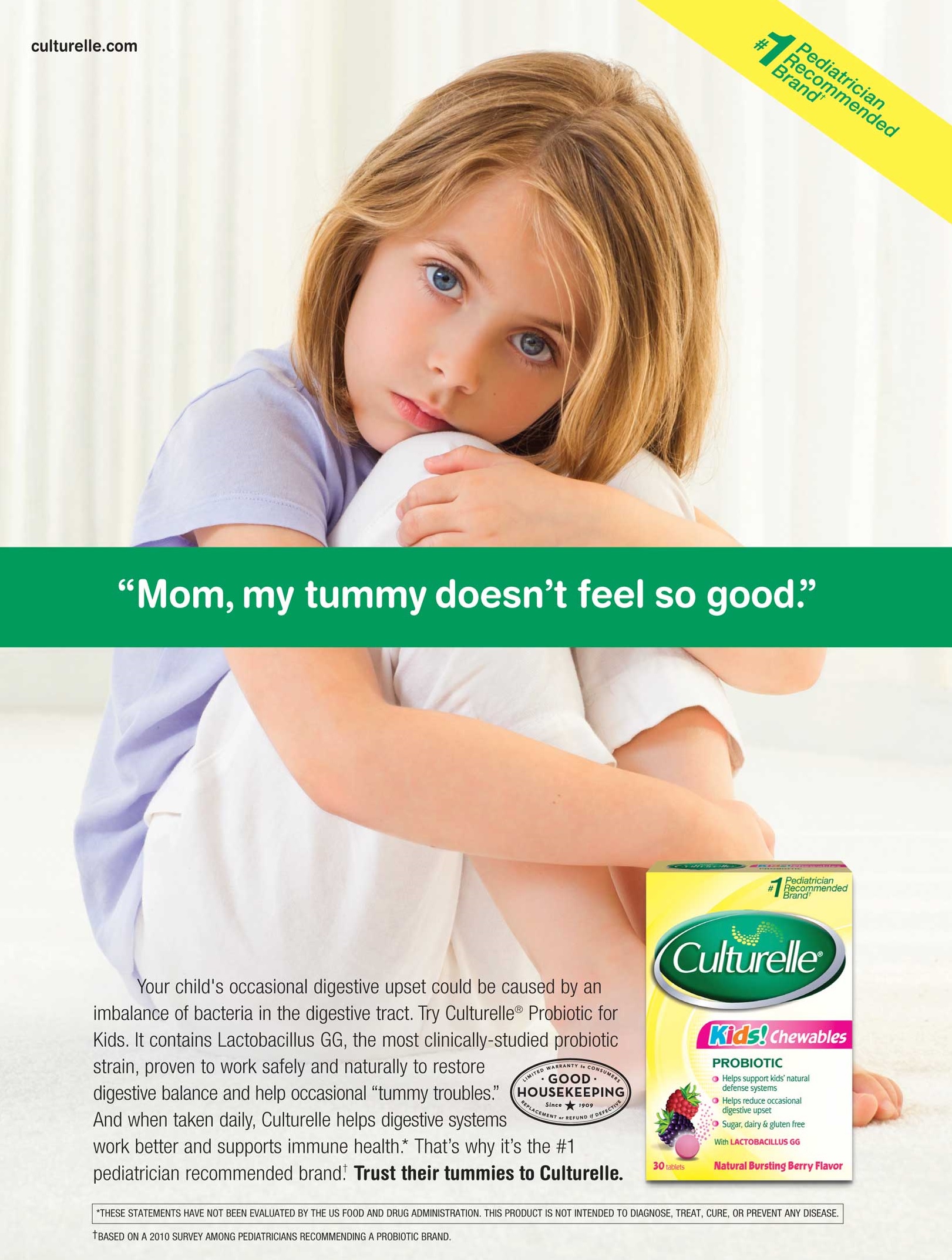
My calendar tells me the year is still 2014, but the marketing team behind Culturelle Kids is clearly situated 40 years ago or more.culturelle

Here we have what appears to be an exceptional childrens’ chewable pill to reduce tummy discomfort, and all Culturelle can think is that kids must only want moms.

Why are dads constantly being told through marketing messages that they’re less than moms? Today, the roles have never been more equal, great strides have been made in various industries and professions with relation to pay, and parents often share duties past generations wouldn’t have dared.

So why must dads continue to hear that they’re second fiddle to mom’s better judgment and instincts? Moms are no more intelligent than dads, and dads are no more clueless than moms. No matter if it’s an animal or a human being, parental instinct is a strong force, and even with lack of knowledge, adults learn as they go.

Yet Culturelle perpetuates the sad and ugly stereotype from a bygone era that dads can’t handle it and thus, kids must want mom first, making dad feel like a secondary, if not useless, parent.

If Culturelle Kids is indeed the #1 pediatrician recommended probiotic – and some of those pediatricians must be dads – then who are their kids calling when they have a sick tummy?

Culturelle, we hope you can consider all of your customers when crafting your marketing materials. Dads take care of kids, too.

Our culture is different now – and you should know better, because it’s part of your name.

Times for a change

I’ve had a lot of ideas over the years.motherlode

Once I pitched a newsletter idea for a sanitation company in a town called White. My original thought was to name it “White Trash.”

Okay, okay, confession: that story and pun was made up.

But even though a pun may fit and might sometimes even seem too good to pass up, it doesn’t make it right.

Consider the New York Times and its Motherlode site. Its goal is “to cover the ways our families affect us, and the ways the news affects our families.”

We love the play on words if it were a moms-only site, and bear with us – we’re not comparing a term like white trash to Motherlode – we’re only using an analogy to make a point. Even its url is listed in web language as http://parenting.blogs.nytimes.com/.

Note the first word used is parenting, as in moms and dads.

Obviously, families include dads, and with a title like Motherlode, how can it possibly make dads feel welcome, or even make them want to check out the site?

Not surprisingly, the writing you’ll find there is fantastic – very fit to print.

After all, this is the New York Times, otherwise known as media royalty. Everyone in the newspaper world wants to be like the New York Times, winners of a record 114 Pulitzer Prizes. It has been the standard in journalism for 163 years, and of course, it is a wonderful act to follow.

Hardly anyone should ever question what they do because they’re as good as it gets, right?

In that vein, does it not seem like everyone’s giving the Motherlode name – surely a discriminatory one – a free pass, just because it’s the New York Times? As readers, do we even recognize its name’s chauvinistic tone, or have we become immune to the exclusion of dad in its title?

In the last 30 days, I counted just one Motherlode news story directed explicitly at dads and fatherly issues (while the “Deployment Diary” is excellent and referred to dad a lot, it’s not a dad-specific issue). And I only noticed three male writers. So, if “families” is its goal, it’s missing the mark in more ways than title alone.

NBC News, another highly reputable media source, became all the wiser when it suddenly renamed its TODAY Moms to TODAY Parents in June, a far more inclusionary and correct name for the news affecting, well, parents.

As it stands now, the New York Times would rather use the word mother as a generic term for parent, like Kleenex is for facial tissue.

Do you ever ask someone, can you please hand me a Puffs?

In the same way, let’s not let this attitude lead to a society where office forms simply state “mother,” but we have to assume the office wants us to list both the mom’s and dad’s name.

Dads know this oft-forgotten tale all too often.

After all, it was only two generations or so ago that dads were not even allowed in the delivery room. While that practice has changed for the better, let’s be honest, doctors still mostly speak only to moms at child well checks as if they’re the lead parent, making dad to feel like an assistant at best, nonexistent at worst.

Being one of the leaders in journalism means setting an example and acting like it, from top to bottom, side to side, and tiny little bit to Motherlode.

With a little help from my friends

Last week dadmarketing had the pleasure of interacting with the excellent Tiny Blue Lines, a wonderful website we’re helphappy to have discovered. Highly recommended.

In our conversation, she brought up an interesting point.

You can head to our Twitter site if you want to read our discussion, but she made a comment worthy of further exploration when she said, “…props to all the dads who don’t think of (handling baby’s night feedings) as ‘helping’!”

That made us think.

In fact, it was enough to make us look up the true definition of help, which can be defined several ways, as noted at dictionary.com. Those most applicable in this case would be:

  1. To give or provide what is necessary to accomplish a task or satisfy a need; contribute strength or means to; render assistance to; cooperate effectively with; aid; assist;
  2. To make easier or less difficult; contribute to; facilitate;
  3. To be useful or profitable to.

However, when put in context with night feedings and caring for a baby – a role most associated with mom – it seems to puts dad back in the assistant/helper role, doesn’t it?

Consider the converse: if a dad was working on a car in the garage all day and mom said, “I helped my husband work on the car today,” wouldn’t that also connote feelings that she was merely an aide, or an assistant?

And then it hit us that this is one of the many reasons dadmarketing exists.

The more we can all rid the world of these labels, stereotypes and preconceived notions, the more we’ll be able to say, dad helped to feed the baby during the night, and it will simply sound like he provided what was necessary to accomplish a task, or contributed to something, or was useful.

Period.

And it won’t sound like he was only assisting his wife with one of her jobs during the night. And when a dad cooks a meal it won’t sound like he was being a good husband and helping mom out in the kitchen. And, maybe, just maybe, we can rid the use of that absurd “Mr. Mom” name.

Tiny Blue Lines’ comment was indeed thought-provoking, because props for sure, to those dads who don’t think of it as helping, but further props to those moms and dads who don’t categorize it a mom or dad job in the first place.

One small tweet from Maggie, one giant leap for change

A few days ago we retweeted a story about this young girl who fought back against a sexist sign, and ultimately claimed victory as the sign was removed.maggie

Her modest, ingenious and charming complaint challenged the higher beings at a store in England, and executives listened.

Way to go, Maggie!

Her protest got us thinking about the foolishness of Jif’s tagline, Choosy Moms Choose Jif.

If a young girl can get the attention of a large retailer, why can’t Jif take inventory of its own sexist practice? Doesn’t their parent company, Smucker’s, want to market their goods to all and be perceived as a modern, progressive, with-the-times business? What does their four-word marketing message say to households without a mom present?

We’ve discussed some of Jif’s plight before, and again, and yet again.

Jif’s stale slogan was created decades ago, during a bygone era when mothers generally handled cooking, cleaning and household shopping. Jif is essentially hanging that chore on mom in present day, and indirectly, the cooking and cleaning, too.  Doesn’t Jif’s approach remind you a little of this?

Yes, even as the year 2015 looms, an embarrassing, inane catchphrase has long passed the old-fashioned phase; in today’s world, the saying looks downright irrational.

The interesting thing about Maggie’s dispute is that despite its marvelous simplicity, it only changed in-store wording for the better. For example, another major retailer, ToysRUs, still categorizes shopping selections as “Boys’ Toys” and “Girls’ Toys.”

So, in theory, little has changed and her fight could still go on.

Jif, on the other hand, is so stuck in time and dead set in its ways that we know there’s still a long way to go toward making things right. Jif is indeed a tough peanut to crack (they won’t even respond to us, or acknowledge us), but we know at least one 7-year-old who could bring the entire empire to its knees.

What do you say, Maggie?

Vote of thanks

We’ve certainly read enough “what I’m thankful for” messages in the past week, so all of creation hardly needs another.thanks

However, since we focus a lot on word choices that advertisers make, if there’s one that gets overlooked and underused, it is this: thanks.

That word has the power to praise, motivate and cheer.

In a marketing world that so often targets individuality and me-first, all the while leaving fathers out of the message, it’s nice to overuse that simple word as much as you can.

Yes, dads especially love hearing it. They repeatedly get ignored by marketers who prefer to speak only to moms, thus making them feel like second-class parents who don’t matter.

We believe this week’s annual exhortation to give thanks is overstated. Giving thanks seems like such an internal, individual, private affair done only in our minds, or perhaps just before Thursday’s big meal.

And all of that is fine.

But giving thanks is one thing.

Saying it is another.