Marketing to baby must involve dad

hylands1Hyland’s has been making safe and natural homeopathic medicines since 1903, and after a quick look at its latest magazine ad, seems to be rather dad-friendly.  It’s nice to see a dad featured prominently in its ad.

But take a close look and read the copy.  Why doesn’t it speak to dads?

Now glimpse at hylands.com and click on “Calming Tablets,” and you’ll find a similar mom-only reference.

Those are some disappointing dad omissions for an otherwise decent overall marketing approach.  Generally, Hyland’s seems to try to use “parent” references, so these nuggets caught us a little off-guard.

hylands3Hyland’s talks about party invitations here, a symbolic reminder that dads want to be invited to the “party,” too.  They take care of babies and have plenty of choices when it comes to baby care products.  So why should Hyland’s give them a reason to go anywhere else?

Parenting isn’t a mom-only thing, and mom isn’t the lead parent, regardless of what any particular family’s situation may be.  It is the responsibility of both parents to raise a child, and that equality has never been more prevalent than it is today.

The Hyland’s example is an exhortation for any company looking to increase sales:  don’t forget your customers, and they won’t forget you.

A picture is worth a thousand hugs

toysrusSure, this featured email promo from Toys”R”Us is a gratuitous Father’s Day message which ran this past June 21, likely the lone time during the year you’ll see a dad-specific message from the giant toy retailer.

Today, however, that’s not of our concern.

Take another look at the ad. The copy is creative. The design is clean. The look is simple.

And, whoa, is that a child is hugging a dad?

That act – the hug – is the kind of thing normally unassociated with the stiff, rigid, unexpressive, stereotypical father, right? So often we typically see hugs and kisses for mom at Mother’s Day, and a lot of tools and neckties for dad on Father’s Day. It’s unfair labeling where we’ve been conditioned by companies to think that only moms are the caring, nurturing ones at home, while dad’s true love must be work since he’s there most of the day, hence the tie.

So when it comes to expressions toward dad, it’s less common to see hugs in advertisements. You might see hand holding or a shoulder ride at best, but a hug for dad is rare in ads.

We applaud the creative team at Toys”R”Us for presenting what others can’t: a deep tenderness and affection toward dad.

This is exactly the kind of move that tells dads, “We know you’re out there, and we value you; we’re talking to you, and we want you as customers.” It presents dads in a caring light as the nurturers they really are, and speaks to them through solid marketing messages that evoke emotion.

Nice work Toys”R”Us, and we look forward to seeing repeat performances not just in June, but throughout the year.

That’s because rumor has it, more than one dad has visited all of your 865 stores before.

What to expect when you’re expecting to be treated like a parent

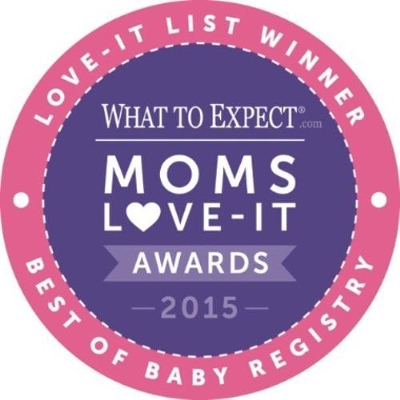
whattoexpect1If WhatToExpect.com truly offers information, as it says, on “pregnancy and parenting,” then why is it singling out one gender and hosting the annual “Moms Love-It” Awards?

It’s confusing how things ended up this way.

Originally, Heidi Murkoff conceived the idea for the famed book, What to Expect® When You’re Expecting, during her first pregnancy as noted on its website: “Determined to write a guide that would help other expectant parent (sic) sleep better at night, Heidi delivered the proposal for What to Expect® When You’re Expecting just hours before delivering her daughter, Emma.”

It’s admirable that the site uses the term “parent” when speaking about Murkoff’s original ambition. Murkoff seems like a fantastic, dynamic, successful woman on a mission to improve lives.

However, somewhere along the way, parent was replaced with mom, leaving dad as the one parent who apparently isn’t on equal footing. It’s a bias we’ve seen elsewhere and remains as unfortunate mistreatment.

Check out the “About What to Expect” page, where Murkoff’s commitment has wavered from its initial care for parents, to now only moms: “Heidi’s passionate commitment to moms and babies…”

And now with the relatively new “Moms Love-It” Awards (launched 2013), it makes expecting fathers feel like they simply don’t matter, underscored by the various award-winning companies from whom expectant dads everywhere will be purchasing their baby needs. Yes, indeed, dads shop too.

whattoexpect2What’s more, this is again yet another example of a website offering a “For Mom” section, with dad information buried elsewhere. Even the “Military Mom” section offers a one-sided look that ignores fathers. Why not offer a “For Dad” section with equal prominence instead of burying it under “More”? How about a “Military Dad” section?

If marketers so often like to falsely earmark dad as the parent who isn’t as smart when it comes to babies or who isn’t as involved, wouldn’t those fallacies be all the more impetus to offer solid information to fathers?

Everyone wants to be treated with respect and dignity, but how can dads find it here? Of course, dads aren’t actually carrying the baby, but that doesn’t mean they’re less important, or don’t matter to the pregnancy – they’re totally, equally important to the child. And the “Moms Love-It” Awards are only two years old. How about renaming them the “Parents Love-It” Awards before another company beats them to it?

Dads have a lot of options when it comes to parenting information, and those companies who choose to actively engage with them will be the true award winners.

Is that a dad in a breastfeeding ad?

lansinoh1Check out this stellar ad from Lansinoh, makers of breastfeeding products and accessories. It features words like “breastfed” and “nipple” and “breast,” yet boldly places at dad at the center of its full page magazine ad.

That’s powerful. That’s wonderful. That’s making dads feel like involved parents!

But then, the company does a strange about face on its website – lansinoh.com – where it decides to bury dad’s importance down below on its home page. If it truly believes that dad is “critical to (the baby’s nursing) success,” as its website states, then why is dad minimized so greatly online?

How about a Lansinoh Dads’ Club?

Why not publish an article titled, “8 Benefits to Dads for Breastfeeding Moms”?

How about more photos of dads on its website (they’re hard to find) – and prominently feature them – like the dad in the magazine ad?

How about have a special dads-only section, which might dig deeper into a dad’s involvement with breastfeeding? Or have a different guest dad blogger featured every so often?

How about simply show the word “dad” more?

The magazine ad was so incredibly fantastic because it proved it can utilize fathers in an advertisement about breastfeeding products, and we were ready to give Lansinoh the highest dadmarketing Seal of Approval™, but then Lansinoh changed its tune online.

Oh. So. Close.

Let’s hope Lansinoh’s marketing professionals can get on the same page and mimic a magazine ad that’s beyond sensational, and thus lead the market among those companies insisting upon total parental inclusion.

Marketing to both parents, at its finest

It would be pretty easy for the marketing team at Cord Blood Registry to feature only a mom in its latest magazine ad. Dads can do anything for a child that a mom can do, except give birth and naturally breastfeed.cbr

So, yes indeed, that umbilical cord is unmistakably a mom-child connection.

However, marketers often like to turn that precious link into some sort of divide, and use it as validation to justify its belief that moms have a stronger bond with children which dads can never match.

Nothing could be more untrue.

We’re here to tell you that moms and dads are equals. The parent-child bond isn’t meant to be something that moms dominate, or hold deeper. Mothers enjoy the absolute honored gift of carrying children – and that’s special. It creates a bond with every child that doesn’t make it more superior than with a father, just unique.

And it should be treated with uniqueness, even in marketing.

Dads and moms are different people, and can parent different, but dads are full, rightful owners of the parental bond every bit as moms. That’s a wonderful thing!

CBR says that too, and it even references the umbilical cord, in its latest powerful ad.

Something as important as cord blood banking deserves marketing treatment without any missteps or miscues, and CBR delivers the goods in pictures and words.

The rest of America would do well to learn from CBR’s fabulous marketing team, who confirms that parenting involves both moms and dads equally.

ig·nore (ĭg-nôr′) – To refuse to pay attention to; disregard

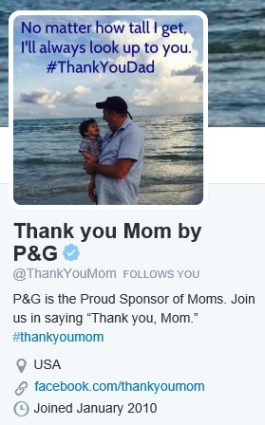
A few days ago we were fortunate to have a nice conversation with Proctor & Gamble regarding an exclusionary p&gapproach.

The talk began when we noticed its Father’s Day plug, awkwardly matched with a Twitter handle which only thanks moms (right). Here’s how it went:

  • Thank you Mom:   It’s #ThrowBackThursday! We love pics with dad! #TBT #FathersDay
  • dadmarketing:       This is awkward.
  • Thank you Mom:   Not at all. We love dads too! #ThankYouDad
  • dadmarketing:       That’s great, but your Twitter handle doesn’t really say that…
  • Thank you Mom:   Did you see our profile? I hope you’ll join us on the 18th 8-9pm for our 2nd annual #DadsJourney Twitter party.
  • dadmarketing: ‏       Love it! But again, the Twitter name…
  • Thank you Mom:    Our ‘brand’ is #ThankYouMom. Just like yours only mentions dad 😉
  • dadmarketing:        We’re a site exploring how companies market to dads, not selling a product both parents can equally buy; it’s exclusionary mktg

We want to emphasize how P&G’s use of Twitter to communicate is so impressive, and it was a true pleasure to chit-chat with a friendly social media team. However, it’s more than disappointing how companies – major companies like P&G – still ignore dads when it comes to parenting.

Now let’s take a look at the ads featured here (click to enlarge), found on back-to-back pages of a parenting magazine this month. What’scbrjohnson&johnson3 the difference between them? One includes only an image of mom, which would be fine enough on its own, but then it reinforces the mom’s-the-lead-parent-when-it-comes-to-babies agenda with accompanying ad copy that reads, “He feels Mom’s gentle touch.”

The other ad shows both mom and dad, with text that reads, “Cord blood banking isn’t just for your newborn, it’s for your whole family.”

In short, one ad speaks only to mom as a parent, another speaks to both parents – and the former is lot like P&G’s Twitter site and Olympic campaign.

Let’s say you’re at a party with your spouse, where you’re meeting lots of new people. If one of these new acquaintances is only speaking to your spouse, and not involving you in the conversation whatsoever, how might that make you feel?

It’s going to make you feel like dads feel after seeing the Johnson & Johnson ad, which make them look for a different baby soap on the store shelf. Sadly for J&J, it has a history of negating dads as parents.

Well done, CBR. As for J&J, you have some work to do.

Why Amazon Mom is like a misshelved library book

A trip to the library is a lot like driving on a long-distance vacation.

It’s fun and fascinating, and whether you’re looking for a particular book or just browsing for whatever meets the eye, it’s a pathway to enjoyment that makes the journey as fun as the destination.amazonmom

One time, though, a friend of mine was cruising through the library, and on a mission.  He was looking for a particular book, and nothing else would do.  He visited the right floor, the right section and the right shelf.  The system said it was available, but it wasn’t.  Even the help of a kind librarian was to no avail.

As it turns out, he eventually found that book.  He said he remembers happily holding it, but also scolding it, as if to ask, “If I didn’t know where you were, how could I find you?”

A recent retail experience again reminded him of that misshelved book.

Amazon knows a thing or two about books.  It started as an online bookstore, and eventually diversified to sell nearly anything that can have a price tag placed on it.  It is the largest Internet based company in the United States, and it’s often our first stop shopping destination.

We love Amazon, and it loves us back.  With regular enticements like free shipping, discounts, Black Friday sales, and rewards programs, it’s everything we’d want in a shopping experience, even if we can’t touch and smell the item first.

Then, several years ago it introduced Amazon Mom.amazonmom2

For years, dads have been unfairly mislabeled “Mr. Mom” – a name they find both offensive and erroneous (would anyone dare call a working mother, “Mrs. Dad”?) – so it’s easy to make a sophisticated deduction about what Amazon Mom might entail.

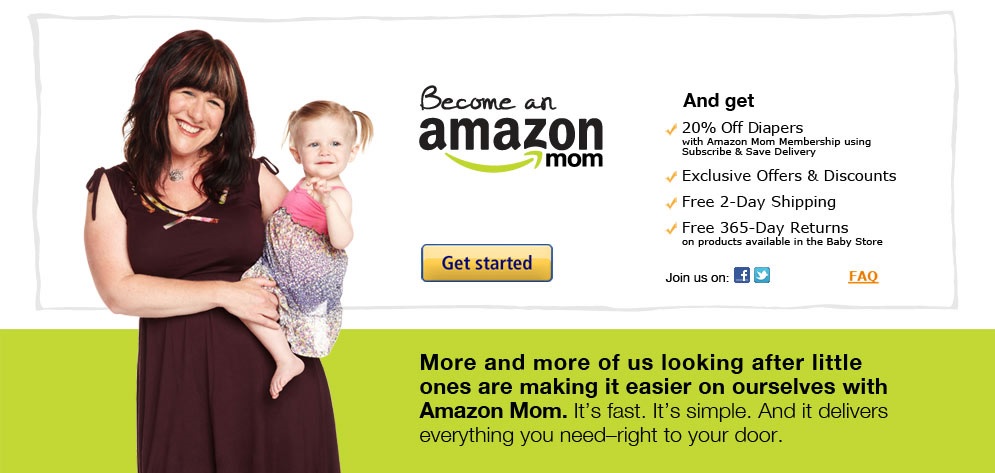
But we don’t want to spoil the fun; here’s Amazon Mom’s own curious self-description:  “(It) is a prime membership program aimed at helping parents and caregivers in the prenatal through toddler years use Amazon to find and save on products that families need.  Amazon Mom is open to anyone, whether you’re a mom, dad, grandparent or caretaker.”

So let’s get this straight:  a dad can join a mom program?  The word mom has become a generic term for parent, like Kleenex is for facial tissues?

And then dads must stop to think:  realistically – as a dad – is Amazon Mom speaking to you?  Does this program’s name suggest something that you would want to browse?  Would you walk into a “mom” retailer, or down a “mom” aisle in a bricks-and-mortar store?

Also recently, we had a pleasant 140-character conversation with the friendly folks at 4moms, a baby robotics company founded in March 2006 which makes high-tech baby gear.

4moms enlightened us that its company name is derived from an initial focus group held that consisted of four mothers.

Cute and unique, indeed, but in a baby world where businesses purposely leave dads out of the parenting mix, it’s a saying that’s well-worn.

Had the name been 3moms or 5moms, we would have never taken issue with anything.  But imagine that the wildly-successful burger-maker franchise Five Guys had been named 4Guys – that means something else entirely, doesn’t it?  We’d all perceive them differently, and wouldn’t women be deservedly up in arms?

We’re sure the desire of 4moms to match true company history with the play-on-words was too good for them to pass up, but you know who gets passed up in the process?

Dads.

Dads are parents too, and it’s time businesses start listening to fathers everywhere.

Judging by its products alone, 4moms seems to have a bright future ahead.  And with a financial backing like no other in cyberspace, Amazon will probably carry on for a long time, that is, unless the recent uproar forces at least an overdue name change.

But like that lost library book, if my friend doesn’t know where these companies are or doesn’t notice them because they’re not speaking to him (he’s even a dad), then how can he find them?  They must not care about dads as customers, right?  If a product is not categorized and shelved properly like that book, do consumers stand a chance at ever finding it, enjoying it, or even using it?

If these companies really cared, perhaps they could start marketing their products to its true customers.

As in, all of them.

Keeping baby safe at home involves everyone

You may have noticed the wonderful and much needed t-shirt now available from the fine folks at the National At-Home Dad Network.

American Baby magazine apparently has not.

Once again we turn to a misguided ABM headline that reads, “The number every mom should know.”americanbabyagain

The blurb talks about the importance of knowing the phone number of the national poison control center, and having it readily available. This wasn’t a case of a headline alone speaking to the mom, the story fortifies it by imploring mom to program that number into everyone’s cell phone – dad’s too, because not only is parenting evidently beyond his scope, so is technology.

This forced snub is another example American Baby magazine – and much of the mom-obsessed media – simply not speaking to dads. The powerful role the media plays in our culture then spills into our psyche and eventually into marketing, where so many unfairly assume that dad plays the part of babysitter when mom isn’t around.

Marketing personnel love playing into mom’s ego as the lead parent, a brutal, old fashioned assumption that she must carry the cash and handle all the shopping because dad is at work.

That notion may have been valid many decades ago, but we all know that’s not true today.

If by chance ABM is reading along here, don’t sit at the next editorial meeting and decide to make a gratuitous “for dads” section a permanent feature of your publication.

Instead, try doing something you’ve clearly never done before: talk to dads.

You’ll be a stronger magazine for it, because we know a few American babies who happen to have dads, and those men deeply care about the safety of their children, too.

Not the earth’s best advertisement

A friend of mine once had an unsettling experience at her job.

It was during a typical end-of-year holiday luncheon when the boss praised a group of workers for a successful project. The cantankerous male boss, however, had a rather old-fashioned attitude toward women in the workplace. He reluctantly accepted females, but didn’t see them as equals to males.earthsbest

Nevertheless, my friend had an equal part in helping this particular project reach its fruition.

At the luncheon, the company chief praised a group of male colleagues for their project work, while intentionally omitting my friend’s name.

She took the high road and never said a word about it again, but being left out really hurt her.

In fact, that same episode has sadly been replayed a few times since, yet she keeps silently marching on and doing her part. She really doesn’t want or need any praise, but rather, just wants to be acknowledged that she’s a part of the team.

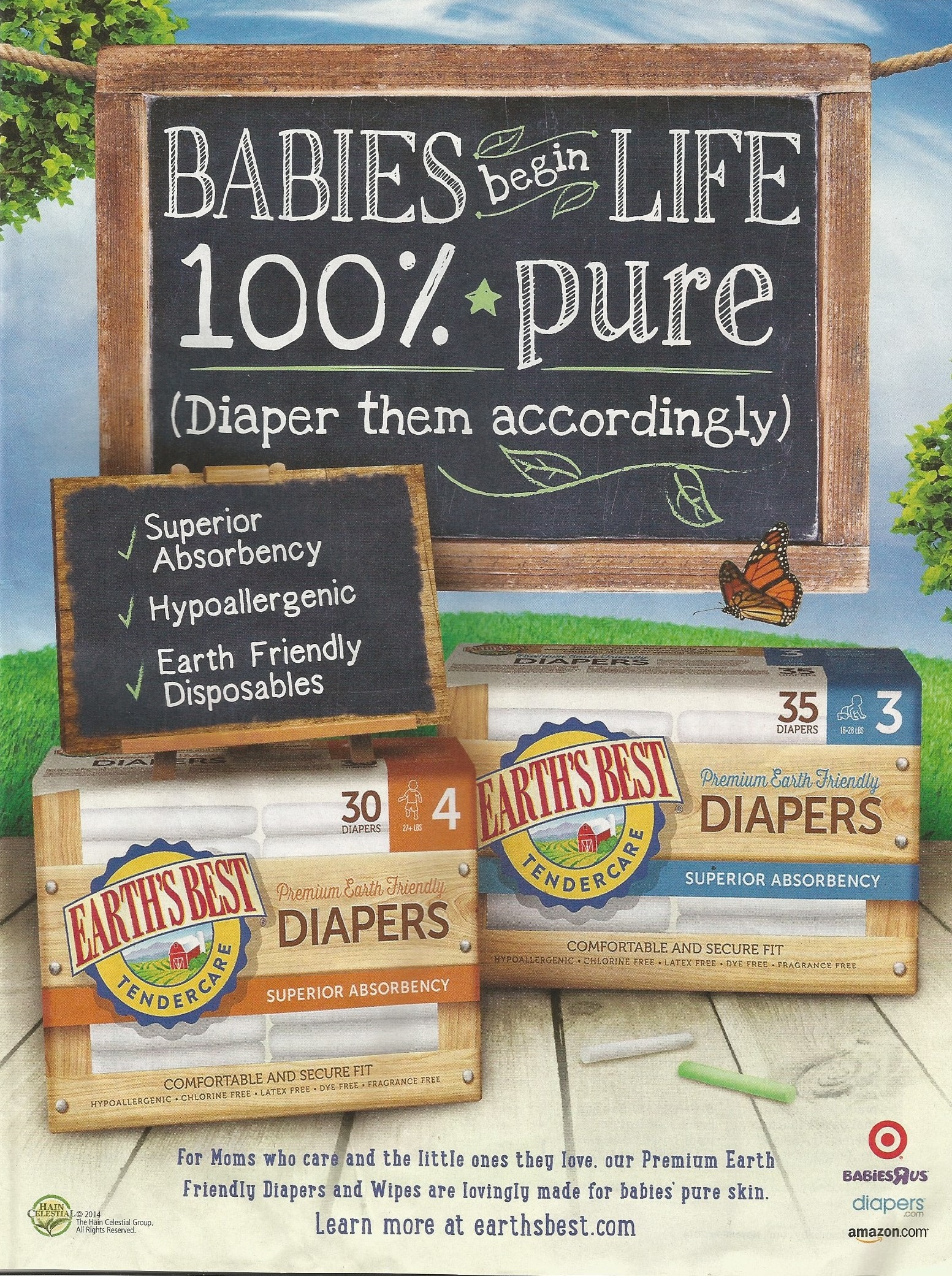
This story bears a striking resemblance to the latest ad from Earth’s Best (featured), makers of earth friendly disposable diapers and wipes.

Note the small-in-print, but large-in-scope exclusion from the bottom of its American Baby magazine ad.

Don’t dads care? Don’t they love their little ones?

Not so, says Earth’s Best, who exhibits the identical uncomfortable and disconcerting conduct of my friend’s boss.

The dad exclusion continues on over at earthsbest.com, where it features a “For Mom, By Mom” section, leaving dads in the cyberspace dust.  It’s a not-so-subtle way of Earth’s Best saying that it doesn’t expect dads to visit its site, almost as if they aren’t able to point and click.  Very disturbing, indeed.

And while we’ll continue to take the high road, we won’t be silent – dadmarketing is here to call out advertising excluders like Earth’s Best and ask it to change.

Dads count too, and if Earth’s Best wants dads to buy its products, it should market them accordingly.

They did produce some change

When companies receive customer inquiries, they have three basic communication options: 1. Ignore it, 2. Auto-respond, 3. Converse/engage.

We’ve experienced all of these as consumers, and equally so here as dadmarketing employees.

Ignoring the customer contact is the peculiar, and unfortunately all-too-often, approach. Many of us make contact with businesses quite frequently, sometimes without even realizing it, and it’s so often we never hear a thing. That’s troubling for those of us as customers, and potentially terminal for the company. Look at it this way: do you like being ignored by family, friends or co-workers?

Auto-responses can certainly serve their purpose. Sometimes it’s nice to know the company received our email when we send it at 6 a.m. At the same time, the company isn’t fooling anyone; auto-responses feel distant, robotic and forced at times, leaving customers to feel like numbers. It makes the business feel like they’re all about busyness.

Those companies who invest in people, however, and choose to converse and engage with its customers truly get it. Sure, it costs more to devote precious dollars to one-on-one interaction, but it’s totally worth it. Finding that level of interaction is rare, but it’s what separates the companies who care, from the ones who could care less.

On Wednesday we received our regular email newsletter from Produce For Kids, a web resource created in 2002 by Shuman Produce, Inc., who grows and ships Vidalia sweet onions. Its website, produceforkids.com, is dedicated to educating families on the benefits of healthy eating, providing simple meal solutions and raising money for children’s non-profit organizations.

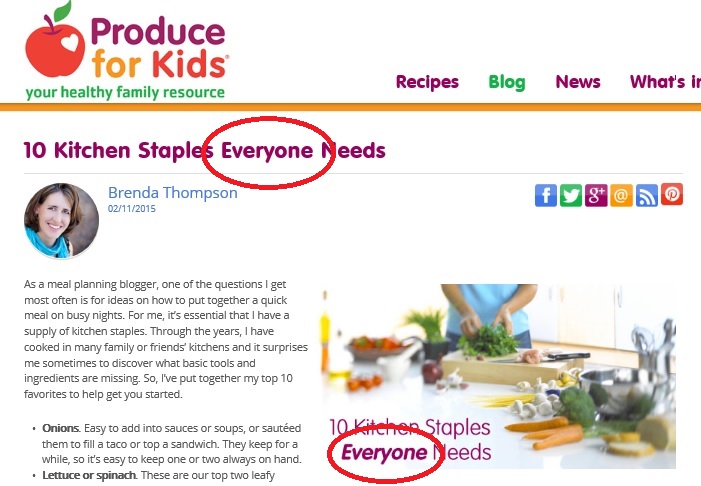
The email newsletter, however, carried a headline that troubled us: “10 Kitchen Staples Every Mom Needs.” We immediately wrote about it, and tweeted Produce For Kids about our post.

Guess what happened?

They listened. They responded. We conversed. They made something wrong, right.produceforkids2

In fact, they made the edit to the headline and photo graphic in a matter of minutes, something completely unheard of in a world of marketing that loves to exclude fathers from messages. Usually that kind of change, simple as it is, must swim through a lot of red tape and organizational bureaucracy.

Cheerios is another story who turned around something negative into something positive, but that quest took several months.

Produce For Kids turned righted the ship over the lunch hour.

For an organization whose efforts revolve around food, produce, shopping, kitchens – it would be easy for it to fall into the dad-exclusionary trap and squarely ignore fathers like so many other businesses and organizations in the same arena. Instead, they have been one of the more stand-up groups, not using a slogan as mere lip service, but rather living by it. Check out its “About Us” page: it could have employed the stereotypical mom-child-kitchen photo, but it didn’t – they gave dads their due.

Here’s to Produce For Kids and its dedicated work at including everyone in the family in its mission — you have dadmarketing’s highest Seal of Approval.