Chuck this cheesy ad in the dumpster

I’ve always been fascinated – more like surprised – by the use of mice in media, advertising and pop culture.chuckecheese
Most of us detest mice, and have little tolerance for them anywhere. Yes, I know some have them as pets, but for most people I suspect they’re filthy, disgusting and a nuisance. They harm plants and crops, can cause house damage and spread diseases with their feces.

Yet we have a culture that turns them into fun-loving, adorable creatures – and we love them!

Think about the cute mice from various movies: “Stuart Little,” “Charlotte’s Web,” “An American Tale,” “Shrek,” “Ratatouille” (I know they’re rats, but still).

There are TV shows and cartoons: “Mighty Mouse,” “Speedy Gonzales,” “Tom & Jerry.”

Even books: “Angelina Ballerina,” “Vera the Mouse,” “Poppy,” “Ralph Mouse,” “If You Give a Mouse a Cookie.”

Of course, we can’t forget that black and white mouse upon which an empire-like movie, music and entertainment industry like no other is based.

It’s fascinating how in real life we’ll do anything to chase and destroy them, yet elsewhere we find them charming and sweet, often heroic. It’s impressive how the entertainment world has found a way to make us love something we should dislike.

And now, we have a mouse from the marketing and advertising world who has entered into rare territory, a realm only occupied by radical parent segregationists like Jif, Kix, Boppy and Gerber.

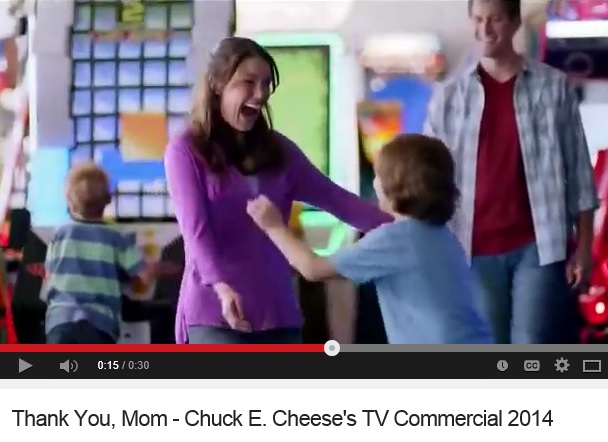
Take a look at this doozy of a commercial, which doesn’t hide a thing about to whom it’s speaking.

I love how the first time Chuck E. Cheese’s decides to let dad have some air time (halfway through the ad), he’s slightly fuzzy and unclear in the background. It’s like the play place chain is reluctantly acknowledging dad’s existence because it has to, but doesn’t actually want to give him much recognition.

In fact, the ad really doesn’t ever let us see the front of dad once. The only time he’s truly center stage (which is a stretch because he’s huddled behind his family) is at the cash register – when it’s time to pay – because dads are merely the providers, right Chuck E. Cheese’s? They’re not nurturers, they didn’t set up the fun day at the restaurant, and they certainly aren’t real parents, or you would have acknowledged them.

Every kid in the ad validates this, including one with a big, warm hug – only for mom.

Just in case my perceptive visual sensibilities are askew, where the possibility always exists that I’m off base on what my eyes see, there’s no mistaking how many times the ad utters the word mom: five.

Dad: zero.

Stop me if I’m wrong, Chuck E. Cheese’s, but from my perspective, the commercial is about as dad exclusionary as it gets. If this was some kind of Mother’s Day ad, that’s great, but it hardly indicates as such.

Further botching its lopsided marketing message is the completely out-of-place, mismatched tagline which seems to want it both ways when it exclaims, Where Awesome Parents Go. Talk about disconnect, the commercial’s one true consistent theme.

There are plenty of warm and engaging mice characters out there, but this ad makes the Chuck E. Cheese’s mascot look like what it really is: a vile rodent.

There’s nothing to giggle about when Giggle says one thing, then does another

If all the mommy blogs suddenly disappeared at once, I think that would leave about 25 remaining blogs in all of cyberspace.giggle

It seems they rule the blogosphere, and that’s great. There are a lot of good, fun mom-focused sites out there, and they each serve a purpose. Keep ‘em coming.

But then you have giggle.com, offering its Giggle Gab blog site, which we’ll get to in a moment.

First, a little background: Giggle is an online baby store, but as they say, it “isn’t just a baby store: it’s a new parent store.”

Cool, huh?

We applaud their clear focus and inclusionary word choice as a store/site for new parents.

But that’s about the last time they’ll address you dads as being real parents.

Over on their Giggle Gab blog, you can not only find a “City Mom” menu tab, but also articles like “5 Photos Every Mom Should Take During Baby’s First Year,” and “3 Tips for Making New Mom Friends & Setting Up the Perfect Play Date.”

If you dads weren’t turned off already and actually decided to click on their “Parent Talk” tab hoping to be spoken to there, you can forget that, too. There you’ll find a “Parent Talk” logo with the amusing description, “Get tips from the trenches with this information-packed blog from the authors of ‘The Rookie Mom’s Handbook’ and ‘Stuff Every Mom Should Know.'”

We’re not taking anything away from the authors or the books, which are probably excellent.

But by listing the names of those books which don’t speak to dads whatsoever, and doing so in a supposed “Parent Talk” section without any dad authors, it’s rather contradictory.

The best dad treatment we could find was an article posted five days before last year’s Father’s Day which helps last-minute moms skate through dad’s important day looking like they were prepared. Here’s the author’s opening:

“Before you panic about being unprepared for Father’s Day this Sunday, I want to remind you that you probably already have everything you need to celebrate. (Yes, really.) Think about it: you could brew some coffee, change all of today’s diapers, and whip up a real present, all in a few minutes.”

Whip up? I don’t want to discount these nice gesture ideas for a mom who’s had a busy week, but that seems like one seriously low-balled Father’s Day. Although the author goes on to give some other sweet ideas, but by then the damage was done.

Giggle.com has an impressive “as seen in” resume, but it’s still a bit of an unknown. If it really wants to be perceived as the go-to site for new parents, it should start acting like it and let dads in on their content.

Dads have feelings. Dads want to learn more about parenting. Dads care about their kids. Dads shop and buy things.

And, dads count too.

Do dads want the best?

When Pizza Hut makes a significant menu change, the national media covers it. When the pizzeria in your hometown does something similar, the local paper doesn’t even notice.walmart

If a New York City radio DJ says something shocking, it makes headlines. Someone could say the same at a tiny Midwestern radio station and it won’t be noted as much.

The Washington Redskins have their whole name controversy, but high schools with identical nicknames fly under the radar.

Bigger certainly isn’t always better, but it is unquestionably more noticeable. It’s also open to more scrutiny, because we expect a little more.

And so it goes with Walmart.

The nation’s largest retailer had a two-page spread in the October 2014 American Baby magazine and proclaims, “Parenthood is full of firsts.” But on the very next page, the ad says this: “When it comes to caring for their baby, moms want only the best.”

Can’t dads care for babies? Don’t dads also want only the best?

Walmart’s website (featured) mimics the same attitude as the magazine ad, which isn’t really a surprise.

Walmart takes a lot of flak for its policies and business practices, treatment of suppliers, employee compensation and working conditions. We’re not ones to comment on those matters – maybe they’re true, maybe they’re not.

However, there’s no mistaking to whom Walmart is speaking in its latest ad. It’s a shame that Walmart doesn’t find enough value in dad as a potential customer, or even as a nurturing parent.

Had the local, independent drug store done this, I wouldn’t even have spotted it. But at Walmart, I expect more.

Hey, isn’t that the slogan of another retailer where dads could take their business?

Hmmm.

Making the headlines

This headline appeared in the Gainesville (Ga.) Times last month, and I suspect it went largely unnoticed across the nation.headline

Except at dadmarketing.

With this newspaper article is a headline which places a sexist stereotype on mom, and one that must surely offend both mom and dad in the process.

Is a mom’s place is in the kitchen?

Is it such that dads can’t cook, or manage to pack a lunch?

Everyone knows that the headline is the text indicating the nature of the article. The newspaper could have been more responsible with its duty and used a clearer, less offensive term, or rewritten it entirely. Who packs the lunch has nothing to do with the story’s main topic (which, by the way, is a good one), that schools are serving healthier meals than ones students bring from home.

Instead, we get a headline rich in stereotype.

We contacted the Times’ Life Editor, J.K. Devine, who kindly offered the following response: “The headline stemmed from an original Associated Press suggestion. It was chosen to show that lunches made at home are no longer healthier than schools. And for the majority of homes, I would say mother’s make the lunches.”

The second sentence really answers the question as to why it was chosen, but why use the mom reference? The third sentence explains that, which is an assumption based on old-fashioned labels society has created over time; it may or may not be true.

A better headline choice might have been: “School serving meals healthier than packed ones.”

All of this reminds me of the oft-used “Mr. Mom” title. Others seem to think it’s fine to typecast a stay-at-home dad as “Mr. Mom.” But no one would dare call a breadwinning, working mom by the title “Mr. Dad.” So why is it still fine to say that only moms make lunches? It’s not.

Finally, let’s not let the Associated Press off the hook. Its “suggestion” is one that categorizes, labels and stereotypes. It’s wrong.

The media plays such a powerful role in shaping our minds and attitudes, and it should know better.

And I always thought it was the media’s job to report the news, not create it.

Culturelle shock

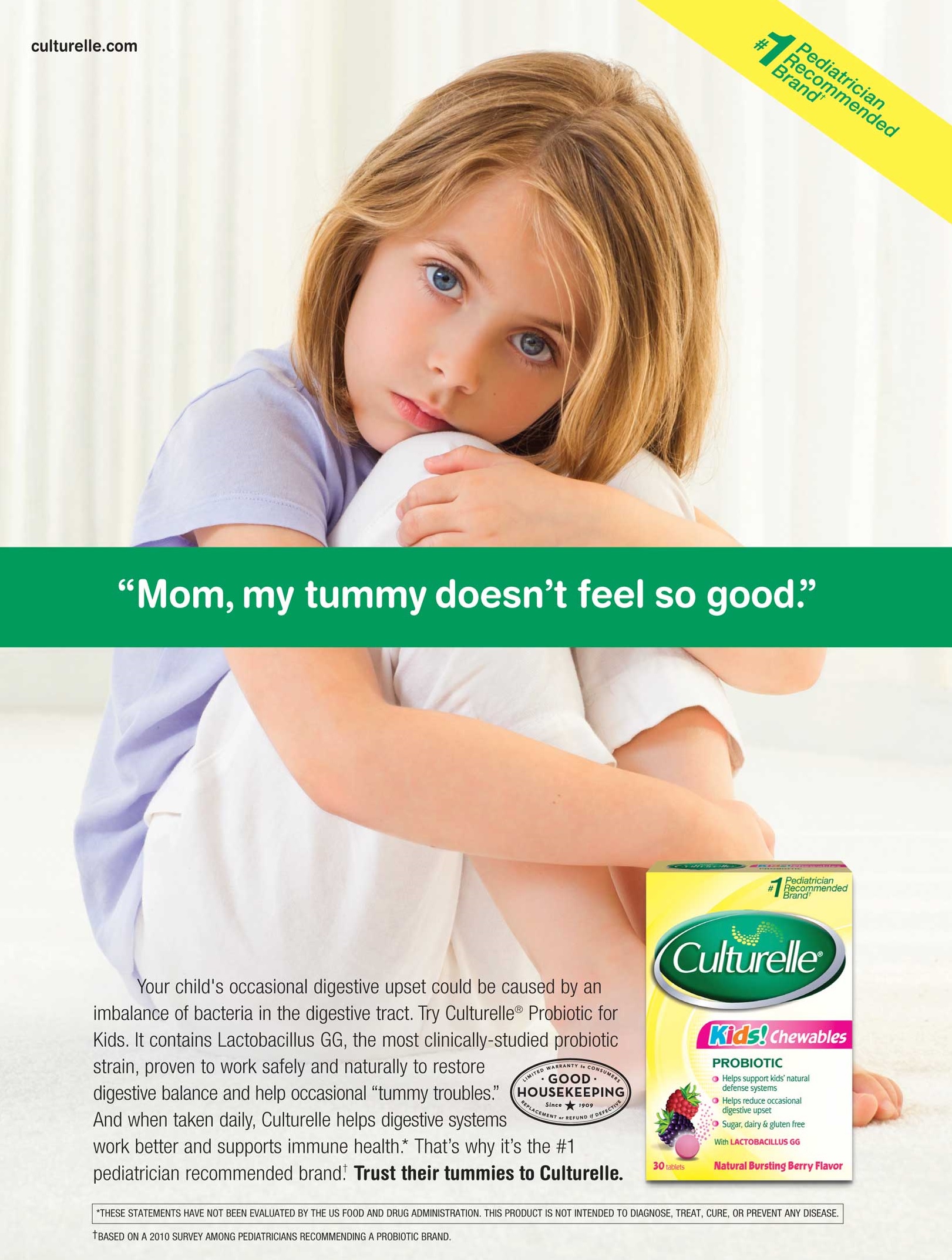
My calendar tells me the year is still 2014, but the marketing team behind Culturelle Kids is clearly situated 40 years ago or more.culturelle

Here we have what appears to be an exceptional childrens’ chewable pill to reduce tummy discomfort, and all Culturelle can think is that kids must only want moms.

Why are dads constantly being told through marketing messages that they’re less than moms? Today, the roles have never been more equal, great strides have been made in various industries and professions with relation to pay, and parents often share duties past generations wouldn’t have dared.

So why must dads continue to hear that they’re second fiddle to mom’s better judgment and instincts? Moms are no more intelligent than dads, and dads are no more clueless than moms. No matter if it’s an animal or a human being, parental instinct is a strong force, and even with lack of knowledge, adults learn as they go.

Yet Culturelle perpetuates the sad and ugly stereotype from a bygone era that dads can’t handle it and thus, kids must want mom first, making dad feel like a secondary, if not useless, parent.

If Culturelle Kids is indeed the #1 pediatrician recommended probiotic – and some of those pediatricians must be dads – then who are their kids calling when they have a sick tummy?

Culturelle, we hope you can consider all of your customers when crafting your marketing materials. Dads take care of kids, too.

Our culture is different now – and you should know better, because it’s part of your name.

Times for a change

I’ve had a lot of ideas over the years.motherlode

Once I pitched a newsletter idea for a sanitation company in a town called White. My original thought was to name it “White Trash.”

Okay, okay, confession: that story and pun was made up.

But even though a pun may fit and might sometimes even seem too good to pass up, it doesn’t make it right.

Consider the New York Times and its Motherlode site. Its goal is “to cover the ways our families affect us, and the ways the news affects our families.”

We love the play on words if it were a moms-only site, and bear with us – we’re not comparing a term like white trash to Motherlode – we’re only using an analogy to make a point. Even its url is listed in web language as http://parenting.blogs.nytimes.com/.

Note the first word used is parenting, as in moms and dads.

Obviously, families include dads, and with a title like Motherlode, how can it possibly make dads feel welcome, or even make them want to check out the site?

Not surprisingly, the writing you’ll find there is fantastic – very fit to print.

After all, this is the New York Times, otherwise known as media royalty. Everyone in the newspaper world wants to be like the New York Times, winners of a record 114 Pulitzer Prizes. It has been the standard in journalism for 163 years, and of course, it is a wonderful act to follow.

Hardly anyone should ever question what they do because they’re as good as it gets, right?

In that vein, does it not seem like everyone’s giving the Motherlode name – surely a discriminatory one – a free pass, just because it’s the New York Times? As readers, do we even recognize its name’s chauvinistic tone, or have we become immune to the exclusion of dad in its title?

In the last 30 days, I counted just one Motherlode news story directed explicitly at dads and fatherly issues (while the “Deployment Diary” is excellent and referred to dad a lot, it’s not a dad-specific issue). And I only noticed three male writers. So, if “families” is its goal, it’s missing the mark in more ways than title alone.

NBC News, another highly reputable media source, became all the wiser when it suddenly renamed its TODAY Moms to TODAY Parents in June, a far more inclusionary and correct name for the news affecting, well, parents.

As it stands now, the New York Times would rather use the word mother as a generic term for parent, like Kleenex is for facial tissue.

Do you ever ask someone, can you please hand me a Puffs?

In the same way, let’s not let this attitude lead to a society where office forms simply state “mother,” but we have to assume the office wants us to list both the mom’s and dad’s name.

Dads know this oft-forgotten tale all too often.

After all, it was only two generations or so ago that dads were not even allowed in the delivery room. While that practice has changed for the better, let’s be honest, doctors still mostly speak only to moms at child well checks as if they’re the lead parent, making dad to feel like an assistant at best, nonexistent at worst.

Being one of the leaders in journalism means setting an example and acting like it, from top to bottom, side to side, and tiny little bit to Motherlode.

Get real, Hilton

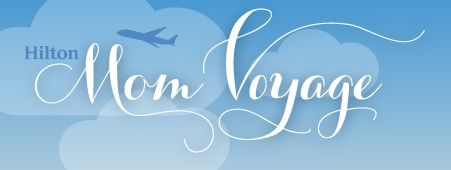
Mega hotel chain Hilton claims to offer a blog about “real families and their travels.”

But there’s just one small problem with that description, because if Hilton’s world is truly reality, then only about 7 percent of dads are traveling. Among its team of 15 bloggers writing about so-called “real families and their travels,” hiltonit’s only authored by one dad.

One dad!

But what we find even more disturbing is that the blog is called, “Hilton Mom Voyage.”

If that title doesn’t strike a nerve with moms and dads alike, it should. In Hilton’s realism, the word mom has become the generic term for parent, strong enough to stamp out the word dad from even existing.

We received news of this messed-up marketing campaign from an email titled, “Real moms give real travel tips,” a partnership with P&G, who has an Olympic-sized history of banishing dads from marketing through its self-proclaimed tagline, “Proud sponsor of Moms.”

We have no problem with real moms giving real travel tips. If moms want to give other moms, or even dads, some tips or advice, have at it. Both genders can benefit from a motherly perspective.

However, when the site’s focus is to offer experiences about real families, and pair it with a blog title that outright excludes dads, that’s when Hilton is sorely missing the mark.

Hilton may want to have a conversation with NBC News and The Today Show, where this past summer its online “TODAY Moms” web section was replaced with the less offensive and more inclusive, if not more modern, “TODAY Parents.” Its rationale is outstanding, but still, why did it take so long to make the change?

Back in the 1950s and 60s, the show employed “Today Girls” (no, they didn’t use all-caps then), who discussed fashion and lifestyle, reported the weather, and covered lighter-fare stories. The last woman to hold that position was Barbara Walters, who said nobody would take a woman seriously reporting hard news back then.

Yet, here we are some 50-60 years later, and dads are not taken as serious parents by Hilton.

When will Hilton make the easy fix that TODAY wisely did? Only Hilton can answer that.

In the meantime, the reality is, there are plenty of other hotel chains where dads and moms can take their business until Hilton realizes that dads like to voyage, too.

One year old

As far as we can tell, there’s not a single entity or individual on the Internet devoted to exploring and analyzing how businesses market their products and services to fathers.oneyearold

It wasn’t until we unveiled dadmarketing.com on December 14, 2013, that history was made.

Like with any new venture, there was some uncertainty about the amount of writing material, how readers might respond, and just what we might achieve.

There was never any question as to its need and relevancy. Dads remain left behind in so many facets of life, and most men don’t realize this until they become fathers themselves.

Consider the following:

  • Why are stay-at-home dads not taken seriously by media and society?
  • Why can’t marketers simply include dads in their messages and advertisements?
  • Why must old-fashioned, anti-dad slogans remain in a society that demands equality?
  • Does it really matter which gender predominantly shops for and feeds children?
  • If kids eventually grow up and leave the nest, at what point do dads become instantly capable of fending for themselves in a store, or in a kitchen?

Questions matter, and we’ll keep asking them. It’s part of our mission, our duty, and our purpose. So are all of your needs, and we plan to keep on listening to them, which help to keep us on target.

We’re smack in the middle of the holiday season, where dads and moms inevitably take part in various parties, some easier to stomach than others. But can you dads imagine attending a party where no one spoke to you the entire time?

Marketers do this all the time with word choices they make, and it’s more than disturbing.

One year is in the books, and as long as dads roam the earth, we figure we have many more to go. Thanks to all of you for your unwavering support, tireless goodwill and unmatched appreciation.

Our continued growth depends on feedback, so please keep it coming.

Here’s to the past year, and the years ahead!

With great power comes great responsibility

I realize the Internet has blurred some of the rules of journalism, but the media still has a certain amount of duty and youtubebabyaccountability.

After what I saw online today, People magazine clearly feels none of it.

Polish dad Bartosz Fórmanski YouTubed a charming video of him placing fake facial hair on his baby, and titled it, “What happens when my wife leaves me alone with our baby.” Although his YouTube name is “Perfect Daddy,” the video simply looks like a dad having fun with his baby. Nothing more.

People magazine wrote about the video on its website, yet interpreted it by making dads out to be the negligent, undependable, butt-of-jokes parent with the irresponsible title, “Here’s Why You Don’t Leave Dad Alone with the Baby.”

People doesn’t appear to have interviewed Bartosz, but decides anyway to make assumptions merely from his headline alone.

It could be that Bartosz is just a funny guy. Perhaps he’s a perpetual practical jokester. Or, maybe it’s just a dad having harmless fun.

But People would rather take the lazy approach and use tired comic relief by reshaping the unknown meaning Bartosz’s YouTube title, making dad out to be the sorry excuse for a parent. Yep, here’s another example of why we can’t leave dads with kids. Clearly, dads aren’t serious parents like mom! They’re only assistants as best!

Why did People have to turn innocent fun into reckless headline writing?

I guess when it gets right down to it, it really doesn’t know, uh, people.

With a little help from my friends

Last week dadmarketing had the pleasure of interacting with the excellent Tiny Blue Lines, a wonderful website we’re helphappy to have discovered. Highly recommended.

In our conversation, she brought up an interesting point.

You can head to our Twitter site if you want to read our discussion, but she made a comment worthy of further exploration when she said, “…props to all the dads who don’t think of (handling baby’s night feedings) as ‘helping’!”

That made us think.

In fact, it was enough to make us look up the true definition of help, which can be defined several ways, as noted at dictionary.com. Those most applicable in this case would be:

  1. To give or provide what is necessary to accomplish a task or satisfy a need; contribute strength or means to; render assistance to; cooperate effectively with; aid; assist;
  2. To make easier or less difficult; contribute to; facilitate;
  3. To be useful or profitable to.

However, when put in context with night feedings and caring for a baby – a role most associated with mom – it seems to puts dad back in the assistant/helper role, doesn’t it?

Consider the converse: if a dad was working on a car in the garage all day and mom said, “I helped my husband work on the car today,” wouldn’t that also connote feelings that she was merely an aide, or an assistant?

And then it hit us that this is one of the many reasons dadmarketing exists.

The more we can all rid the world of these labels, stereotypes and preconceived notions, the more we’ll be able to say, dad helped to feed the baby during the night, and it will simply sound like he provided what was necessary to accomplish a task, or contributed to something, or was useful.

Period.

And it won’t sound like he was only assisting his wife with one of her jobs during the night. And when a dad cooks a meal it won’t sound like he was being a good husband and helping mom out in the kitchen. And, maybe, just maybe, we can rid the use of that absurd “Mr. Mom” name.

Tiny Blue Lines’ comment was indeed thought-provoking, because props for sure, to those dads who don’t think of it as helping, but further props to those moms and dads who don’t categorize it a mom or dad job in the first place.