Fall Is Here. Is Dad in Your Marketing?

September marks a significant change in the American consumer calendar. For brands, it’s one of the busiest stretches of the year.

It’s also a good time to consider whether dad is getting the attention he deserves.

Fathers are involved in everyday decisions that shape household spending, from groceries and children’s activities to education, technology, travel and financial products.

Yet marketing still sometimes relies on a familiar division of roles: mom manages the household and the children, while dad appears only when the subject turns to cars, tools, sports, or grilling.

Reality is considerably more complicated.

A 2026 survey of fathers found that 92% said they influence household purchases, with 37% identifying as the primary decision-maker and another 55% saying they make decisions jointly with their partner. Fathers reported involvement in decisions involving education, healthcare, nutrition, children’s entertainment and financial planning.

The numbers suggest something marketers may want to keep in mind as the fall season begins: dad isn’t a niche consumer. He is the audience brands are already trying to reach.

Football Is More Than a Dad Stereotype

Football may be the most obvious example. Every new football season ushers in another fall of weekend games, fantasy leagues, tailgates, watch parties and conversations about teams and players. Football has long been one of the easiest cultural shortcuts for marketing to men. Put a dad in a recliner, add a television, a plate of wings and a jersey, and the scene is immediately recognizable.

There’s nothing inherently wrong with that image. Plenty of dads will spend part of the fall exactly that way. But it represents only one small part of what being a dad looks like.

The same father watching Sunday football may also be the father coaching his daughter’s soccer team Saturday morning. He may be the one buying the groceries for a gameday gathering, helping a son with homework, taking the kids to practice or planning the family’s weekend.

That’s where the opportunity gets more interesting for marketers. Rather than asking, “What do dads buy?” perhaps the better question is, “What role does dad play in the decisions we’re already marketing around?”

And for a master class in how to market to both genders, look no further than the NFL.

Fall is a Family Season

This matters because so much of fall marketing is really family marketing.

Football. Halloween. Fall clothing. Home improvement. Outdoor activities. Streaming. Travel. Food. Youth sports. And, before long, holiday shopping. These aren’t isolated categories with neatly divided male and female consumers. They’re parts of family life, and fathers are absolutely involved in the decisions surrounding them.

That doesn’t mean every campaign needs to feature a dad. Nor does it mean marketers should force fathers into advertisements simply to check a demographic box. It means brands should be careful about assuming that the mother is the default consumer whenever a product or service involves children or the household.

The goal isn’t to replace one stereotype with another. It’s to make the picture more accurate.

The Dad Behind the Purchase

One reason this can be easy to miss is that fathers don’t always announce themselves as consumers. That’s because most fathers don’t want the spotlight. They tend to put their spouses and kids first, thus remaining in the background.

A dad may be researching the family vehicle without being the person who ultimately walks into the dealership. He may compare youth sports equipment online before discussing it with his spouse. He may research a new television, plan a family vacation or decide which streaming service makes sense for the household.

In many cases, the purchasing decision is shared. That matters because marketing has historically been very interested in identifying a single “decision-maker.” But families don’t always work that way. The purchase may belong to the household, while the research, recommendation, comparison, or final decision is divided between two parents.

The Modern Dad Doesn’t Need a Special Campaign

There is also a danger in overcorrecting. Marketing to dads doesn’t necessarily mean creating a “dad campaign.” In fact, the most effective approach may be to stop treating fathers as a niche audience in the first place. A father doesn’t necessarily want advertising that announces, “Hey, dad, this one’s for you!” He may simply want to see himself represented naturally in the life the brand is depicting.

That could mean a father packing lunches. A dad shopping for school clothes. A father taking his kids to practice. A dad making dinner. A father comparing insurance options. A dad decorating the house for Halloween.

And yes, sometimes it can mean a dad sitting down to watch football. The point isn’t that one image is wrong. It’s that one image isn’t enough.

A More Complete Picture

The advertising industry has become increasingly attentive to the ways it portrays women and mothers. That has helped broaden the picture of family life presented in advertising.

Fathers are part of that picture, too.

The traditional image of dad as breadwinner, disciplinarian and weekend recreational companion hasn’t disappeared. It simply doesn’t describe every father, or necessarily the majority of what fathers contribute to family life.

For marketers, September offers a useful reminder.

As the country moves into football season, fall activities and eventually the holiday shopping season, there will be countless opportunities to show families as they actually live. That doesn’t require making dad the star of every advertisement. It may simply require remembering that he’s in the picture. He’s watching the game. He’s also doing a lot of other things.

Marketing should probably notice.

Brands Are Missing Half Their Audience This Back-to-School Season

Every August, marketers spend billions trying to convince parents to buy backpacks, lunchboxes, sneakers, laptops, and far too many glue sticks.

Yet many back-to-school campaigns still rely on a familiar script: Mom has the shopping list. Mom packs the lunch. Mom drops the kids off. Dad? He’s often nowhere to be found, or he’s the comic relief who can’t figure out which notebook to buy.

The reality is very different.

The National Retail Federation expects families with K-12 students to spend a record $43.3 billion on back-to-school purchases this year, with the average family spending nearly $864 on clothing, electronics, shoes, and school supplies. That’s a massive opportunity for retailers, but also a massive opportunity they’re only partially addressing.

Today’s fathers aren’t occasional assistants. They’re active shoppers, lunch packers, homework helpers, carpool drivers, and school volunteers. Research over the past several decades shows fathers are spending significantly more time raising their children than previous generations, and that trend continues to grow. Parenting has become a shared responsibility in households, yet much of the marketing hasn’t caught up.

Families are also shopping differently than ever before. Nearly two-thirds of parents had already started shopping by early July, more than half planned purchases around major summer sales, and almost half are delaying some purchases while waiting for better deals. Price—not tradition—is driving decisions.

So why are so many brands still talking almost exclusively to moms?

This isn’t about replacing moms in advertising. It’s about reflecting reality. When dads see themselves authentically represented, such as comparing backpacks, packing lunches before work, checking supply lists on their phones, or helping pick out the first-day outfit, they’re more likely to feel that a brand understands their family.

The best marketing doesn’t reinforce yesterday’s stereotypes. It mirrors today’s lives.

This back-to-school season, brands have a choice. They can keep producing the same commercials they’ve been making for decades, or they can recognize what millions of families already know: Dad isn’t “helping” with back-to-school.

He’s parenting.

Parenting Phrases That Quietly Divide Couples and Shape Marketing

Most couples would never intentionally divide parenting into “mom territory” and “dad territory.” But sometimes, our language does it for us.

Take a simple phrase like:
“Can you watch the kids for me?”

At first glance, it sounds harmless. Practical, even. But hidden inside the sentence is an assumption: the children primarily belong to one parent, while the other is temporarily assisting.

We hear versions of this everywhere.

“Dad is babysitting tonight.”
“Go ask your mother.”
“Mom’s better at that stuff.”
“He’s helping with the kids.”

None of these phrases are malicious. Most people say them without a second thought. But over time, language has a way of shaping identity, expectations and roles inside a family. And this kind of talk shapes how marketing speaks to us everyday.

When Parenting Becomes Separate Worlds

Eventually, parenting can start to feel less like a shared mission and more like two separate departments operating under one roof.

One parent becomes the default organizer, emotional manager and scheduler. The other slowly drifts into the role of helper, substitute, or “fun parent.” Not necessarily because either person wanted that dynamic, but because culture quietly trained them into it.

The interesting thing is that families often drift apart linguistically before they drift apart relationally.

Compare:
“My son” versus “our son.”
“Can you help me with the kids?” versus “Can we figure this out together?”
“I need a break from the kids” versus “We’ve had a long parenting week.”

Small differences. Big implications.

Words Shape Family Culture

Words create atmosphere. Repeated daily, they create culture. Marketing then uses this creation in content, and thus, an endless, sad cycle continues.

Maybe stronger families aren’t built only through big moments, vacations, or parenting strategies. Maybe they’re also built through tiny reminders — spoken over and over — that this family belongs to both of us and each parents matters just the same.

Be an example for marketing and media by choosing your language carefully. Because in their line of work, words definitely matter.

Get ‘Ems by Gerber – What Are Dads Supposed to Get?

Gerber launched a new product line for toddlers called Get ‘Ems – small, poppable snacks designed for little hands and on-the-go parents. The concept? Smart. The packaging? Cute. The marketing? Disappointing.

If you’ve been following Gerber’s social media lately, you’ve probably noticed the trend:

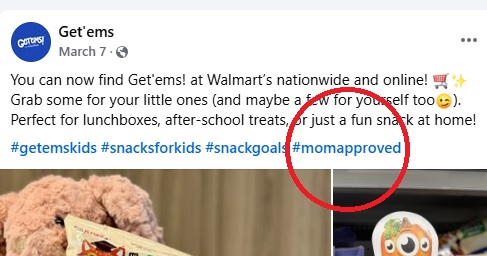
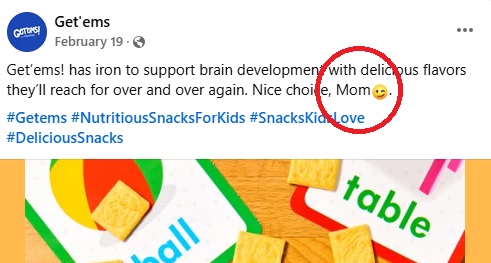
  • “…made with the good stuff moms love too”
  • “…Mom’s stamp of approval”
  • “Nice choice, Mom”
  • #momapproved

The implication is loud and clear: when it comes to feeding toddlers, Gerber sees moms – not parents – as the default audience.

This kind of gendered marketing isn’t new. But it’s especially disheartening coming from a legacy brand like Gerber, which has the reach and influence to shape how we think about modern parenting. In 2025, we should be past this old-fashioned stereotype.

The truth is: dads buy snacks too. Dads do school pickup. Dads pack the diaper bag, prep meals, and handle snack time in the minivan.

Dads aren’t fringe players in the parenting game – they’re in it, every day, just like moms.

So when a major brand rolls out a new product and makes a big splash across Instagram, TikTok, and Facebook with mom-only messaging, it sends a signal. Not just to fathers, but to kids, and to the culture at large: “Only certain customers matter.”

But here’s the thing: parenting isn’t a marketing niche carved out just for women. It’s a shared experience that deserves inclusive language and thoughtful messaging.

Imagine if Gerber said:

  • “…made with the good stuff parents love too”
  • “…A parent’s stamp of approval”
  • “Nice choice, Mom & Dad”
  • #parentapproved

Not only would that resonate with modern families – it would reflect the reality of how parenting works now. Tradition runs deep, but that’s no excuse to keep leaving dads out of the frame.

Brands like Gerber have an opportunity (and frankly, a responsibility) to lead with messaging that reflects today’s diverse parenting landscape. Because the more dads feel seen, that’s good for everyone – kids included – because it strengthens families. And for companies, it maximizes ROI.

Gerber, we’ve been through this before, so here’s a tip: Next time you’re brainstorming social media posts, try ones that don’t assume who’s doing the snack run.

Dads see the Get ‘Ems. They just want to be seen, too.

All Dads Want for Christmas is Their Due

Dads don’t want a lot for Christmas,
There is just one thing they need.
And they don’t care about the presents,
If they’re discounted or free.
Just a change that’s overdue.
More than you could know is true.
Make their dream break through,
All dads want for Christmas is their due.

[music picks up]
Dads don’t always seem included,
Left out of conversations, it’s true.
All they ask this holiday,
Is a bit of fairer view.
They don’t want to be excluded,
Forgotten, left out every day.
They are parents, don’t forget it,
Stereotypes do not portray.
Just please change, it’s overdue.
More than you could know is true.
Make their dream break through,
All dads want for Christmas is their due.

They won’t ask for much this Christmas,
They won’t even wish for snow.
They’re just gonna keep on waiting,
For brands to change names and logos.
They are more than backup parents,
More than sidekicks. Aloof? No way!
They can do anything, it’s instinct.
Anything that’s in their way.

They want change that’s overdue.
More than you could know is true.
Make their dream come into view.
All dads want for Christmas is their due.

Oh-oh, dads have done the shopping,
Household chores, it’s nothing new.
So why do companies claim,
Dads can’t deal with simple doo doo?
And everyone is clinging,
To an old-fashioned ‘50s upbringing,
Santa, won’t you bring dads
The thing they really need?
Inclusion in word, photo, and deed.

Oh, dads don’t want a lot for Christmas,
To be remembered is all they’re for.
Include them, name them, don’t forget them.
That’s the gift to make them whole.
Just a change that’s overdue.
More than you could know is true.
Make their dream break through,
All dads want for Christmas is their due.