Why does Claritin insist dads don’t take care of kids?

Who says dads don’t take care of kids’ allergies? Bayer Global, makers of Children’s Claritin – that’s who.

It doesn’t take long to figure out who Bayer wants as its customer base when you visit its gender-specific website which insists dads aren’t parents who buy or provide medicine. Bayer doesn’t just offer a Smart Allergy Mom Toolkit – they’re so convinced that only moms matter they trademarked it.

claritin.jpg

But that’s not all. Bayer even offers the Claritin Mom Crew, which offers only moms free product samples and promotional items in exchange for positive reviews. Dads, it would seem, were not even given an opportunity to speak because the invite was never extended.

claritin2

It’s all a tough pill to swallow for dads who remain dedicated as part of today’s modern families. It’s these same dads who hear constant viral stories of mothers who complain about having to do it all, then get little by way of backup from ad agencies who insist just that – moms must do it all.

Of course, we all know this not to be true. Dads also seek assistance when looking to administer medicine to allergy-suffering children. Dads are every bit equal, competent parents who care greatly about their children.

These are not your dads of yesteryear, depicted in 1950s sitcoms as aloof, unemotional and neglectful. Nor are they the spoofed, incompetent 1980s fathers of “Mr. Mom” and “Vacation” who needed corrected by their more sensible wives.

Bayer’s approach is both disappointing and troubling. It’s effectively telling fathers everywhere – you don’t matter. It’s a surprising and unfair omission from a company whose mission is “to achieve and maintain leadership positions in our markets” and to “respect the interests of all our stakeholders.”

It’s hard to imagine how all of these ideals can be accomplished when it’s not aiming to reach the dad market, nor respecting the members of that market.

Bayer’s #BeAnOutsider social media campaign is a clever one that encourages Claritin users to start enjoying the outdoors again. But it also offers a heavy dose of irony to dads: they already are outsiders.

Perhaps someday Bayer will let dads in and make them to feel like the true, equal parents they are without any bias toward who they think cares for kids today.

If Bayer truly knew its customer base, it would know differently.

Let’s stop telling dads they’re not parents

A clear shortcoming of excluding dads from marketing is how it diminishes his ability as a capable consumer.dadshops6

Of course, moms possess no more instinctual ability to purchase items than dads, who are fully fit shoppers. The current message and stigma about dads, however, has trained us to think otherwise. It’s that same messaging that influences moms while they shop on their own. It’s curious to contemplate that while some people believe everything outside the home is a man’s world, the marketing community firmly believes otherwise when constructing messages in relation to everything inside the home.

With all of the emotion, empowerment, and authenticity of advertising directed toward mothers, how constructive are advertisements which speak only to them?

armandhammer1.jpgIn other words, is society really taking mothers seriously when all the focus is placed on them to the exclusion of fathers? Do mothers really want this heap of responsibility when scores of moms incessantly plead for help in the home and caring for children? Do mothers really want it all, as ads so often suggest: motherhood, career, and control of the household and family? Is it fair to portray women solely as happy homemakers in half of the ads and as sex objects in the other half?

Viewed collectively, these ads seem to be at odds with how women are regarded in society and inadvertently places unwanted labels on them.

The subjective conception of such marketing means that women pay a price beyond labels and undesirable pressure.

Humanity will never achieve overall equality for women, particularly at work, until the same equality for men is achieved as parents. The two are intertwined.

When gender stereotypes unfairly discount men as true parents and view women as instinctual caretakers of children, it conveys a message that it’s a man’s world everywhere but home.

Beware of the unconscious bias

To see food products like Jif and Kix hold on to their timeworn, stereotypical catchphrases — all of it has reached a state of comicality. It certainly suggests absurdity and irrationality. We’re talking about peanut butter and cereal. Those products are specific to moms?

But then there are those items related to babies, and less people seem to notice the exclusionary practices tied to its marketing. Boppies were never invented solely for mothers, but they’re regularly positioned to exclude dads from messaging and thus, demote dads to secondary parental status. Similac offers baby formula – a surefire product for dads if there ever was one – yet its makers go out of their way to reject dads in messaging.

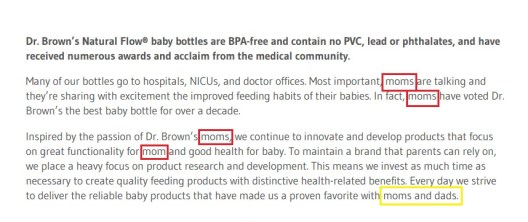
drbrowns4All of this is detrimental to families, of course, because it impedes the family from flourishing as it should without recognizing fathers as equal, competent parents.
Dr. Brown’s can now be grouped with the Boppy and Similac. They’re all products that owe us a little more, that need to try a little harder, that have a responsibility to go out of their way to ensure that dads don’t feel left out. They’re products that should regularly feature dads and speak to them in all that they do.

Go ahead and try to find a single image of a dad on the Dr. Brown’s site. Is there even one? That’s hardly representative of today’s modern families, or even families of yesteryear.

The current actions of companies like Dr. Brown’s, Boppy and Similac would be a little like Lowe’s only using men in its ads and scripting slogans and ad copy that only speaks to that one gender. And imagine the uproar if they did! Rather, they know that home improvement is hardly a gender-specific thing, even though common stereotypes indicate that power tools and outdoor work is supposedly for men.

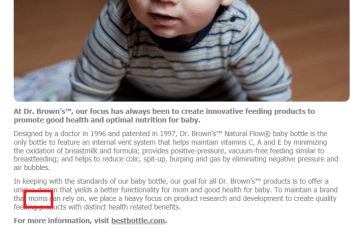
But instead, Dr. Brown’s takes the old-fashioned route and tells us that dads don’t take drbrowns2.jpgcare of babies, or can’t bottle feed, or don’t want to. It’s all very troubling for a company that prides itself on innovation and support. And check out the disconcerting use of moms as a synonym for parent. Sorry Dr. Brown’s, but not all parents are moms, and thus, those terms can’t be succinctly substituted without leaving someone out.

Also take note of its Ambassadors program. Not only does it exclude fathers, it behaves as if they don’t exist.drbrowns5

Dr. Brown’s Twitter bio promises that its focus is “to create innovative feeding products to promote good health and optimal nutrition for baby.” If that’s true, then it’s time to make several revisions to its website and social media.

Dads want to deliver those things, too, and if someone tells him he can’t, he’s going to look elsewhere for someone who believes in him.

Baking up parental equality

Most consumer products have peak sales times of the year – periods on the calendar when companies can best capitalize on generating the most revenue.entenmanns.jpg

For many, that time of year is the holiday shopping season, when gift buying is strong. For others, such as home improvement stores, that time occurs during the spring when home owners are fixing and planting. Fitness centers especially profit during January and February as New Year’s resolutions mean losing weight and exercising more.

Of course, this time of year – back-to-school season – is when breakfast and lunch makers ramp up efforts to get families in the groove of using their products.

And what is snack maker/baker Entenmann’s doing? It’s telling the nation that only one parent takes care of kids.entenmanns2.jpg

Not only can you find use of the word mom (not parent), you can also find images of a lopsided 13 moms vs. 4 dads on its Parents/Have Fun With Us page.

All of this would have been appropriate some 60-70 years ago when moms ran the show. But parenting has changed dramatically since then. In today’s modern families, dad is now also in charge of buying groceries, clothes, school supplies, and other products and services the family needs to exist. So the marketing approach is key, because dad needs to see he is a trustworthy purchasing agent for his family. The best way to do this is to involve him in the marketing process and value him as an equal parent as well as a valued customer.

By marketing directly to moms, Entenmann’s reinforces a certain stereotype and subliminally makes dad feel that mom is a better/leading parent.

Entenmann’s could do everyone a service by ending this practice of only conversing with moms. It will also do itself a firm favor by winning back dads who are currently reaching for another brand.

Not all parents are moms

While it’s disappointing to find another lunch product maker ignoring dads as equally competent parents and shoppers, the latest exclusionary campaign – this time from Land O’Frost – hits dads landofrost7below the belt in a variety of ways. But you’ll have to look carefully for its greatest offense, which is buried beneath several gender-biased marketing methods.

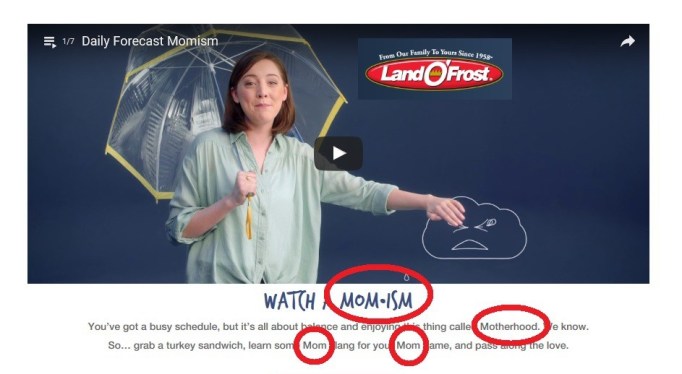
No, it’s not the spinoff webpage section which uses its company name for a play-on-words covering everything related to parenthood, er, um, motherhoodlandomoms.com.landofrost2.jpg

It’s not the numerous web graphics which speak only to moms with language like, “Ah, mom life,” or definitions of “mom-ism.” Imagine the strange vibe a dad might get who visits landofrost.com or landomoms.com, and is repeatedly having to read that he’s a “mom,” which at the very minimum makes it clear with whom the company wishes to communicate.

It’s not social media posts, which landofrost6.pngsometimes awkwardly encourage both “moms and dads” to check out its tips and recipes at its one-gender-only named site.

It’s not even the problematic trademarked pledge above its logo that insists, “From our family to yours since 1958.” Keep in mind, this is a family company headed by three consecutive dads, who one can only assume wish for dads to be treated as important as anyone else. landofrost8.png

What’s really disappointing is how the one-and-only dad imagery found on the front page of landomoms.com reveals a dad shouting and pointing at a tiny child who’s cowering on the ground, in the corner (right). Don’t dads deserve a little better than this? Does Land O’Frost really want to use its only photo of a dad in a terribly negative light? It’s not that the story’s topic itself isn’t valid – it’s a helpful topic of interest for parents – it’s just that there should be a greater quantity and quality of dad images. It would be nice to see an equal mix of genders celebrating the good in parenting, rather than furthering negative, stereotypical imagery of dads who aren’t happy, engaged, nurturing and caring parents.

That really was never true long ago, and it certainly isn’t now.

Land O’Frost seems like a fine company with quality products and strong community involvement. We say celebrate all that is good and show the nation what its story represents: how it was founded and carried on by three wonderful fathers who remained devoted to their families for generations.

What do you say, Land O’Frost? It’s not just dads and moms who are watching – it’s the kids. A renewed approach to marketing will remind future generations that family matters, and that the motto above your logo isn’t merely words.

Dads deserve better

There’s a great deal of misinformation about dads, and – ironically – it starts with the very groups and organizations who purport to uphold fatherhood.

While we appreciate the efforts of fatherhood organizations like the National Fatherhood Initiative (NFI) and National Center for Fathering (NCF), we question the level of father absence that they claim exists in America, as well as campaign strategies from similar fatherhood organizations who continue to highlight father absence as a growing problem in America.

In the 1990s, the NFI and NCF established campaigns to build society-wide movements to reverse father absence, initiated by a growing body of social science research that showed there were record numbers of American children living in father-absent homes.

Three decades and hundreds of millions of dollars later, both organizations proclaim that father absence has reached “epidemic” and “crisis” proportions.

In fact, the following statements are posted on their websites.
“According to the national surveys conducted by the National Fatherhood Initiative, 9 in 10 parents believe there is a father absence crisis in America.”
“If it were classified as a disease, fatherlessness would be an epidemic worthy of attention as a national emergency… In short, fatherlessness is associated with almost every societal ill facing our country’s children.” – National Center for Fathering

How is it possible that after three decades of working to reverse father absence, these organizations can claim there is a fatherlessness crisis in America? This question prompted us to raise even more questions about father absence that pundits have failed to address. To help us find the answers, we contacted the Pew Research and asked:
1. Is there a clear definition of father absence?
2. Do you know if anyone has conducted research on what causes father absence?

Although we’re grateful for their prompt reply, we’re also very frustrated that they never answered the questions. Instead, we received two links to reports with the same old song and dance about father absence. Much of it was stereotypical, based on attitudes and tradition from yesteryear, similar in vein to the slanted and subjective messages that continue to describe a dad’s parental inadequacy and how he’s lacking in paternal deeds – and how there is a connection between father absence and an increase in social problems in America.

We reviewed both reports and found no definition of father absence, nor research on its causes. We also conducted our own investigation and could not find answers to our questions.

Why are the questions we presented important? How is it possible to conduct research without a clear definition of “father absence or what causes father absence?”

Sadly, most people mistakenly assume only a dad causes father absence when the truth is that there are many other origins.

Physical absence also doesn’t necessarily mean a dad is emotionally absent. And who should have the power to decide if a dad or mom is emotionally absent?

The reports also raised questions with respect to gender equality. For example, the report reveals that more moms are in the workforce and that the divorce rate is up.

Could we consider a mom who chooses a career over staying home as an absent parent? Could we consider a mom who does not have full custody after a divorce as an absent parent? Could we consider a mom who is in prison as an absent parent?

The report also admits that mothers are more overprotective than fathers, which many mental health experts define as maternal gatekeeping. Maternal gatekeeping can sometimes become an intimidating force. Even fathers who desire to be active and involved with their kids often drift away in the face of persistent maternal advice. Usually the way a dad parents is viewed as being wrong, when in truth, it’s simply different – each parent, regardless of gender, brings value to their children.

As such, more questions abound.

Where is the study on how maternal gate keeping prevents a father’s involvement or how it negatively affects children and causes social ills? Where is the study on mother absence? If one has not been conducted, why not? And if there is, did the researchers use the same rules and criteria as father absence? Did they spend the same amount of time analyzing mother absence?

One might also logically ask, where are these national organizations’ counterparts? Every parent can become better versions of him or herself, yet we do not see a National Responsible Motherhood Clearinghouse and slogan like “Take time to be a mom today.” What message does this send to dads toward being respected as equal, competent parents?

It strikes us as odd that these academic experts are held in high regard, yet create their own rules/definitions – or in the father absence case, yield no definitions or common sense upon which to conduct their research.

What we find even more frustrating about one of the reports is how it was conducted by telephone as stated on page 8 of “Parenting In America.” If researchers are directing a report of this much social and cultural significance, could it not have been done by observing and questioning actual parents in their respective communities?

Yes, it would require more work. However, it also might divulge some truths about fatherhood the public doesn’t want to hear, such as: fathers are every bit equal, are more active and involved, and are just as competent parents as moms – even in the primary caregiver role. The latter is a fact supported by the increased population of dads who choose to be the primary caregiver for their families.

Unlike the NFI, NCF and other fatherhood organizations who continue to play the father absence card, we are more optimistic about the state of fatherhood.

We wholeheartedly believe there are far more good people than bad people in this world. Therefore, we also believe the responsible, active dads far outnumber the irresponsible, absent dads. And we believe this to also be true with moms!

To prove our claim that the responsible, active dads far outnumber the irresponsible, absent dads, we propose a new “Fatherhood is Alive and Well” campaign. This endeavor shares real facts on how much growth has occurred with the active role dads have played as parents in the last three decades.

Our proposal is not just for dads, but moms too. Why? Because when business and organizations devalue a dad’s role as a parent, it also insults a mom – that’s the husband she chose to marry and serve as the father of their children.

It is time to stop the dad bashing and gender war in the parenting community. Let’s focus on finding ways to encourage dads and moms to create and model a loving parenting community for the kids!

Why your oatmeal doesn’t like you

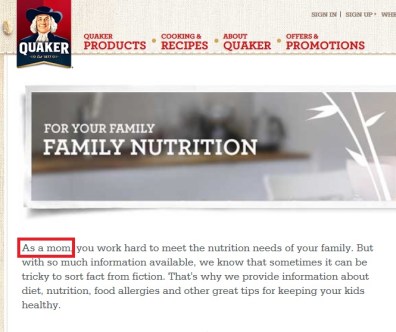
quakeroats.jpgIf you’re a dad, take a moment to read these featured screen shots from the pages of Quaker.com.
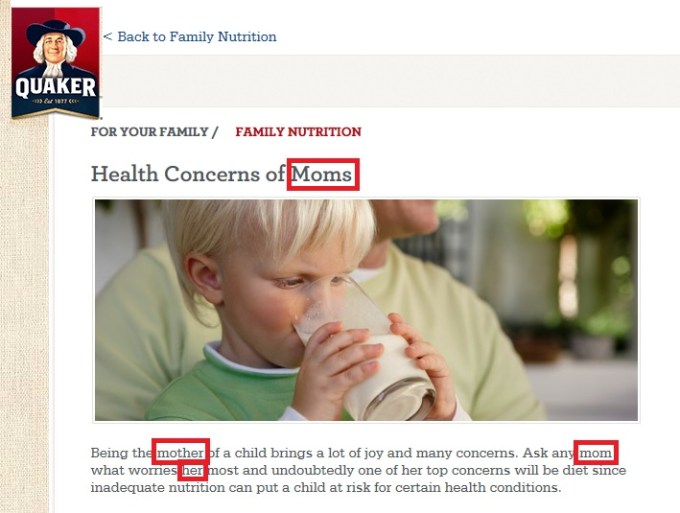
How do they make you feel?

Left out? Like a forgotten parent? Like an assistant parent at best?

They only speak to moms, and yet these are from Quaker Oats, a product consumed by nearly everyone at some point in life. Quaker should take steps to review its content so as to not alienate readers. Specifically, Quaker should take the responsible road and consider its entire customer base, which includes dads.quakeroats2.jpg

If Quaker claims it’s purposely targeting moms, that’s wrong, because parenting is a shared duty. Anything else furthers the myth that it’s mom’s job to shop, to cook, to care for the family. Dads deserve better.

Quaker was founded by a dad, Ferdinand Schumacher, who had seven children of his own! It even features a man on its well-known logo. What might Schumacher think of the way his company treats dads today?

Dads place trust in Quaker, too, and it’s high time that Quaker recognizes that parents raise children, not just one gender.

quakeroats3.jpg

Consistently inconsistent

If every baby company could produce an ad as good as this one from SwaddleMe, think how the parental community would be that much more unified as one.swaddleme.jpg

Here we have both a mom and a dad featured not once, but twice. And it utilizes words like love, hold and swaddle prominently — accurate terms (unfortunately) not often associated with fathers. The multiple use of mom and dad imagery means this is one of the rare instances we’ve seen where an equal numbers of dads featured with moms.

However, SwaddleMe’s keen eye on parental equality seems to end with its print ad. Once you take a visit to its website, you’ll find a site that portrays a different approach:

  • Its About Us page declares its real intent: “At Summer Infant, we strive to delight moms and babies, and walk beside you in your parenting journey…”  It should be noted that this goal seems rather conflicted when considering that the company was founded by a devoted dad.
  • It offers a Mommies Melodies Lamb, which hardly appears to be anything exclusive or reserved solely for moms.
  • Regularly utilizes phrases likeswaddleme2.jpg, “Other products moms love” and “What moms love.”
  • Even its product testing page assumes that everyone visiting its site is a mom! (right)

It won’t take much to achieve greatness, SwaddleMe. Here’s hoping you can match your website with an outstanding print ad. We’ll be cheering for you.

We’ve got a fever, and the only prescription is dad inclusion

For decades, health and wellness product marketers have placed mom in the lead when it comes to taking care of sick children. For example, it’s commonplace to see children’s medications employ the phrase “mom recommended” or “used by more moms.” The concept is based on the notion that mom is the nurturer and caregiver, and the only one who nurses a sick child back to health while dad is not involved.exergen3.png

We all know that times have changed, and that today’s modern family is different from those of yesteryear.

Thermometer-maker Exergen has been circulating a promo lately that continues with this same premise. Yet it takes the gender-biased language even further by creating what it calls a “Mother’s Rebate.” This, of course, creates the awkward situation where a dad could plausibly apply for and receive a rebate that supposedly was not intended for him.

It’s difficult to accept this slanted name for a variety of reasons, not the least of which that it discounts fathers as true parents. exergen.jpg

This makes the irony just that much greater when you visit its website, where it proudly boasts that Exergen is “changing the way the world takes temperature.” However, dads are a part of this world, too. In our estimation, Exergen’s promo is only perpetuating old-fashioned stereotypes that squarely disregard dads as nurturers and caregivers.

Let’s hope Exergen can get it straight before its self-made dad-exclusion-fever reaches new levels. After all, there are other brand name thermometers out there.

Cleaning up diapers: why the race for dads is on

In the world of diapers, there seems to be a sudden race to reach the long, undervalued segment of dads.

Although in some respects, the race might resemble that of a slow crawl.

Within the past month, we’ve seen the big three diaper makers – Pampers, Huggies and Luvs – all take intriguing steps toward speaking to the parent other than mom. Of course, that would be dad, the other parent who’s curiously inconspicuous from most diaper websites.

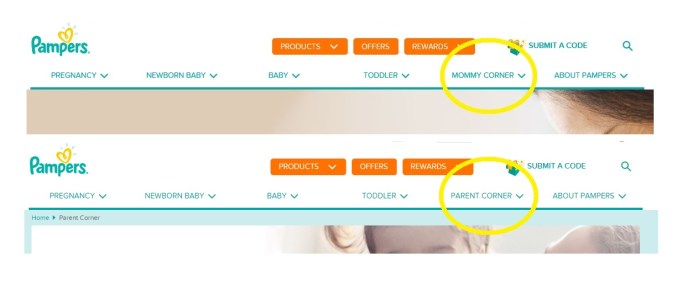
Pampers seems to be in the early lead, having quietly updated its prominent menu tabpampers2.jpg with little fanfare:  “Mommy Corner” was switched to “Parent Corner.”  Of course, Dad Marketing Headquarters noticed the change, and gave instant kudos for the fantastic, albeit minor one-word upgrade.  Fresh off its successful #PampersBabyBoard event, several dads there and elsewhere noticed the improvement and too offered their appreciation via social media.  Pampers still has a way to go to reach full parental inclusion, but tweaking a prominent communication tool like a website menu is a positive start.
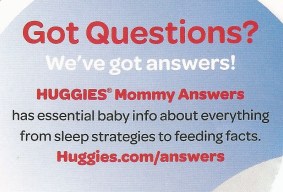
Huggies, on the other hand, maintains its long-standing “Mommy Answers” menu tab, a huggies2section which ignores fathers as equal parents in more ways than one.  We’ve been in communication with its PR agency, who assures us that changes are on the way this summer.
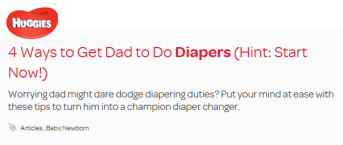
Huggies is no stranger to controversy. Its 2012 “Have Dad Put Huggies to the Test” campaign backfired, causing its marketing team to embark on some serious damage control after one father started a “We’re dads, Huggies. Not dummies,” petition that garnered more than 1,000 signatures in less than a week.

huggies7And just this calendar year it maintained a web page at huggies.com offering the unabashed advice, “4 Ways to Get Dads to Do Diapers.”  That piece has since been removed.

Luvs also made a significant change last week:  one of its front page web sliders at luvs.com was altered after repeated nudging from our office.  It only took a simple edit to make dads everywhere feel included with its new self-proclaimed slogan:  “The Official Diaper of Experienced luvs7.pngParents.”  The only problem is, there’s other sliders on its landing page that contain other mom-only references, as well as others on its site that need updated, too.

These easy fixes are often at the core of the problem.  So often it’s a matter of a quick edit – many times a mere one word – that would make a noticeable difference.  In today’s ease-of-use content management world, they’re the kind of changes that anyone could make quick and painless within minutes.  While Huggies’ changes seem to be part of a full site-wide revision and overhaul, why wait to make uncomplicated, one-word adjustments?  Those straightforward, obvious fixes should be made right now.  All of this is part of a slow, drawn-out process and it doesn’t need to be this way.  Equality shouldn’t wait.

For now, at least a word of congrats to these diaper makers is in order.  But at the same time, no parent would let a child sit for days with an oopsie in its diaper.  So why should an exclusionary website sit unattended to, just the same?

The race is on to capitalize on the spending power of dads.  Who will win?  Keep up-to-date with this site and also follow us on Twitter, Facebook, and Instagram, where you can be certain we’ll stay on top of it.