Why Amazon Mom is like a misshelved library book

A trip to the library is a lot like driving on a long-distance vacation.

It’s fun and fascinating, and whether you’re looking for a particular book or just browsing for whatever meets the eye, it’s a pathway to enjoyment that makes the journey as fun as the destination.amazonmom
One time, though, a friend of mine was cruising through the library, and on a mission.  He was looking for a particular book, and nothing else would do.  He visited the right floor, the right section and the right shelf.  The system said it was available, but it wasn’t.  Even the help of a kind librarian was to no avail.

As it turns out, he eventually found that book.  He said he remembers happily holding it, but also scolding it, as if to ask, “If I didn’t know where you were, how could I find you?”

A recent retail experience again reminded him of that misshelved book.

Amazon knows a thing or two about books.  It started as an online bookstore, and eventually diversified to sell nearly anything that can have a price tag placed on it.  It is the largest Internet based company in the United States, and it’s often our first stop shopping destination.

We love Amazon, and it loves us back.  With regular enticements like free shipping, discounts, Black Friday sales, and rewards programs, it’s everything we’d want in a shopping experience, even if we can’t touch and smell the item first.

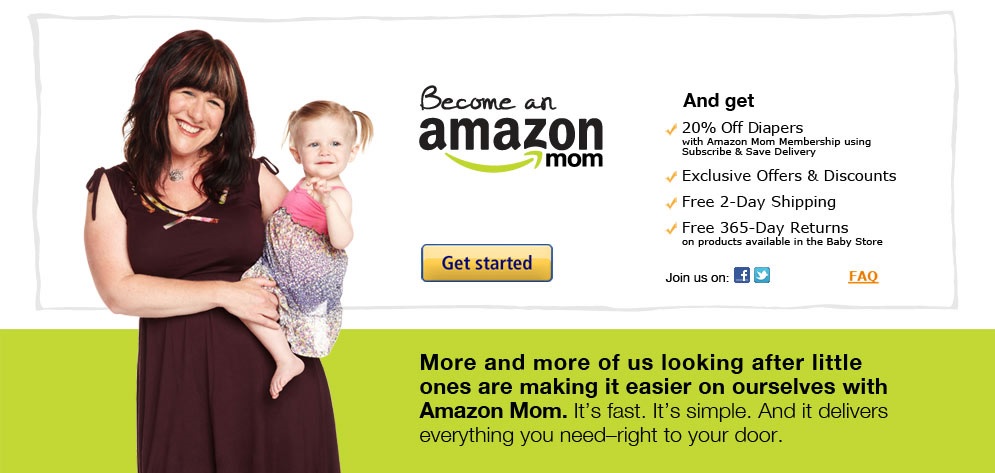
Then, several years ago it introduced Amazon Mom.amazonmom2

For years, dads have been unfairly mislabeled “Mr. Mom” – a name they find both offensive and erroneous (would anyone dare call a working mother, “Mrs. Dad”?) – so it’s easy to make a sophisticated deduction about what Amazon Mom might entail.

But we don’t want to spoil the fun; here’s Amazon Mom’s own curious self-description:  “(It) is a prime membership program aimed at helping parents and caregivers in the prenatal through toddler years use Amazon to find and save on products that families need.  Amazon Mom is open to anyone, whether you’re a mom, dad, grandparent or caretaker.”

So let’s get this straight:  a dad can join a mom program?  The word mom has become a generic term for parent, like Kleenex is for facial tissues?

And then dads must stop to think:  realistically – as a dad – is Amazon Mom speaking to you?  Does this program’s name suggest something that you would want to browse?  Would you walk into a “mom” retailer, or down a “mom” aisle in a bricks-and-mortar store?

Also recently, we had a pleasant 140-character conversation with the friendly folks at 4moms, a baby robotics company founded in March 2006 which makes high-tech baby gear.

4moms enlightened us that its company name is derived from an initial focus group held that consisted of four mothers.

Cute and unique, indeed, but in a baby world where businesses purposely leave dads out of the parenting mix, it’s a saying that’s well-worn.

Had the name been 3moms or 5moms, we would have never taken issue with anything.  But imagine that the wildly-successful burger-maker franchise Five Guys had been named 4Guys – that means something else entirely, doesn’t it?  We’d all perceive them differently, and wouldn’t women be deservedly up in arms?

We’re sure the desire of 4moms to match true company history with the play-on-words was too good for them to pass up, but you know who gets passed up in the process?

Dads.

Dads are parents too, and it’s time businesses start listening to fathers everywhere.

Judging by its products alone, 4moms seems to have a bright future ahead.  And with a financial backing like no other in cyberspace, Amazon will probably carry on for a long time, that is, unless the recent uproar forces at least an overdue name change.

But like that lost library book, if my friend doesn’t know where these companies are or doesn’t notice them because they’re not speaking to him (he’s even a dad), then how can he find them?  They must not care about dads as customers, right?  If a product is not categorized and shelved properly like that book, do consumers stand a chance at ever finding it, enjoying it, or even using it?

If these companies really cared, perhaps they could start marketing their products to its true customers.

As in, all of them.

Keeping baby safe at home involves everyone

You may have noticed the wonderful and much needed t-shirt now available from the fine folks at the National At-Home Dad Network.

American Baby magazine apparently has not.

Once again we turn to a misguided ABM headline that reads, “The number every mom should know.”americanbabyagain

The blurb talks about the importance of knowing the phone number of the national poison control center, and having it readily available. This wasn’t a case of a headline alone speaking to the mom, the story fortifies it by imploring mom to program that number into everyone’s cell phone – dad’s too, because not only is parenting evidently beyond his scope, so is technology.

This forced snub is another example American Baby magazine – and much of the mom-obsessed media – simply not speaking to dads. The powerful role the media plays in our culture then spills into our psyche and eventually into marketing, where so many unfairly assume that dad plays the part of babysitter when mom isn’t around.

Marketing personnel love playing into mom’s ego as the lead parent, a brutal, old fashioned assumption that she must carry the cash and handle all the shopping because dad is at work.

That notion may have been valid many decades ago, but we all know that’s not true today.

If by chance ABM is reading along here, don’t sit at the next editorial meeting and decide to make a gratuitous “for dads” section a permanent feature of your publication.

Instead, try doing something you’ve clearly never done before: talk to dads.

You’ll be a stronger magazine for it, because we know a few American babies who happen to have dads, and those men deeply care about the safety of their children, too.

Three cheers for Cheerios making it right

cheeriosloveLast April, we penned an entry which spoke of the wonder of Cheerios.

In our estimation, it has been the perfect cereal since birth, a spectacle of simplicity combining a healthy, any-time-of-day food option with surprising versatility for enjoyment beyond basic sustenance.

Our many tastes change with age – clothing, books, TV, music, movies – but not Cheerios. We’ve enjoyed it our entire lives, from birth to old age, and there aren’t many cereals or even entertainment options which can claim that.

Cheerios has securely been part of our lives. We love it. It loves us. Its round shape is practical, if not symbolic, a reminder of our eternal and endless love, which like a circle has no beginning and no end.

But then, like a marketing executive suddenly turned to the Jif Side of the Force, we noticed a bizarre, Kix-like web page that made us think otherwise.

It was as if Cheerios instantly soured to everyone – moms and dads, young and old, large and small – by showing favoritism to one and ignoring the other, trying to tear apart so many of us that shared this common, charming cereal bond.

That’s when we wrote about this marketing aberration which made us so confused and angry.

You may recall that at that time, Cheerios was actually getting a lot of praise for its dad-loving TV commercial, which may have been the reason its web-based dad exclusion flew under the radar.

We tried communicating with General Mills several times, but to no avail.

Fast forward to today, some nine months later, when we occasionally like to check up on our topics, and we were pleasantly surprised to discover that web graphic no longer exists at cheerios.com.

Eager to know more about the change, we reached out elsewhere, this time with the excellent Kirstie Foster, public relations and social media director at General Mills.

Through Foster’s mediation, Cheerios responded with the following:

Hi there! We’ve always thought the world of dads. Many factors led us to the decision that it was finally time to show it.

How about that? No, it wasn’t a direct shout out to dadmarketing, but we like to think we had a hand in the change.

We may be a small, upstart organization, but our influence and message shouldn’t be understated. Dads have been left out of the marketing messages too long, too often. Cheerios no doubt recognized that, and we’re proud of those involved with the change at General Mills.

Think about Jif’s “Choosy Moms Choose Jif.” How sexist and old fashioned is that?

Cheerios changed for the better, so why can’t Jif? Why can’t others?

We’ll keep beating the drum until others reach Cheerios status, and maybe together – through sharing, talking and communicating – we’ll help more of them become products we can stick with for a lifetime.

Innovation is useless without marketing to match it

jifwhipsWhile we consider ourselves marketing watchdogs, we can certainly take a moment to give a product credit where it’s due.

Despite all the fair and deserving scrutiny we lend our friends at Smucker’s, we think Jif is a tasty and fresh product. (Just don’t expect a Christmas card from us this year, Jif.)

Product innovation, on the other hand, has never exactly been one of Jif’s strong points. After debuting in 1958, it took nearly two decades to introduce its extra crunchy flavor (1974), followed by a healthier version (1991), again, almost two decades after that.

Now, exactly two more decades after 1994’s Reduced Fat Jif, we now have Jif Whips, as we noticed in a primetime TV commercial last night.

It wasn’t like we were expecting to see the old-fashioned “Choosy” tagline eradicated from the ad, but we were hoping it might be a chance for Jif to match this product originality with the beginnings of a marketing slogan revolution that could catapult the company into modernism.

We should have known better.

Like an eighties child attached to tired catchphrases of yesteryear, Jif remains unknowingly insistent on showing its old age, unable to let go of a past by introducing an inventive, new product mismatched with a slogan that simply doesn’t work anymore.

This isn’t like a midlife crisis — [insert mumbling voice] you’re 56, by the way, Jif — it’s more like a catastrophe. A disaster. And certainly an embarrassment.

This awkward screen shot only validates the confused and gauche product we call Jif.

We know Jif doesn’t really care for dads, but what do gay dads think of the “Choosy” slogan and its website’s “mom advisor”?  Has Jif even bothered to ask?  It’s unfathomable how long this ridiculous slogan has lasted, but it’s difficult to disengage from pride.

Actually, we’re not asking Jif to run away from its traditions, but it cannot become a slave to its past. Its past is its present. It can’t let a so-called unchangeable slogan be an excuse for a possible eradicating perception as a pioneering company, or at least for being the best it can be. It must aggressively compete for every customer imaginable, and cannot sneer at innovative marketing thoughts and forward thinking simply because it’s connected to some slogan from which it can’t let go.

The great brands don’t sit on a slogan for life, and even the rare ones who can (Nike comes to mind), don’t possess a phrase that’s old-fashioned at best, and gender-parental exclusionary at worst.

We insist, all of the above is a recipe for an eventual loss of market share.

What do you say, Jif? Can you whip up something new?

At least one Christmas card and a whole lot more customers might depend on it.

Growing pains

nutrientsforlifeIn the grand marketplace of life, there are some aisles relatively free of dad exclusion.

True, we’ve seen marketers spoil campaigns for all kind of products and services, but we know we’ll especially find blunders, for example, with those items revolving around child rearing: lunch items, diapers, juice boxes, cereal.

It’s not that we’re giving these companies a free pass, it’s just that our expectations are so low. Put another way, you expect to see garbage in a landfill; anything else is a surprise.

But then there are products that are hard to mess up. I mean, how could any organization who promotes fertilizer really be guilty of dad exclusion? We’re talking fertilizer!

Ladies and gentlemen, I give you the Nutrients for Life Foundation, a group whose mission is to “provide science-based information that helps educate people about the beneficial role of fertilizer.”

It seems like an admirable group, and their recipe card is actually quite novel in how it reminds us that fertilizer is needed to help the apples (used in the recipe) grow.

The truth is that NFLF probably meant no harm. This isn’t Kix cereal or Jif Peanut Butter, who actively make no bones about who they want to buy their product.

However, their cute message to “thank mom for the cookies” continues to perpetuate an old-fashioned stereotype, a myth that the kitchen is a place only for mothers (an assertion I’m sure many moms would dislike), and thus dads get excluded in the process.

NFLF’s website boldly proclaims that “Growth Begins with Education,” and thankfully dadmarketing believes the same: growth among marketers for dad inclusion begins with educating them about why this topic is so important.

The good news is that NFLF seems to know a thing or two about recipes, and how you can tinker with the formula to make it even better. The same applies to marketing.

What do you say NFLF?

TEAM: Together Everyone Achieves Marketing success

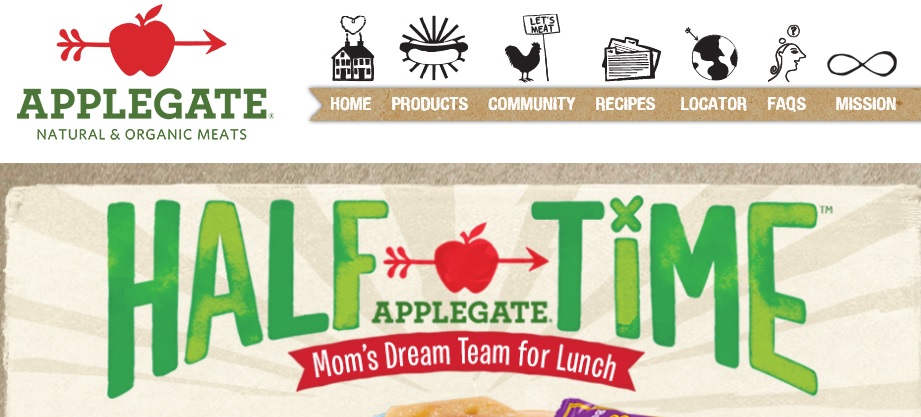
applegateI think we’d all agree that sports involve some measure of teamwork. Even so-called individual sports like golf and tennis have caddies, coaches and often an army of behind-the-scenes aides to help athletes achieve their best.

Applegate could have used their sports analogy quite well in its recent cross-promotion with Stonyfield and Annie’s, but instead completely drops the ball by forgetting one of its teammates.

As we’ve seen so many times before, dads were not just left on the sidelines, they weren’t even invited to play.

Applegate calls their latest pairing with Stonyfield and Annie’s “Mom’s Dream Team for Lunch,” then uses more words to make sure dads really feel the hurt:

  • “We invited Stonyfield and Annies (sic) over for lunch!”
  • “As friends and teammates, we share the same goals.”

Let’s take a look at some of these words that must surely pain dads: invited, friends, teammates, share same goals. Applegate clearly places moms on the team, because this new pairing was already referenced earlier as Mom’s Dream Team for Lunch. Dads on the other hand, as was already established, weren’t even invited.

So, as we decipher this ad further we find that Applegate not only excludes dads, but they classify dads as playing on a different team: dads aren’t friends with Applegate; they aren’t teammates; they don’t share the same goals.

Ouch.

In sports or in business, winning is hard work. But spread around to everyone it lightens the load.

Hopefully Applegate won’t realize that too late, because losing hurts even more.

Mytake on Myworld on Mytime

I once heard someone say that there are no new ideas in marketing, just old ideas being reused over and over again.

Who can really argue with this?mygerber

Today’s version of the already 21-year-old “Got Milk?” campaign is the “Keep Calm” slogan, now printed on a t-shirt near you.

But in this personalized, me-first world, none of that is enough. Marketing must go deeper, right down to the individual user.

Today we have nearly every company tagging their business name with “My” on the front, in an attempt to individualize the customer experience, and make everyone feel like they count through their own separate, customizable world.

The My epidemic is real, and it’s everywhere: My Yahoo, My MSN, MyPanera, MyFitnessPal, My Ebay, My Apple, My Verizon, My Coke Rewards, My Garmin, My Best Buy, My Cloud, My AOL, MyLife, My Starbucks, Myspace, myHerbalife, MyScouting, My American Heart, My Dish, My NASA, myEarthLink, My Wells Fargo Rewards, My Xbox Rewards, My Cub Rewards, myPLACE, My Bayer, MyWedding.

My. Oh. My.

And when exactly did My become a positive word? Starting at a very early age, most parents are trying to rid that term from their toddlers’ language: My toy! My clothes! My cookie!

Even the overused expression selfie – an act which is hardly novel – has connotations of self-absorption.

I long for the day when a company uses the word My in less possessive, more playful sense, such as the motto, “I Want My MTV” or “My Little Pony.”

Customization isn’t anything new. Once upon a time, Burger King offered us their famous “Have It Your Way” campaign of the 1980s. But now it isn’t enough to be talked to, as Burger King once did by telling us we could have it however we wanted it – perhaps a prelude to this growing narcissistic ad world. Today’s companies are obsessed with the notion that customers must want to have it the other way around, as if we the customers are talking directly to the company by calling the shots through our own personal account and unique website.

It seems that no one wants to have it both ways and simply carry on a conversation, despite what companies may claim.

And that includes the ever dad-unfriendly realm of Gerber, who now offers the senseless MyGerber using the distinctive tagline, “For mom. For baby. From the beginning.”

This case of Gerber My disease is tragically comical. After all, there must be a dad or two employed at Gerber somewhere, yet not one of them spoke up to offer the premise that perhaps MyGerber’s tagline should also include “For dads,” too? Aren’t dads involved from the beginning through the conception of their babies?

Perhaps if companies started thinking in terms of “we,” there might be increased dialogue, mutual respect and greater understanding between businesses and customers; the label “we” would by default include dads, too.

It might even give all of us one less key fob to carry, and one less username and password to remember.

Spread the word on Sunbutter

Being a watchdog for the marketing/advertising world is a little bit like being a movie critic. We’re relentlessly trying to evaluate and analyze items we see, and it takes a lot for us to witness someone achieving perfection. We lean toward optimism, but after constant trying of teach an old dog new tricks, we sometimes find ourselves thrust into a position that seems cynical.

When writing about the businesses we see in print or on television, we encounter a quandary: the medium only has so much time and space to offer. We recognize the limitation, but also identify that much is expected and required of the company – the one who has invested sunbutterthousands or millions into its message and people.

A few days ago we came across a TV ad for Sunbutter, a product we use and love. We wrote about their dad exclusion, and Sunbutter immediately entered into a sincere discussion with dadmarketing. They recognized the fact they should be including dads in their slogan, and plan to incorporate them in future ads.

They “got it” right away.

We’re not here to proclaim validation. That is not our mission. Far more important, and the reason we write today, is that a company listened. We didn’t ask them to take our stance, just listen.

They didn’t appease us with a one-time corporate-speak email that they’ll “bring it to the attention of the marketing department.” They didn’t pacify us with promise of a special message-to-come only around Father’s Day. They didn’t set up a patronizing dads-only section of their website.

They simply listened. And we weren’t even expecting change, but that appears to be the direction they’re heading after some genuine, honest and open dialogue.

In short, we salute the people of Sunbutter for their exceptional ability to truly listen to their customers, because we’re one of them.

A good product – which they have – is only part of the equation. Good people is the other part of it. Having both is the sign of a great company with even better things to come.

Coppertone deaf

We’re all in full summer mode, and that means spending more time outdoors. More time outdoors means we’re spending more time in the sun. More time in the sun means we’ll need sun protection.

As we do that, we reach for a brand we know and trust: Coppertone.

Coppertone’s name actually originated from its marketing, when in 1944, a pharmacist invented the lotion to darken tans (henceforth, a “copper”-colored skin “tone”). It really became famous in 1953 when the iconic Coppertone girl was created, whereby a dog pulls down her blue swimsuit and reveals her behind to have a lighter tone than the rest of her tiny body, all accompanied by the slogan, “Don’t be a paleface!”

If you think that slogan has an element of racist tinge, you are not mistaken. Coppertone’s original logo was the profile of an Indian chief. (Don’t feel too bad, Coppertone, you have company.)

Although it wasn’t a permanent fix at the time, at least Coppertone’s ancestors had the decency to lessen the nuances by replacing the Indian coppertonewith the girl. Eventually, the slogan was eliminated altogether, and even her “paleface” and bare bottom disappeared, too.

In later years, the Coppertone girl has been imitated, cartooned and parodied.

And somewhere along the way, I suspect someone – probably another pharmacist – realized darkening a tan isn’t the best thing for your health, so they developed a popular line of sunscreens to protect us. Coppertone was even named the #1 pediatrician recommended brand.

All seemed well in the slather-iffic world of Coppertone until their highly paid marketing geniuses decided to run an ad in the June 2014 American Baby magazine, and then let it fall into the hands of the dadmarketing headquarters.

Coppertone has a history of adapting with the times, but their latest magazine ad reeks of 1953. I love the opening two lines, “You want to let your kids be kids. But you still have to be the mom.”

Yep, if it weren’t for moms, kids would be dying of skin cancer everywhere because dads won’t do it; they’re lazy. That’s exactly the message Coppertone is sending, isn’t it?

But don’t take dadmarketing’s word for it, the rest of the world thinks dads are lazy, too. Go to Google Images and search “lazy.” You’ll find incessant pictures of men sleeping on couches, or watching TV.

Stereotypes die hard.

But then again, so does halfhearted, outdated, behind-the-times ad copy.

Now that’s what I call lazy.