Beware of the unconscious bias

To see food products like Jif and Kix hold on to their timeworn, stereotypical catchphrases — all of it has reached a state of comicality. It certainly suggests absurdity and irrationality. We’re talking about peanut butter and cereal. Those products are specific to moms?

But then there are those items related to babies, and less people seem to notice the exclusionary practices tied to its marketing. Boppies were never invented solely for mothers, but they’re regularly positioned to exclude dads from messaging and thus, demote dads to secondary parental status. Similac offers baby formula – a surefire product for dads if there ever was one – yet its makers go out of their way to reject dads in messaging.

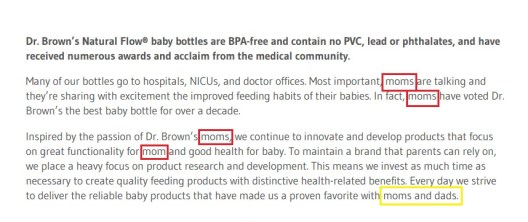
drbrowns4All of this is detrimental to families, of course, because it impedes the family from flourishing as it should without recognizing fathers as equal, competent parents.
Dr. Brown’s can now be grouped with the Boppy and Similac. They’re all products that owe us a little more, that need to try a little harder, that have a responsibility to go out of their way to ensure that dads don’t feel left out. They’re products that should regularly feature dads and speak to them in all that they do.

Go ahead and try to find a single image of a dad on the Dr. Brown’s site. Is there even one? That’s hardly representative of today’s modern families, or even families of yesteryear.

The current actions of companies like Dr. Brown’s, Boppy and Similac would be a little like Lowe’s only using men in its ads and scripting slogans and ad copy that only speaks to that one gender. And imagine the uproar if they did! Rather, they know that home improvement is hardly a gender-specific thing, even though common stereotypes indicate that power tools and outdoor work is supposedly for men.

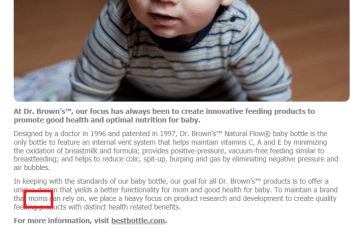
But instead, Dr. Brown’s takes the old-fashioned route and tells us that dads don’t take drbrowns2.jpgcare of babies, or can’t bottle feed, or don’t want to. It’s all very troubling for a company that prides itself on innovation and support. And check out the disconcerting use of moms as a synonym for parent. Sorry Dr. Brown’s, but not all parents are moms, and thus, those terms can’t be succinctly substituted without leaving someone out.

Also take note of its Ambassadors program. Not only does it exclude fathers, it behaves as if they don’t exist.drbrowns5

Dr. Brown’s Twitter bio promises that its focus is “to create innovative feeding products to promote good health and optimal nutrition for baby.” If that’s true, then it’s time to make several revisions to its website and social media.

Dads want to deliver those things, too, and if someone tells him he can’t, he’s going to look elsewhere for someone who believes in him.

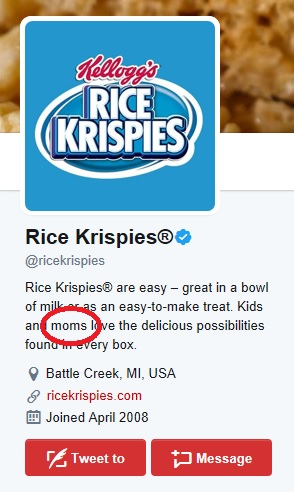
Is Rice Krispies really intended for only kids and moms?

Makers of breakfast foods have long been known for innovation.  New cereal and frozen foods hit the shelves regularly.

But it would seem that not everyone’s invited to the table.

Pick up any cereal box and you’ll often discover a world that speaks only to moms.  Despite all the newfound innovations in the grocery store, marketers remain convinced that the family dynamic hasn’t changed – that dads don’t take care of children, don’t tend to the home, or even spend their morning ritual with the family.ricekrispies.jpg

The Rice Krispies Twitter page reinforces this outdated stereotype with a Twitter bio (right) that excludes dads from the outset.  The exclusion is particularly surprising for a brand that’s well accepted and loved by families everywhere — families which include dads.

Its approach is surprisingly consistent with a few of its iconic shelf mates.  It wasn’t until 2015 that Cheerios changed its webpage touting itself as “Mom’s Choice.”  Kix defers to mom in both slogan and message on every box.  Even the back of Frosted Mini-Wheats exhorts kids to specifically ask mom for more.  And El Monterey has long used the hashtag #momwins throughout its social media.

Our tweets on the Rice Krispies bio recently caught the attention of Kellogg’s, but the communication fell flat when subsequent tweets weren’t returned.  We’re still waiting for what could be a quick fix and thus restore balance to the cereal shelves.

Of course, this particular cereal stretches far beyond the bowl.  The oft-duplicated rice puffs are a virtual kitchen staple, useful in many recipes around the kitchen.  Its Twitter page frequently touts its popular endearing spinoff, the Rice Krispies treat. Even its venerable mascots Snap, Crackle and Pop resonate with everyone.

Given its prowess in our daily lives, let’s hope Rice Krispies can turn things around soon and become close with dads again.

Like super close.

Like white on rice.

Can’t dad use a Boppy?

Last month we came across a thought-provoking post titled “Needlessly gendered products for men.” There’s actually several articles on this topic, so consider reading at least one of them via your friendly neighborhood browser.boppy9

Anyway, that post made us consider the many needlessly gendered slogans which exist, phrases which promote products unnecessarily aimed at one gender:

Jif Peanut Butter – to its credit – is slowly releasing the stranglehold it has on its timeworn phrase, but it’s still hard to believe the CEOs of these companies continue to cling on to these old-fashioned, sexist slogans, allowing their marketers to intentionally discount the viability of at least half of its customer base, particularly with products that have nothing to do with gender.

Alas, peanut butter is no more a feminine product than watching football is intended solely for men.

boppydadBut then you have some products which seem to bemuse our perception, products which have been marketed for so long, positioned in such a convincing way and aimed at a certain audience that we’ve come to believe its use was envisioned strictly for one gender.

That’s certainly the case with the Boppy, which for 26 years has made us believe it is a breastfeeding pillow.  For starters, go ahead and visit boppy.com and notice your browser, which reads “nursing pillow.”

Its website is loaded with mom-only references, and yet you may be surprised to know the product was never intended for nursing.

According to this story, inventor Susan Brown came up with the idea in 1989 when, her daughter’s day care center requested parents to bring in pillows to prop up infants. Brown’s idea for a horseshoe-shaped pillow soon came about, but Brown never invented it for the sole purpose of breastfeeding:

“Now it’s almost embarrassing to admit, but when people started using it for breast-feeding, I was like, ‘Oh, yeah.  Of course,’” she said.

boppy11A brief reflection upon its own history and founding – and a glance at its own latest ad – may encourage Boppy to return to its roots.  Check out the bottom of this ad, where Boppy describes four of its product’s core uses, none of which have to do exclusively with moms (while physical breastfeeding does, general feeding – the word used in the ad – doesn’t).

If a Boppy can do all these things, why exclude dads from its marketing and ignore dads’ contributions to parenting?

Yet it specifically proclaims the Boppy to be mom’s domain.  It’s another unfortunate exclusionary tale which makes us wonder at least four times over:  why not use the word “parent” instead of “mom”?  Replacing that word would no longer alienate dads, it wouldn’t make moms turn the page in revolt, and Boppy would position itself as a true baby product for both parents.boppy12

It’s a little ironic that Boppy references “boy bands” is its clever headline.  Several members of those ‘90s bands are now dads, and rumor has it that some of them even use a Boppy.

What do you say Boppy?  Twenty-six years is a long time, but it’s time to start recognizing both genders as equal parents.

Marketers could learn a lot from the NFL

Statistics and ratings indicate that more men attend, watch and follow the NFL in greater numbers than women.  Take a casual look at fantasy football leagues, and those numbers widen even more.nfl

So if it were the case, you could forgive the NFL for targeting males in its advertising.  But being the wise, billion-dollar enterprise it is, you’ll hardly find its 32 teams (total worth: $63 billion) spending its marketing dollar only where the big money is located.

Rather, it places a strong emphasis on women, and wouldn’t dare make the catastrophic mistake of alienating an important part of its fan base.

So, no, the NFL won’t be unveiling new marketing slogans this season which focus on one gender, such as:

  • Choosy dads choose the NFL (Jif)
  • Kid tested, father approved (Kix)
  • Support for all dadkind (Boppy)
  • Welcome to the brotherhood of fatherhood (Similac)
  • #DadsKnow (Juicy Juice)
  • #DadWins (El Monterey)
  • Created by a dad for dads (Jesben)
  • For dad. For kids. From the beginning. (MyGerber)
  • Good for dads. Awesome for kids. (Capri Sun)

(You might note that none of these items referenced are feminine products.)

The NFL knows how to be popular and prosperous, so currently you see a successful, inclusive slogan like, “Football is Family.”

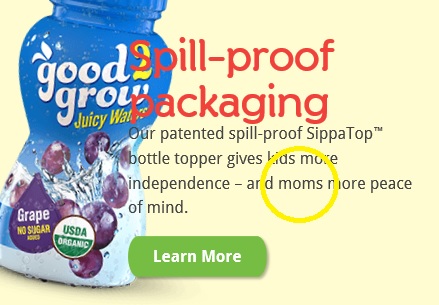
good2growAll of this makes the communication from good2grow so unusual, who claims to be “a family owned and operated company” with “one simple goal—creating wholesome, nutritious drinks in irresistible packaging kids love.”good2grow2

The juxtaposition is unusual, because families include dads, and in general, kids love their dads.  So if good2grow wants to create a product kids love, it should consider the other half of its customer base, which also includes boys, many of whom will eventually become dads.  Right now, it’s not speaking to dads in print, or on its website.

What do you say, good2grow?  Can dads be a part of your team?

Soggy cereal

What exactly does this Twitter bio say about dads? And if you are a dad, what is it saying to you?momsbestcereals1

In our estimation, it’s saying that you don’t count, the company isn’t talking to you, and it doesn’t want your business.

What’s strange about MOM Brands is that it adopted its exclusionary name in 2012. No, that’s not 1912, but 2012 – as in, three years ago!

Jif adopted its discriminatory slogan decades ago, and same for Kix’s mom-centric box, while Similac has been ignoring fathers nearly since its beginning.

But 2012? It’s hard to imagine a company looking so old-fashioned in today’s equality-hungry, politically correct world that strives to include everyone and even blur the lines between, say, toys and clothes. Alas, MOM Brands has found a way to make even cereal buying sexist, because dads apparently do not know best.

What’s equally bizarre about MOM Brands is how they proclaim to have made the name change to reflect “the company we are now. We’ve been family-owned since 1919…” and “We’re really proud of the fact that we’ve saved families over one billion dollars since 2007.”

But don’t families include dads, too?

Apparently not, according to MOM Brands, or it might recognize them by name – or at least on Twitter.

It’s hard to stomach this say-one-thing, do-another corp-speak, especially since MOM Brands seems like a rather progressive group. We admire its innovative packaging that’s helping to keep its cost (and customers’) down. Its variety and tastes are every bit good as the next cereal brand.

But that name. And that Twitter bio.

Both are enough to make dads reach for something else. Chances are, they already have, but it won’t be easy: marketers of the cereal industry seem insistent that only moms have the ability to put breakfast food on the table, and/or mom’s place is in the kitchen.

Alas, cereal makers are stuck in time (see #7).

It’s quite the reversal from the days when pa would gather and hunt for what the family needed.

MOM Brands says it’s taking the saying “’mom knows best’ to the next level,” and perhaps that’s a good thing.

Maybe, just maybe, that “next level” might include dads in the future.

Ashton Kutcher: a dad’s best hope

They say ‘good things come to those who wait,’ but it’s likely Ashton Kutcher never listened.kutcher

Upon leaving the University of Iowa in 1996, Kutcher rose to meteoric fame by immediately modeling, and then landing on Fox’s long-running “That ‘70s Show” by 1998, where he gained his instant stardom.

He appeared in his first film by 1999, and deftly spread his wings by starring in and producing a varied mix of shows, including the clever “Punk’d,” the cult film “Dude, Where’s My Car?,” and the psychological thriller “The Butterfly Effect.”

And his acting accomplishments may seem like nothing compared to his prowess on social media, particularly Twitter, where he became the first user to reach one million followers in 2009.

Yet as he reaches a nearly 20 years of work in Hollywood, Kutcher is taking on his biggest role yet: dadvocate.

Last October, he and Mila Kunis gave birth to daughter Wyatt, and just a few months later, Kutcher had become victim to dad exclusion like so many fathers before him. So, this past March, Kutcher complained about the lack of pubic diaper changing stations on his Facebook page, a post that went viral and caught the attention of a New York state senator, Brad Hoylman (D-Manhattan).

Hoylman’s proposed an amendment would change the New York Civil Rights Act and require many newly constructed or renovated public buildings to provide diaper-changing rooms in men’s rooms where they are also present in kutcher2women’s rooms.

Kutcher, meanwhile, launched a change.org petition intended to have Target and Costco offer changing stations to both moms and dads in their stores.

How this plays out remains to be seen, but for now, both Kutcher and Hoylman should be enthusiastically lauded for their efforts.

With all due respect to our lawmakers and government, Kutcher, in particular, carries a lot of weight and power, and he may be a key figure in putting dads on a rightful equal ground.

However, real change isn’t going to happen in a restroom, it’s going to happen when perception shifts – and that can only occur when principal influences begin to treat dads like they count as much as moms when it comes to parenting.

Those influences are in the marketing and advertising of the products and services we use, in the media which shapes our attitudes, and in how Hollywood portrays the dad character.

As long as Jif Peanut Butter trumps its one-sided marketing slogan, and Kix cereal speaks only to moms, and American Baby magazine employs old fashioned writing that ignores fathers, and writers slap unfair and embarrassing stereotypes on dads which only apply to a minority – and thus we keep reading, and buying and using these products – diaper changing stations for dads will be merely pacifistic tools demanded by law.

And only fathers would see the change anyway; indeed, it would be a welcoming and needed change in law, but only dads would benefit and see the restroom modification.

Instead, if Kutcher could really get to the heart of the matter, and use his influence to encourage others to include dads in positive ways through marketing, media and entertainment, the “#1 Dad” mug he receives from his daughter on his first Father’s Day this June will be more valuable than any acting honor he’s ever accepted.

And letting everyone see it would make for the best tweet ever.

Search your feelings

So many people had been waiting for this weekend all year.

The anticipation was high, many combed the Internet first, and when the moment finally arrived, it was met with great enthusiasm – if not simultaneous screaming heard across the land – at the instant when people were finally allowed to obtain what they desired all along.

The new Star Wars trailer was unveiled.

In my circle of life, I don’t know any mothers who care about Star Wars. There must be plenty of fanmoms out there, but I think it’s a safe bet that they’re in the minority.starwars

The Star Wars culture is especially dominated by men and boys who grew up emulating Luke Skywalker, Darth Vader and Yoda.

Let’s face it, you’re far more likely to find a boy wearing a Star Wars t-shirt than a girl, and theater seats at next December 18’s midnight showings will mostly be males, many of whom dads who will no doubt bring their sons and impart lifelong movie fandom to their younglings.

Yet, is it not interesting how movies like Star Wars don’t try to market solely to dads?

Of course, the film’s inherent aggressive tone will appeal to a more masculine side, but movie marketers aren’t trying to seal the deal with forced pleadings to dad in the same way Jif and Kix think that shopping and feeding children must be mom’s solitary birthrights.

A mega-successful franchise like Star Wars certainly has its chances.

For sure, its movie marketers have multiple opportunities to play the father-son card with Luke Skywalker supposedly taking on the wise Obi-Wan-type master role, its interminable Jedi master-student themes, and the ever-quotable “I am your father.”

Rather, Star Wars appeals to everyone with a trailer that does not disappoint and leaves fans of all genders and parental entities feeling a part of the Force.

This Black Friday will go down as the best in history thanks to Star Wars, for it didn’t even involve the overused and illogical term doorbusters, nor did it disrupt and creep into anyone’s Thanksgiving.

And Star Wars didn’t make dads look or feel like turkeys.

An unfair lady

You may have noticed the recent headline about the University of Tennessee athletic department dropping the “Lady” volunteersportion of its Volunteers nickname from all sports, except basketball.
I vividly remember the first time I was introduced to the word lady and its association with a sports team – at my local high school. Frankly, I couldn’t believe my eyes, and I had questions. Lots of them.

Why was a girls team purposely making themselves out to be different than the boys (and as a result, giving them a lesser-than feel) by putting this unnecessary word on their jerseys?

Did the athletic director or the coach dream up this humiliating way of separating the girls from the “official” sports teams otherwise known as the boys? (That was the message it appeared to send to myself, and others.)

At the very least, why couldn’t they be identified as girls, instead of such a formal word like lady, which really has more of an adult connotation?

Why use a prim and proper term like lady anyway? That implies refinement and politeness, hardly qualities I’d want in a sports team. (Then, that made me wonder if, during games, these female athletes would really sweat, or rather glow?)

And, treating all things equally, why then, didn’t the boys team use the moniker “gentlemen” on theirs?

It was as if the girls team was intentionally signaling everyone in attendance with a madcap scarlet letter and caution label right on their jerseys: no, we’re not the real sports team, we’re just the ladies sports team. If you want to see the official sports teams, you’ll have to watch the main event, the boys.

I’m all for recognizing two different genders and giving each their due, but this deliberate separation by way of a simple term left the entire situation feeling so unnecessary, cruel, unfair and demeaning.

The Academy Awards doesn’t call it a Lady Oscar for the actress; it’s just an Oscar.

We don’t have teachers, and lady teachers.

There aren’t parents, and lady parents.

All male cats aren’t just cats, with the others being called female cats.

Sure, there’s still plenty of absurdity in our world. Seeing a female city council member categorized as a councilman looks as inane as it is literally inaccurate.

Yet even other parts of the sports world have been slow to embrace equality. Despite the effects of Title IX, sports has taken a long time to get with the program.

For example, why must the men’s NCAA basketball logo be branded “Final Four” while the women’s logo states, “Women’s Final Four”? Shouldn’t the former be called “Men’s Final Four,” making all things uniform?

And speaking of uniforms, isn’t that what sports clothing is supposed to do – make things alike, as in unified? If you let one team wear “Volunteers” on a jersey, and their counterpart wear “Lady Volunteers,” does that really send a message of togetherness and harmony among the entire Tennessee athletic department?  And its women’s teams even have their own blue accent color to create a further divide.  Talk about a silent, unspoken rebellion.

Then you have the NBA. Yes, the NBA came first, but why is the women’s league deemed the WNBA? Shouldn’t the men’s league be rebranded the MNBA, or at least give the women’s league a name with a less secondary feel to it, such as the Liberty Basketball Association, or American Basketball Association?

What about the PGA vs. the LPGA? Are not the women golfers of equal stature? The “L” makes it seem like the lesser league that it’s not. When Michelle Wie played on the PGA tour from 2004-2008, did it not seem like the media had promoted her to the main/real/top league? NASCAR doesn’t have a special WNASCAR for female drivers like Danica Patrick.

What surprised me the most about Tennessee’s announcement was how some former female athletes felt they were losing their identity with the loss of the word lady.

Those athletes might read this post and charge us with political correctness gone too far. But this has nothing to do with political correctness. The term “PC” describes the attitude of being careful not to offend any group of people in society believed to have a disadvantage.

One could accurately argue that women have disadvantages in a variety of ways, but using the nickname Lady Vols certainly doesn’t create any advantage; it belittles, demeans and unnecessarily separates.

I suspect the athletes, fans and those around Tennessee athletics had become desensitized to a term that was so commonplace and deeply rooted in sports culture at their university. The winning ways of the successful hoops team no doubt made it famous and celebrated.

The term had grown and became its own separate brand with no one ever stopping to question how silly it looked in the first place. Can’t see the forest for the trees, kind of comes to mind here.

It’s a bit like Jif’s “Choosy Moms Choose Jif” saying, or Kix’s “Kid-Tested, Mother-Approved.” Frankly, I’m surprised more dads aren’t up in arms over them. But both moms and dads have probably become deadened to the phrases. Those old-fashioned sayings have been around for decades and after all, many people enjoy the products anyway, so the slogans go unnoticed, and in the if-it-ain’t-broke-don’t-fix-it vein, most really don’t ask questions.

But questions are important.

As for my original questions, no one’s really ever been able to succinctly answer them. I doubt anyone associated with Tennessee can either, especially those who strangely want to continue with the Lady Vols nickname for basketball only.

But our country was founded on dignity and equality, and dadmarketing will keep searching for it in our corner of the world.

We hope the folks at Tennessee do in theirs, too.

Pillow talk

If you’ve never heard of a Boppy, it’s a unique product that was originally created as a baby support pillow, but also can be used to prop a baby during feedings.boppy

The concept is wonderful, and during its brief history has enjoyed a great deal of national publicity through TV shows, magazines and celebrity plugs.

The company appears knows a thing or two about creating a good product that works, but when it comes to marketing, they’re one of the worst offenders we’ve seen when it comes to some serious, major league dad omission.

In the Boppy’s world, dads are not present, plain and simple. Mothers should be greatly offended by this extreme, unwarranted dad exclusion, for it’s their husbands whom Boppy is shunning. Let’s take a look at how they reached this woeful state.

Slogan

Support for all Momkind? We could see a motto like this making the grade, even being somewhat acceptable, at least two or more generations ago. Take Jif and Kix – it’s not like their slogans are proper or right or appropriate, because they remain 100 percent offensive and outdated. But even though they’re both like the Washington Redskins (refusing to change out of stubbornness) at least those old school slogans were born during an era when saying those things might have been customary once upon a time (like using a name such as Redskins).

The Boppy was invented in 1989! How can a company actually make this an official slogan in this modern era, let alone copyright it, all against better judgment in a world that demands equality? Boppy manages to downgrade fatherhood with a simple four word slogan, if not completely banish it, from their one-sided marketing mission. That’s one giant leap backward for all of humankind.

Mom Center

Here we have yet another website with a “moms-only” section. We get the fact that men and women are different as parents, but why exclude dads? Can’t dads feed babies with Boppies, too? Sure they can.

We’ve sent similar thoughts to other companies who respond with things like, “Yes, dads are our heroes too and we’ll take a look at it,” or “Check out this special dad section we created for Father’s Day.”

Why a special section? Why do something only once a year when the calendar tells you to think of dads in June? How about just calling it a “For Parents” section?

25th anniversary

Take a look at the “25 Years!” menu tab on the website, which doesn’t invite dads to the celebration in any way. There you’ll find a giant photo of mom with baby and the script, “We’re celebrating 25 YEARS of supporting mom & baby.”

As long as Boppy thrives on stereotypes, we’ll offer one as we pose this question: if dads are supposedly the providers and earned the money to buy the Boppy, can’t the company at least acknowledge this notion and offer a simple “thanks” for purchasing it in the first place?

Apparently not, because…

There are no dads anywhere

You can’t find even one dad photo anywhere at boppy.com, unless you consider the degrading drawing of ignorant Abe Lincoln putting the Boppy on his head like some clueless dad. And no, we don’t count the guy in the Martha Stewart photo or the two male employees – who knows if they’re dads? We’d like to see an even 50-50 ratio of dad stock photos with moms.

Aren’t dads equal parents, too?

Would Lowe’s or Home Depot ever dream of featuring all dads/men on their site accompanied by a sexist slogan like, “Support for all dadkind”? Of course not, there’d be a mom uprising, and rightly so. It wouldn’t be right.

So why does Boppy get away with it the other way around?

All the baby boys pictured on the site had better enjoy the attention while they can, because they’ll be ignored and forgotten the moment they become fathers by the very company who once featured them.

The numbers don’t lie

Boppy claims to be “beloved by over 15 million moms worldwide!” That’s an amazing statistic which should make Boppy very proud. But you know how many dads (who are potential customers) they’ve managed to ignore?

About 15 million.

Cake loss

Trying to rid the world of dad exclusion regarding anything kitchen related is like asking a Kardashian to stay away from a camera lens.

It’s a challenge, but dadmarketing came into being just for this.

(The dad stuff, not the Kardashians.)bettycrocker2bettycrocker1

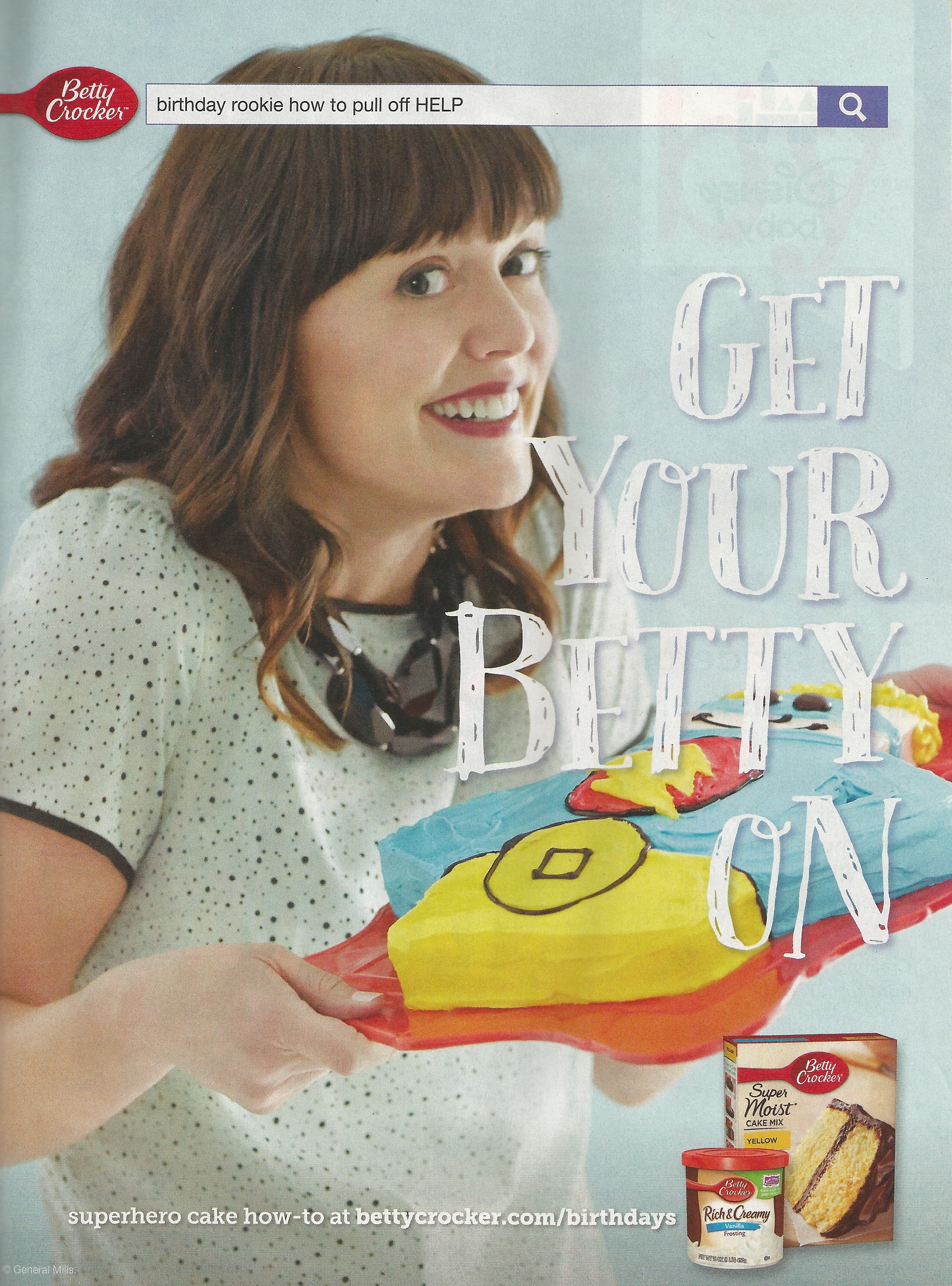
Our latest offender is Betty Crocker, which should not come as all that surprising. But what is surprising is how Betty Crocker did it, and so very unnecessarily.

A quick look at the ad reveals nothing glaringly wrong. There aren’t any Kix-like, dad-excluding slogans plastered front-and-center. There aren’t any “Attention Mom” banners adorned at the top. The word “mom” really isn’t anywhere noticeable.

For a few brief moments we were actually overjoyed about the possibility of a column lauding Betty Crocker for not pushing the “baking is only for moms” agenda.

But then we read the fine print.

If you took the time to dig all the way through this copy-heavy, two-page spread from the September 2014 American Baby magazine, you’ll find that it’s really not directed at dads whatsoever, because Betty Crocker assures that after a day of baking, “you will look like Wondermom!”

How’s that for a red-spooned slap in the face, dads?

You see, venerable Betty Crocker, you may be surprised to know that some dads like to bake for their families. Dad doesn’t come home from work with mom waiting there and hot food on the table like it happened a few generations ago. What’s more, boys like to bake too, and you could learn a lot from Hasbro, makers of the Easy Bake Oven, who developed a boy-friendly version of their classic toy after one young girl simply spoke up.

Betty Crocker has been around for almost 100 years, and has been moderately progressive in modernizing their female likeness over time. But their treatment of dads in today’s modern world where fathers clearly do more than past generations makes them look stuck in the past.

No one should know better than Betty Crocker how the tiniest ingredient can alter an entire recipe. That’s exactly what happened in BC’s latest ad blunder.

We’ll be surprised if we ever hear from Betty Crocker, seeing how they’re operated by General Mills, makers of two of the most dad unfriendly brands around: Cheerios and Kix. We’ve tweeted them before, and they’ve ignored us like a stale cookie crumb.

Still, we’ll keep trying, because a small change in marketing approach would require “no superpowers needed,” and then we can all celebrate together with a Betty Crocker dessert.

Until then, we’ll just keep using another brand actually created by a man who knew a thing or two about cakes.