
 We recently met a couple expecting their first child, who received a nice little starter gift in the mail – a free trial pack of Similac formula. They’re not sure exactly how they obtained it, but suspect the address-sharing-snowball-effect commenced once the couple merely signed up for a baby registry.
But they didn’t care how it happened, they were thrilled.
Three canisters of Similac formula might not seem like much in the scope of a baby’s life, nor will it last terribly long when the child starts devouring bottles every five minutes. However, with the cost of formula being a small fortune, the package was a welcome surprise, and a classic example of product sampling.
The whole experience was a win-win for both the parents and Similac.
Or was it?
As the father happily dug through the box and its enclosed Similac literature, he felt his Daddy-Sense tingling.
What he noticed was something quite curious about the entire package as a whole. What he noticed was – it wasn’t for him.
It was for his wife.
He doesn’t recall whose name was on the address label. That didn’t matter. What mattered was its message.
Similac had sent this wonderful surprise, a sample package of its valuable products to this first time excited couple, yet Similac couldn’t have cared less whether the dad was in the picture or not.
Never mind the fact that this dad is to be every bit as responsible as the mom for raising this child. Or that the dad cares very much about what he’ll be feeding his child. Or that neither parent possesses any more instinctual ability than the other to rear this child. Or that the dad plans to personally shop for formula in stores and online. Or that in this particular case, the dad’s salary will provide the sole means to purchase this very product.
Or never mind that – and here’s the real kicker – from a pure marketing perspective, baby formula is intrinsically built-in for dad use. Yes, we’re not sure why Similac needs us to point this out, but guys can’t physically nurse children. To be sure, Similac should be pushing its product with dads every chance it gets. They are arguably Similac’s most prized and integral customers!
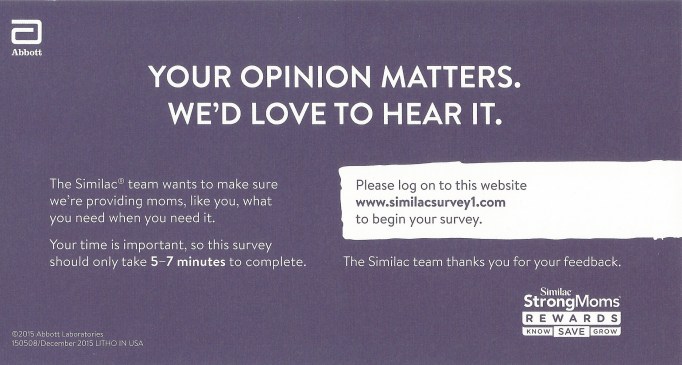
Rather, this dad had to open the package and find literature, such as the featured card, which paradoxically wants opinions.
Just not his.
That point was reinforced in the card’s opening sentence, where it mentioned only mom by name, as well as the ‘StrongMoms Rewards’ logo at the bottom.
This shaky attempt at quantitative data essentially leaves the search out of research, whereby Similac ignores a whopping half of the parenting duo by making dads transparent. All this, despite this and every dad’s shared ability to mix formula in a bottle, yet have no physical means to breastfeed.
It’s another frustrating dropped ball from the marketing team at Similac, which sadly, we’ve seen before.
The whole experience is a massive Simi-lack of judgment.

 Which brings us to the

 Though Fatherly came into existence around two and a half years ago, the site launched just last April as a go-to source for all things ‘dad.’ It made an instant splash when it unveiled its “
 Plum notes that 75 percent of working parents are unhappy with their work-life balance, but are afraid to bring it up at the office, and, almost one in three parents have even faked being sick to meet a family obligation. As such, Rothman is proud of a campaign that talks about an issue which really wasn’t discussed head-on before, even as recent as 10 years ago.
 We’re seeing a striking similarity with Dr. Smith’s latest ad, and ads from yesteryear that would be deemed offensive today.
 Hyland’s has been making safe and natural homeopathic medicines since 1903, and after a quick look at its latest magazine ad, seems to be rather dad-friendly. It’s nice to see a dad featured prominently in its ad.
 Hyland’s talks about party invitations
  Companies like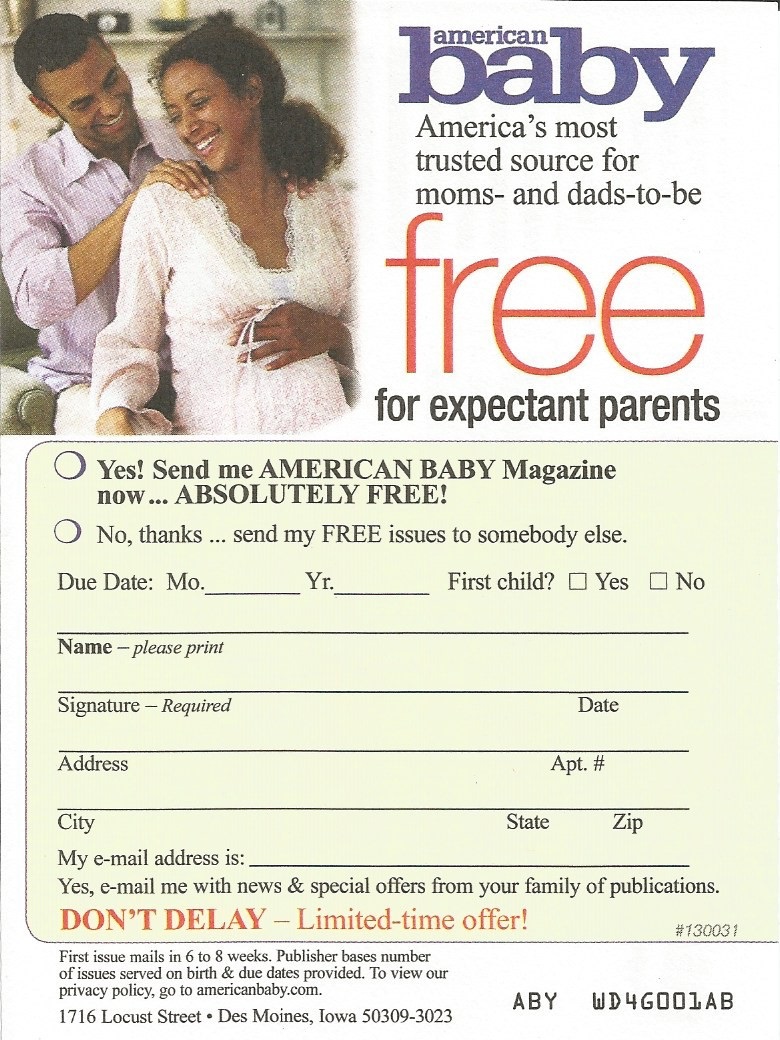

 dadmarketing