You may look like a dad, but we’re going to call you a mom

similac13It would’ve been great to be a fly on the wall when the male model (featured in this ad) got the call from his talent agent to appear in this Similac magazine ad:

Agent: How’s my favorite client?
Model: I’m good.
A: Great news – I landed you a new photo shoot for a parents magazine ad.
M: That’s cool. What’s the company?
A: Similac.
M: Similac?
A: You know, they make baby formula.
M: Oh, right.
A: Anyway, they want you to appear in a grocery store aisle holding a cute little baby.
M: Simple enough.
A: But there’s one catch…
M: What’s that?
A: They want to call you a mom.
M: (Momentary pause) A mom? But I’m a guy.
A: I know, I know. You’ll still be playing the part of a dad, but you see, their tagline is “Welcome to the Sisterhood of Motherhood.”
M: But dads aren’t moms.
A: True, but Similac likes to use “mom” as a synonym for “parent.”
M: (Awkward silence) But isn’t baby formula the perfect product to sell to dads, especially since they can’t breastfeed?
A: Right again, but they don’t need dads as customers.
M: Why not?
A: Because they say only women take care of kids and shop.
M: But I shop.
A: You’re single. When you get married and have kids, you don’t shop anymore. That’s a mother’s job.
M: That seems kind of sexist.
A: But Similac is paying you big money to look and act like a dad. (Awkward silence) They just want to call you a mom.
M: Now it all makes sense. Where do I sign?

Once again, Similac takes the shared role of parenting and needlessly genders its product – thus turning it into a mothers-only thing. It’s all the more troubling because they (gasp), used the word “parent” twice in its ad copy, only to follow up with its obdurate tagline. It concludes with a partisan invitation for only moms to converse further on social media.

The ad looks even more abnormal when you consider its “sisterhood” theme of supporting the choice between breast- and bottle-feeding – and then reflect on the same underlying “choice” theme in this particular heading – with a dad included. Breastfeeding and a dad?

We like to think that, at some point, Similac will discontinue this madness of posing dads in ads and calling them mothers in a sisterhood, but it has company when it comes to miscasting roles.


‘Choosy moms’ no more at jif.com

jif11In a move that can only be classified as ground-breaking and revolutionary, Jif Peanut Butter has removed its long-standing slogan – “Choosy Moms Choose Jif” – from its website, jif.com.
It’s a surprising and stunning development to be sure, where use of an old-fashioned, exclusionary, yet seemingly notable catch phrase is no longer being employed – at least on its website.

What this means for the future of the slogan’s long-term use is unclear.  So far, there’s no acknowledgement of the removal anywhere from Jif, or from its parent company, Smucker’s.

For decades, the phrase has sent a message to dads that Jif isn’t speaking to them, and for moms has implied that it’s their job to shop and cook.  Of course, with those parenting roles and stereotypical responsibilities having changed long ago, it appears that Jif is finally either succumbing to social pressure, or simply doing what’s right.  Either way, it’s an overwhelmingly positive move for Jif, who’s finally catching up with the times.

We’ll keep on top of the situation.  For now, it seems to be a strong step by Jif to make dads finally feel like a part of its product and messaging.


Can’t dads put sunscreen on kids?

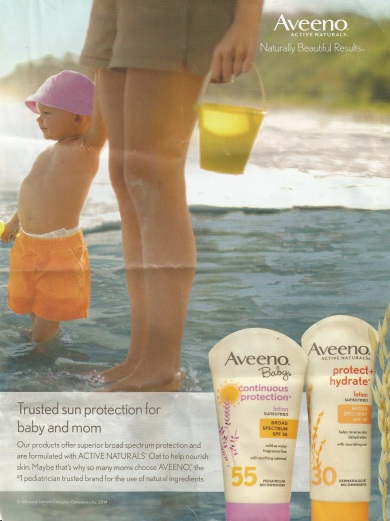
aveenobaby2It’s ironic how there are some who admonish dads for their lack of parental involvement, and some who spend their time furthering that notion through advertising.

Take, for instance, this parent magazine ad for Aveeno Baby, produced by a company who believes that it’s only mom’s duty to handle a child’s skin protection.  That company may argue that “market research indicates…” or “readers prefer…” or “our focus groups suggest…” – but the fact is that it’s furthering a perception which is unfair, sexist and wrong.

Dads shop.  Dads parent.  Dads care.  And, well, dads apply sunscreen.

If you aren’t bothered by this chauvinistic ad, you should be for more reasons than one.  Not only does it disregard and intentionally exclude dads, it also uses the image of a boy to sell its product, the very product that will one day ignore this same boy should he become a father someday.  Spouses, too, should be bothered by this gender annexation:  that person they’re ignoring is your partner, your equal, your helpmate in this adventure called parenting.

Interestingly, last week we received a note from @KnowYourObama, who said, “Marketers don’t market to dads as parents because, mostly, they’re not.”

There’s no telling why this person believe this, but we wanted to chat a little more, and the following brief conversation ensued:

@dad_marketing:  “I think you might have offended Obama, plus a lot of other dedicated dads.”

@KnowYourObama:  “Obama’s a good dad, yes. But good dads – dads – are hard to find. Yay for the good ones.”

Here at DM Headquarters, we have no hard data to prove that there are more dedicated dads than uninvolved dads, but there should at least be some protection against libel, or perhaps some rules which guide what marketers can or can’t say.aveenobaby

Marketing departments have been saying or doing whatever they wanted for years, sometimes with little adaptation for societal changes – all in the pursuit of the almighty dollar.  It takes some real honorable companies to take a stand and do what is right and not just offer lip service (check out Jif-maker Smucker’s, and its “promise” page).

And who – you might ask – makes Aveeno Baby lotion?  None other than Johnson & Johnson, who has a history of waffling on gender equality.

To quote a word from Aveeno’s own ad, parents (dads included) have “trusted” Aveeno Baby and Johnson & Johnson for years.  When will that trust be returned?

This boy will someday be ignored by the very company using his likeness

garanimals4Do you see that cute little boy?  He’s been used.

Used by a company that was only in need of his smiling face, and then, will be ignored the moment he becomes a dad someday.

But don’t take our word for it.  Check out the Garanimals website, which uses parents and moms interchangeably like synonyms.  Of course, moms are parents, but one word refers to both genders of parents, the other only female parents; expressly mentioning moms and leaving out dads, as it did on its company website and in this print ad, purports mom to be the lead parent, the one who handles the shopping, the one who dresses kids, the one who takes care of kids alone.

That’s unfair.  That’s wrong.

It’s yet another unfortunate example of a company ignoring fathers as equal parents, and it has to stop.

Yes, that boy is smiling now, but someday he may be holding a child of his own.  He might even end up flipping through the pages of a parents magazine, encounter a Garanimals ad and then wonder, “I guess I only existed when that company needed something.”

And he might even use another company for his child’s clothes.

So in the end, this ad was not very, well, useful.

Marketers could learn a lot from the NFL

Statistics and ratings indicate that more men attend, watch and follow the NFL in greater numbers than women.  Take a casual look at fantasy football leagues, and those numbers widen even more.nfl

So if it were the case, you could forgive the NFL for targeting males in its advertising.  But being the wise, billion-dollar enterprise it is, you’ll hardly find its 32 teams (total worth: $63 billion) spending its marketing dollar only where the big money is located.

Rather, it places a strong emphasis on women, and wouldn’t dare make the catastrophic mistake of alienating an important part of its fan base.

So, no, the NFL won’t be unveiling new marketing slogans this season which focus on one gender, such as:

  • Choosy dads choose the NFL (Jif)
  • Kid tested, father approved (Kix)
  • Support for all dadkind (Boppy)
  • Welcome to the brotherhood of fatherhood (Similac)
  • #DadsKnow (Juicy Juice)
  • #DadWins (El Monterey)
  • Created by a dad for dads (Jesben)
  • For dad. For kids. From the beginning. (MyGerber)
  • Good for dads. Awesome for kids. (Capri Sun)

(You might note that none of these items referenced are feminine products.)

The NFL knows how to be popular and prosperous, so currently you see a successful, inclusive slogan like, “Football is Family.”

good2growAll of this makes the communication from good2grow so unusual, who claims to be “a family owned and operated company” with “one simple goal—creating wholesome, nutritious drinks in irresistible packaging kids love.”good2grow2
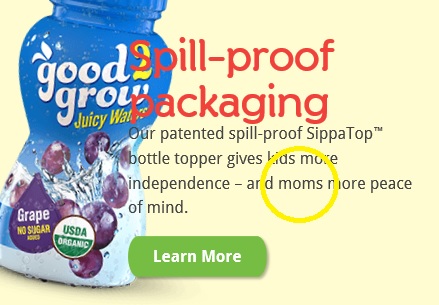
The juxtaposition is unusual, because families include dads, and in general, kids love their dads.  So if good2grow wants to create a product kids love, it should consider the other half of its customer base, which also includes boys, many of whom will eventually become dads.  Right now, it’s not speaking to dads in print, or on its website.

What do you say, good2grow?  Can dads be a part of your team?

The most exquisite folly is made of wisdom too fine spun

elmonterey7How many contradictions can one company make in a single email?  We came across this promo recently, and it’s hard to decide which of these items offers more incongruity:

  • Quoting Ben Franklin – a father – and then saying that its product is a wise choice only for moms?
  • Using a quote whose original use employs the word “man,” and then disregarding that same “man” in its promotional hashtag?
  • Using the term “kids” in the ad copy instead of just “girls”?  Because after all, El Monterey will eventually disregard the boys (who are among those kids) when they become dads.
  • Assuming that Ben Franklin would’ve loved El Monterey burritos, when even as an adult in modern times, he couldn’t have made the pick to buy them.  Clearly, according to El Monterey, it would’ve taken his own mother to choose them in the store for him.

Of course, the startling, underlying theme for El Monterey once again, is that a mother’s place is in the kitchen.  Otherwise, there would be no other reason to continue to snub dads, who certainly must be capable of microwaving a frozen food product.

And also, of course, El Monterey caps off the email promo with its #momwins campaign, which essentially leaves no one as a winner:  mom is typecast as the one who cooks, dad loses by way of exclusion.

The disappointing insistence of this El Monterey old fashioned marketing push leaves us hungry for another burrito maker, one that is thus, all the wiser.

Is Babies R Us starting a trend?

babiesrus3Ahhh, yes – car seats.

If there’s one item dads have no business meddling with, it’s the car seat.  Leave that up to mom, marketers say, because they’re the ones who will be shuttling baby along to appointments, shopping trips and day care centers.  Dad doesn’t even visit baby stores, and when he tries, it turns into utter chaos, right KSN?

But is this trend changing?

babiesrus4Here we have an email ad from Babies R Us, who doesn’t just give dad his due once, but twice – and almost exclusively by way of hiding a mom in the fuzzy background.  This wasn’t necessary, but it certainly sends a strong message as to who this store wanted featured in its marketing.  To be sure, we’ve seen plenty of mom-and-dad photos before, but this ad almost wholly features dads.
Babies R Us proves that dads belong in baby ads, and that they parent, too.  It isn’t afraid to buck the old fashioned trend that it formerly perpetuated, when we wrote about its Big Baby Book.

However, that was almost two years ago, so we’ll ask it again:  are things changing for the better?

We like to think so, and kudos to the creative team at Babies R Us for its inclusion of dads as the rightful parents they are, substantiating the fact that dads shop and parent, too.

Your opinion matters! We’d love to hear it! Sort of…

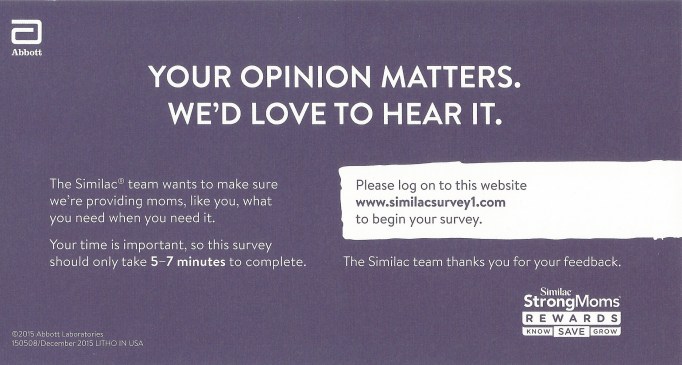
similac12We recently met a couple expecting their first child, who received a nice little starter gift in the mail – a free trial pack of Similac formula.  They’re not sure exactly how they obtained it, but suspect the address-sharing-snowball-effect commenced once the couple merely signed up for a baby registry.

But they didn’t care how it happened, they were thrilled.

Three canisters of Similac formula might not seem like much in the scope of a baby’s life, nor will it last terribly long when the child starts devouring bottles every five minutes. However, with the cost of formula being a small fortune, the package was a welcome surprise, and a classic example of product sampling.

The whole experience was a win-win for both the parents and Similac.

Or was it?

As the father happily dug through the box and its enclosed Similac literature, he felt his Daddy-Sense tingling.

What he noticed was something quite curious about the entire package as a whole.  What he noticed was – it wasn’t for him.

It was for his wife.

He doesn’t recall whose name was on the address label.  That didn’t matter.  What mattered was its message.

Similac had sent this wonderful surprise, a sample package of its valuable products to this first time excited couple, yet Similac couldn’t have cared less whether the dad was in the picture or not.

Never mind the fact that this dad is to be every bit as responsible as the mom for raising this child.  Or that the dad cares very much about what he’ll be feeding his child.  Or that neither parent possesses any more instinctual ability than the other to rear this child.  Or that the dad plans to personally shop for formula in stores and online.  Or that in this particular case, the dad’s salary will provide the sole means to purchase this very product.

Or never mind that – and here’s the real kicker – from a pure marketing perspective, baby formula is intrinsically built-in for dad use. Yes, we’re not sure why Similac needs us to point this out, but guys can’t physically nurse children.  To be sure, Similac should be pushing its product with dads every chance it gets.  They are arguably Similac’s most prized and integral customers!

Rather, this dad had to open the package and find literature, such as the featured card, which paradoxically wants opinions.

Just not his.

That point was reinforced in the card’s opening sentence, where it mentioned only mom by name, as well as the ‘StrongMoms Rewards’ logo at the bottom.

This shaky attempt at quantitative data essentially leaves the search out of research, whereby Similac ignores a whopping half of the parenting duo by making dads transparent.  All this, despite this and every dad’s shared ability to mix formula in a bottle, yet have no physical means to breastfeed.

It’s another frustrating dropped ball from the marketing team at Similac, which sadly, we’ve seen before.

The whole experience is a massive Simi-lack of judgment.

Is laundry only a mother’s job?

Laundry.  It comes in heaps and never stops, and this week we found a few items in need of a good washing.

First, let’s take a look at the latest Arm & Hammer ad, which offers something both endearing and cautionary about the way it positions its brand.armandhammer1

On one hand, A&H takes a clever, charming approach by using generational ties as laundry solutions.  We can certainly appreciate the appeal of doing things the way our parents did them.  Passing down advice from one generation to another offers a timeless sentiment that pulls at our emotions.  That aspect is nice.

But on the other hand, with piles of laundry comes great responsibility.

That laundry room in your home – yes, that one over there – must be handled with extreme caution.  It’s dangerous to assume that it’s mom’s domain. That would be inconsiderate, old-fashioned and passé, sort of like saying a mother’s place is in the kitchen.  Frankly, it would have been better had A&H had not even gone there and employed this motherly theme.

We acknowledge that sometimes an idea can be too good to pass up, but that doesn’t mean you still can’t.  Look at the incongruity the New York Times offers in name with its Motherlode section – a section which supposedly covers the issues of parenting.

So, by A&H using mom as the focal point, we’re all led down a path to believe that laundry is the mother’s duty.  That creates perceptions that aren’t necessarily true, especially in today’s modern, dual-income, gender-lines-have-been-blurred, and everybody-takes-on-different-roles world.

ariel1Which brings us to the peculiar ad unveiled by Indian detergent maker Ariel.  In it, Ariel offers an apology to moms everywhere, on behalf of dads, for guys not helping with the laundry.

Admittedly, we’re somewhat ill-equipped to analyze this ad, as we have no awareness of Indian culture.  However, for the purposes of this column, we’ll probe within an American context.

The Ariel ad is admirable for encouraging everyone to help around the house, but sadly, it’s at the expense of dads.

Once again, dads are made out to be the bad guy – the lazy spouse – and coerced into apologizing unnecessarily.  Let’s put this ad in perspective:  you have to remember that in days past, when the dad traditionally went to a job all day and was the sole breadwinner, it was the mom’s duty to run the household – and there’s nothing wrong with that scenario even today.  Both roles contribute to a family and household, even if they’re held by opposite parties nowadays.  No job is more important than the other.

The older father in the ad shouldn’t have had to apologize for anything, unless he wasn’t carrying his load and doing his part in life.  The younger father in the background, clearly isn’t – at least for the brief period shown in this elongated ad.

A&H curiously has an ad of its own, and not once is a male of any age shown.  Perhaps these laundry detergent makers could have compared notes, rather than send conflicting messages that only leave dad caught in the middle of two contradictory campaigns:  one that puts dad at fault, another that says it was never dad’s job in the first place.

So when the A&H ads are stacked up next to Ariel’s apologist campaign, it’s more than a little disconcerting to see the commercial’s closing question:  “why is laundry only a mother’s job?”

I think we all know the answer to that question:  it’s not.

But, maybe, just maybe, that question is better posed directly to A&H.

Tell us, A&H, why is laundry only a mother’s job?

Plum Organics and Fatherly inspiring parents who struggle with work-life balance

Being a dad has never been easy, and today’s father might deal with more than any generation in the past.

Consider just a few of the conditions affecting dads nowadays:  kids’ desires for unlimited access to social media websites, the seemingly slippery slope of sexualized media, incessant materialism, shifting economies, and the constant worry of violence in schools, if not everywhere.fatherly2

It’s a nonstop pace of life with which dads can hardly keep up.  Today’s plugged-in world might offer pockets of freedom here and there, but the sad trade-off is the expected work accessibility, no matter the time of day.

It hardly lets them have time to be, well, dads.

And that’s when the experts of Plum Organics and Fatherly decided to team up to take a close look at the work-life balance in relation to Plum’s successful Parenting Unfiltered campaign.

“Starting with our ‘Chief Dad’ and co-founder, Neil Grimmer, and bridging to other dads like me, we have in leadership roles at Plum today,” said Ben Mand, SVP marketing and innovation, Plum Organics.  “Plum has a long history of advocating for caregiving, hands-on working dads everywhere.  So when we decided to tackle work-life integration for Parenting Unfiltered, Fatherly, through their unique focus on millennial dads, was the perfect partner.”fatherly1

The two entities are using the award winning #ParentingUnfiltered campaign – found notably at parentingunfiltered.com – to shine a light on the challenges surrounding work-life integration.  Both believe the topic affects their brand, their consumers and American families.

“Together, we hope to inspire parents – particularly fathers, who struggle to be valued as caregivers both at home and at work, to take the filter off,” said Mand.  “We want to catalyze candid discussions about what we can all do (as spouses, colleagues, employees, employers) to make the landscape better for everyone.”

fatherly3Though Fatherly came into existence around two and a half years ago, the site launched just last April as a go-to source for all things ‘dad.’ It made an instant splash when it unveiled its “50 best places to work for new dads,” garnering stories with several national media outlets, including USA Today and others.

But it was Fatherly’s unique focus on millennial dads that offered the perfect match for Plum’s campaign.

“(Plum Organics) told us about their Parenting Unfiltered campaign, which struck a chord with us,” said Mike Rothman, co-founder and CEO, Fatherly.  “It was a real authentic voice with a sense of unvarnished truth. They were looking to portray all the messier moments in parenting.”

The partnership’s different facets explore the complex state of working parents in America, which includes an ethnographic report; expert interviews with Stew Friedman of Wharton’s “Work-Life Integration Project” and Anne Marie Slaughter, author of the viral article “Why Women Still Can’t Have it All”; and, videos featuring an array of working parents from the street, each with poignant personal stories.

Slaughter’s article was originally printed in The Atlantic, and turned out to be the most popular article it has ever published.

The partnership has already surfaced some fresh, unfiltered thinking and actionable solutions that’ll help dads everywhere get to a better place. Some companies are already looking at more family-friendly work policies.

“The results were really inspiring and challenging,” said Rothman.  “We’re looking at the nitty-gritty to broader issues.  It’s a really amazing conversation. In that sense, we were able to take this content online into the real world.  There are people struggling with these issues.”

plumorganics3Plum notes that 75 percent of working parents are unhappy with their work-life balance, but are afraid to bring it up at the office, and, almost one in three parents have even faked being sick to meet a family obligation.  As such, Rothman is proud of a campaign that talks about an issue which really wasn’t discussed head-on before, even as recent as 10 years ago.

“There are a lot of companies who realize this isn’t just good marketing and communications, this is good for the bottom line of the company,” Rothman said.  “Friedman has been able to prove that this isn’t just a marketing issue – you’ll improve your company.  That’s part of the conversation that needs to happen.”

Rothman also notes that the way dads are portrayed in marketing and advertising is improving.

“Brands are wisening up,” he said.  “Increasingly, it’s no longer just mom, it’s talking about parents.  Marketers are catching themselves when they’re talking about just moms, because it’s about dads, too.”

For now, both Plum and Fatherly are excited to change the way parents look at work and how it affects their families.

“There’s a lot of legs to look at this in different ways,” Rothman said.  “I would expect to collaborate with the Plum folks to take this campaign a bit further.  It is really great for us because there aren’t as many (companies) that are as progressive as Plum.”