Search your feelings

So many people had been waiting for this weekend all year.

The anticipation was high, many combed the Internet first, and when the moment finally arrived, it was met with great enthusiasm – if not simultaneous screaming heard across the land – at the instant when people were finally allowed to obtain what they desired all along.

The new Star Wars trailer was unveiled.

In my circle of life, I don’t know any mothers who care about Star Wars. There must be plenty of fanmoms out there, but I think it’s a safe bet that they’re in the minority.starwars

The Star Wars culture is especially dominated by men and boys who grew up emulating Luke Skywalker, Darth Vader and Yoda.

Let’s face it, you’re far more likely to find a boy wearing a Star Wars t-shirt than a girl, and theater seats at next December 18’s midnight showings will mostly be males, many of whom dads who will no doubt bring their sons and impart lifelong movie fandom to their younglings.

Yet, is it not interesting how movies like Star Wars don’t try to market solely to dads?

Of course, the film’s inherent aggressive tone will appeal to a more masculine side, but movie marketers aren’t trying to seal the deal with forced pleadings to dad in the same way Jif and Kix think that shopping and feeding children must be mom’s solitary birthrights.

A mega-successful franchise like Star Wars certainly has its chances.

For sure, its movie marketers have multiple opportunities to play the father-son card with Luke Skywalker supposedly taking on the wise Obi-Wan-type master role, its interminable Jedi master-student themes, and the ever-quotable “I am your father.”

Rather, Star Wars appeals to everyone with a trailer that does not disappoint and leaves fans of all genders and parental entities feeling a part of the Force.

This Black Friday will go down as the best in history thanks to Star Wars, for it didn’t even involve the overused and illogical term doorbusters, nor did it disrupt and creep into anyone’s Thanksgiving.

And Star Wars didn’t make dads look or feel like turkeys.

Comparing bad apples to good oranges

We’re all looking to eat healthier in life, and judging by smarter food options that seem to be growing more readily halosavailable in the grocery and at restaurants, businesses are listening.

That’s making harder work for marketers, who’ve spent a lifetime selling the “sizzle” to generations who think only of their taste buds first, and taste buds second. Many still want instant gratification and happiness, and if that comes in the form of ridiculously unhealthy junk food, then so be it.

Most grocery stores spend little time on produce name brand offerings, and simply stock them accordingly with what they can get available through their distribution channels. The selection is all good, but as consumers, we don’t necessarily look on a pear for a brand label that doesn’t exist.

Enter Halos, and its promise of pure goodness grown inside the tiny wonder of the mandarin orange, perhaps nature’s even more perfect food than the ever-venerable banana and its once ubiquitous tagline.

I love and eat a lot of fresh produce, but I have to admit that I have never really cared much for the mandarin orange.

But the way Halos markets its fruit made me purchase some specifically from them, and isn’t that what marketing is supposed to do?

For starters, check out its addicting, sensational commercials with an entertaining, simple attitude that turn out to be memorable, and downright funny.

Halos could have easily taken the tired Jif approach and targeted only moms, but guess what – it included several dads in its brilliant Super Bowl quality spots – validating what we’ve been saying all along: fathers have the intellect and capacity to shop, and the instinct to feed their kids.

Go figure.

Now, wander over to its pleasant website – halosfun.com – where you’ll find a refreshing minimalism and uncomplicatedness in full force, reminiscent of the simple mandarin itself. There you’ll see plenty of words backing up what Halos presented visually in their commercials.

Like so many grocery store foods prior (yes, we’re looking at you again, Jif), Halos had plenty of chances to exclude dads, but it didn’t by using words like people, families and even a story about good ‘ol pops. Here’s a sampling:

“Liz Coulter works with Wonderful Halos to help people make healthier snack choices.”

“For snacking, kids’ lunch boxes, and families on the go, Halos are nature’s perfect treat.”

“My Dad always told me about receiving an orange in his stocking at Christmas each year, and that they looked forward to that kind of treat.”

“In fact, families like yours have made Wonderful the fastest-growing brand in America’s produce aisles.”

The fact that half of the energy for Halos’ packing facility comes from green energy generation ultimately confirms what we’ve seen since the beginning: Halos is a winner.

The Halos brand may be relatively new to the grocery store aisle, but judging by their dad exclusion-free attitude, we think they’ll be around for a long time.

Keep up the heavenly work, Halos.

An unfair lady

You may have noticed the recent headline about the University of Tennessee athletic department dropping the “Lady” volunteersportion of its Volunteers nickname from all sports, except basketball.
I vividly remember the first time I was introduced to the word lady and its association with a sports team – at my local high school. Frankly, I couldn’t believe my eyes, and I had questions. Lots of them.

Why was a girls team purposely making themselves out to be different than the boys (and as a result, giving them a lesser-than feel) by putting this unnecessary word on their jerseys?

Did the athletic director or the coach dream up this humiliating way of separating the girls from the “official” sports teams otherwise known as the boys? (That was the message it appeared to send to myself, and others.)

At the very least, why couldn’t they be identified as girls, instead of such a formal word like lady, which really has more of an adult connotation?

Why use a prim and proper term like lady anyway? That implies refinement and politeness, hardly qualities I’d want in a sports team. (Then, that made me wonder if, during games, these female athletes would really sweat, or rather glow?)

And, treating all things equally, why then, didn’t the boys team use the moniker “gentlemen” on theirs?

It was as if the girls team was intentionally signaling everyone in attendance with a madcap scarlet letter and caution label right on their jerseys: no, we’re not the real sports team, we’re just the ladies sports team. If you want to see the official sports teams, you’ll have to watch the main event, the boys.

I’m all for recognizing two different genders and giving each their due, but this deliberate separation by way of a simple term left the entire situation feeling so unnecessary, cruel, unfair and demeaning.

The Academy Awards doesn’t call it a Lady Oscar for the actress; it’s just an Oscar.

We don’t have teachers, and lady teachers.

There aren’t parents, and lady parents.

All male cats aren’t just cats, with the others being called female cats.

Sure, there’s still plenty of absurdity in our world. Seeing a female city council member categorized as a councilman looks as inane as it is literally inaccurate.

Yet even other parts of the sports world have been slow to embrace equality. Despite the effects of Title IX, sports has taken a long time to get with the program.

For example, why must the men’s NCAA basketball logo be branded “Final Four” while the women’s logo states, “Women’s Final Four”? Shouldn’t the former be called “Men’s Final Four,” making all things uniform?

And speaking of uniforms, isn’t that what sports clothing is supposed to do – make things alike, as in unified? If you let one team wear “Volunteers” on a jersey, and their counterpart wear “Lady Volunteers,” does that really send a message of togetherness and harmony among the entire Tennessee athletic department?  And its women’s teams even have their own blue accent color to create a further divide.  Talk about a silent, unspoken rebellion.

Then you have the NBA. Yes, the NBA came first, but why is the women’s league deemed the WNBA? Shouldn’t the men’s league be rebranded the MNBA, or at least give the women’s league a name with a less secondary feel to it, such as the Liberty Basketball Association, or American Basketball Association?

What about the PGA vs. the LPGA? Are not the women golfers of equal stature? The “L” makes it seem like the lesser league that it’s not. When Michelle Wie played on the PGA tour from 2004-2008, did it not seem like the media had promoted her to the main/real/top league? NASCAR doesn’t have a special WNASCAR for female drivers like Danica Patrick.

What surprised me the most about Tennessee’s announcement was how some former female athletes felt they were losing their identity with the loss of the word lady.

Those athletes might read this post and charge us with political correctness gone too far. But this has nothing to do with political correctness. The term “PC” describes the attitude of being careful not to offend any group of people in society believed to have a disadvantage.

One could accurately argue that women have disadvantages in a variety of ways, but using the nickname Lady Vols certainly doesn’t create any advantage; it belittles, demeans and unnecessarily separates.

I suspect the athletes, fans and those around Tennessee athletics had become desensitized to a term that was so commonplace and deeply rooted in sports culture at their university. The winning ways of the successful hoops team no doubt made it famous and celebrated.

The term had grown and became its own separate brand with no one ever stopping to question how silly it looked in the first place. Can’t see the forest for the trees, kind of comes to mind here.

It’s a bit like Jif’s “Choosy Moms Choose Jif” saying, or Kix’s “Kid-Tested, Mother-Approved.” Frankly, I’m surprised more dads aren’t up in arms over them. But both moms and dads have probably become deadened to the phrases. Those old-fashioned sayings have been around for decades and after all, many people enjoy the products anyway, so the slogans go unnoticed, and in the if-it-ain’t-broke-don’t-fix-it vein, most really don’t ask questions.

But questions are important.

As for my original questions, no one’s really ever been able to succinctly answer them. I doubt anyone associated with Tennessee can either, especially those who strangely want to continue with the Lady Vols nickname for basketball only.

But our country was founded on dignity and equality, and dadmarketing will keep searching for it in our corner of the world.

We hope the folks at Tennessee do in theirs, too.

Cooking someone’s goose

For something as new as Jesben Slow Cooker Sauce, and for someone as young as its founder, its slogan is about as archaic and dated as it gets.

Doing its best Jif impersonation, Jesben advances an old-fashioned stereotype while demeaning not just dads, but moms too, as it implies the well-worn “moms cook, dads don’t” mantra we hear from tired products who often find it hard to innovate, giving the perception of an old-fashioned product.

Ironically, that should be the opposite of Jesben.jesben

Although we haven’t tried its sauce, we like the entire concept, its packaging and logo, and overall looks like a winner. Its primary slogan, Elevating & Simplifying The Art of Slow Cooking, is a much stronger description for a product that should want to be seen as pioneering. After all, slow cookers aren’t the simplest and quickest meals to make (nor clean up), yet the terms elevating and simplifying are the kind of words that make us want to give it a try.

And we get the fact that we’re all busy, but why put dads in parentheses, making them out to be the lesser cook, the secondary go-to-source for family meals?

Why not replace the “Moms (& Dads)” with the bolder and more succinct “Parents”? Better yet, how about eliminate the entire slogan entirely and stick with the much finer “Elevating” saying as the primary wordmark?

With an outdated slogan like the one on the front page of its website, we were fully expecting to see an FAQ with something degrading like, “Is it easy enough for dads to use?”

Jesben’s product is young, and it has a bright future.

Consider every customer, Jesben, and dads will consider you.

Innovation is useless without marketing to match it

jifwhipsWhile we consider ourselves marketing watchdogs, we can certainly take a moment to give a product credit where it’s due.

Despite all the fair and deserving scrutiny we lend our friends at Smucker’s, we think Jif is a tasty and fresh product. (Just don’t expect a Christmas card from us this year, Jif.)

Product innovation, on the other hand, has never exactly been one of Jif’s strong points. After debuting in 1958, it took nearly two decades to introduce its extra crunchy flavor (1974), followed by a healthier version (1991), again, almost two decades after that.

Now, exactly two more decades after 1994’s Reduced Fat Jif, we now have Jif Whips, as we noticed in a primetime TV commercial last night.

It wasn’t like we were expecting to see the old-fashioned “Choosy” tagline eradicated from the ad, but we were hoping it might be a chance for Jif to match this product originality with the beginnings of a marketing slogan revolution that could catapult the company into modernism.

We should have known better.

Like an eighties child attached to tired catchphrases of yesteryear, Jif remains unknowingly insistent on showing its old age, unable to let go of a past by introducing an inventive, new product mismatched with a slogan that simply doesn’t work anymore.

This isn’t like a midlife crisis — [insert mumbling voice] you’re 56, by the way, Jif — it’s more like a catastrophe. A disaster. And certainly an embarrassment.

This awkward screen shot only validates the confused and gauche product we call Jif.

We know Jif doesn’t really care for dads, but what do gay dads think of the “Choosy” slogan and its website’s “mom advisor”?  Has Jif even bothered to ask?  It’s unfathomable how long this ridiculous slogan has lasted, but it’s difficult to disengage from pride.

Actually, we’re not asking Jif to run away from its traditions, but it cannot become a slave to its past. Its past is its present. It can’t let a so-called unchangeable slogan be an excuse for a possible eradicating perception as a pioneering company, or at least for being the best it can be. It must aggressively compete for every customer imaginable, and cannot sneer at innovative marketing thoughts and forward thinking simply because it’s connected to some slogan from which it can’t let go.

The great brands don’t sit on a slogan for life, and even the rare ones who can (Nike comes to mind), don’t possess a phrase that’s old-fashioned at best, and gender-parental exclusionary at worst.

We insist, all of the above is a recipe for an eventual loss of market share.

What do you say, Jif? Can you whip up something new?

At least one Christmas card and a whole lot more customers might depend on it.

Pillow talk

If you’ve never heard of a Boppy, it’s a unique product that was originally created as a baby support pillow, but also can be used to prop a baby during feedings.boppy

The concept is wonderful, and during its brief history has enjoyed a great deal of national publicity through TV shows, magazines and celebrity plugs.

The company appears knows a thing or two about creating a good product that works, but when it comes to marketing, they’re one of the worst offenders we’ve seen when it comes to some serious, major league dad omission.

In the Boppy’s world, dads are not present, plain and simple. Mothers should be greatly offended by this extreme, unwarranted dad exclusion, for it’s their husbands whom Boppy is shunning. Let’s take a look at how they reached this woeful state.

Slogan

Support for all Momkind? We could see a motto like this making the grade, even being somewhat acceptable, at least two or more generations ago. Take Jif and Kix – it’s not like their slogans are proper or right or appropriate, because they remain 100 percent offensive and outdated. But even though they’re both like the Washington Redskins (refusing to change out of stubbornness) at least those old school slogans were born during an era when saying those things might have been customary once upon a time (like using a name such as Redskins).

The Boppy was invented in 1989! How can a company actually make this an official slogan in this modern era, let alone copyright it, all against better judgment in a world that demands equality? Boppy manages to downgrade fatherhood with a simple four word slogan, if not completely banish it, from their one-sided marketing mission. That’s one giant leap backward for all of humankind.

Mom Center

Here we have yet another website with a “moms-only” section. We get the fact that men and women are different as parents, but why exclude dads? Can’t dads feed babies with Boppies, too? Sure they can.

We’ve sent similar thoughts to other companies who respond with things like, “Yes, dads are our heroes too and we’ll take a look at it,” or “Check out this special dad section we created for Father’s Day.”

Why a special section? Why do something only once a year when the calendar tells you to think of dads in June? How about just calling it a “For Parents” section?

25th anniversary

Take a look at the “25 Years!” menu tab on the website, which doesn’t invite dads to the celebration in any way. There you’ll find a giant photo of mom with baby and the script, “We’re celebrating 25 YEARS of supporting mom & baby.”

As long as Boppy thrives on stereotypes, we’ll offer one as we pose this question: if dads are supposedly the providers and earned the money to buy the Boppy, can’t the company at least acknowledge this notion and offer a simple “thanks” for purchasing it in the first place?

Apparently not, because…

There are no dads anywhere

You can’t find even one dad photo anywhere at boppy.com, unless you consider the degrading drawing of ignorant Abe Lincoln putting the Boppy on his head like some clueless dad. And no, we don’t count the guy in the Martha Stewart photo or the two male employees – who knows if they’re dads? We’d like to see an even 50-50 ratio of dad stock photos with moms.

Aren’t dads equal parents, too?

Would Lowe’s or Home Depot ever dream of featuring all dads/men on their site accompanied by a sexist slogan like, “Support for all dadkind”? Of course not, there’d be a mom uprising, and rightly so. It wouldn’t be right.

So why does Boppy get away with it the other way around?

All the baby boys pictured on the site had better enjoy the attention while they can, because they’ll be ignored and forgotten the moment they become fathers by the very company who once featured them.

The numbers don’t lie

Boppy claims to be “beloved by over 15 million moms worldwide!” That’s an amazing statistic which should make Boppy very proud. But you know how many dads (who are potential customers) they’ve managed to ignore?

About 15 million.

Bad medicine

Change is hard for products stuck in the past, but for a company that’s brand new it may be easier to look drcocoamodern and get things correct right from the start.

Take for instance, sports nicknames. If I started a new professional sports franchise, do you think there’s any chance I’m going to choose an antiquated and offensive team name like the Redskins, Indians, or Chiefs?

No. Way.

So what in the name of Jif Peanut Butter is going on with new children’s medicine Dr. Cocoa?

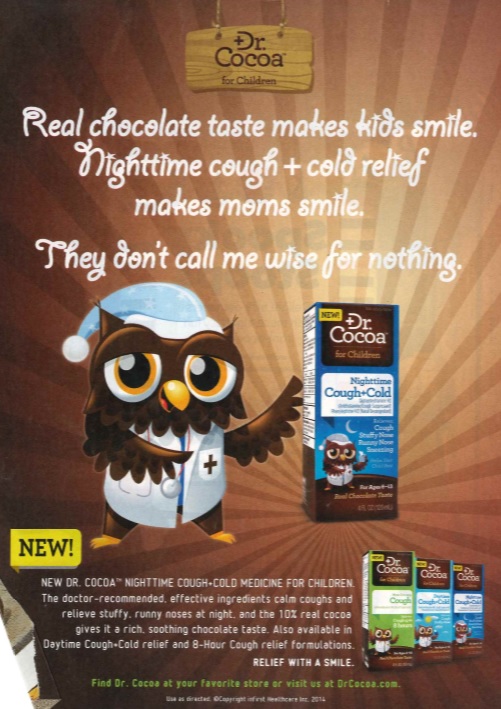
If you’ve been unlucky enough to get your hands on a copy of the October 2014 Parents magazine, you’ll notice that there’s an ad for a new kids medicine called Dr. Cocoa (pictured). In Dr. Cocoa’s advertising world, dads simply don’t count.

Dr. Cocoa continues to perpetuate the unfortunate notion that dads don’t really take care of sick kids at night. That’s supposedly what moms do, and dads are pinch hitters at best.

There’s nothing like introducing a new product with a decent premise and completing blowing the premiere by alienating dads right from the start.

And I thought owls were supposed to be “wise” creatures.

Jif, ignoring the problem only makes it worse

We seem to be on a Jif Rift lately.jifad

Part of it has to do with Jif ads on TV. They’re continuing to use the outdated, old fashioned choosy slogan that further validates they are the “Washington Redskins of Ad Slogans” (refusing to change when others say they need to). Their new ads during prime time bring back the unpleasantness into the limelight once again, so in effect they’re creating their own problems.

Another complaint has to do with their blatant snubbing of our inquiries. We’re simply trying to chat with them via Twitter, but they’re flat-out ignoring us. Herein lies the principal reason we were formed – to stop dad exclusion in marketing and advertising. It doesn’t matter how good a product is, if Jif doesn’t even listen to its consumers (i.e., dads), they’re not maximizing their potential. Period.

Odd as all that may seem (and believe us, Jif continues to get more odd everyday as they press on with this ridiculous slogan in today’s world), the fact they added their only-audible, non-print dad-add-on, “Choosy moms and dads choose Jif,” makes things even more peculiar.

Here’s what Justin Aclin of the excellent Hunter PR blog wrote on February 22:

“‘Brands get in trouble when they think having a dad in the commercial necessitates calling out that it’s a dad,’ said Chris Routly—who gained national attention when his blog The Daddy Doctrines called out a Huggies ad campaign to the point where the ads were eventually pulled—on a panel discussion called ‘Marketing to Today’s Dad.’”

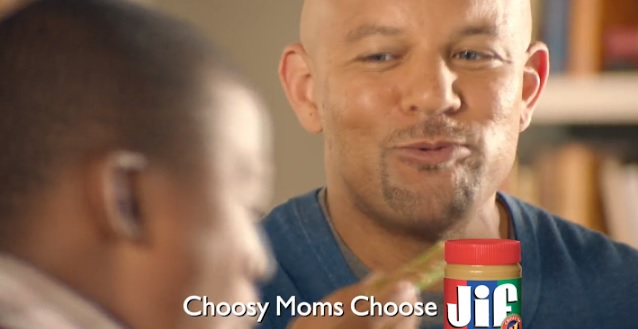
As if this quote wasn’t enough, notice the image featured in this blog post. Doesn’t the photo make Jif look like a confused company when coupled with their slogan? And as we pointed out on July 17, this silly add-on only draws more attention to the fact that Jif has excluded dads for a long time.

It’s been 56 years since Jif was introduced in 1958, but it’s not too late.

Jif, please make things right and be a brand of the future, not your past – because as we consumers see it now, your past is your present.

Let’s fix it in a Jif-fy

Some say there isn’t any common sense in Washington, but dadmarketing would argue otherwise. The year was 1995 when the NBA’s Washington Bullets changed its nickname to the Wizards. Apparently then-team owner Abe Pollin decided the Bullets name carried violent overtones, especially in a city with a high homicide and crime rate. And apparently he was jifright.

One can certainly argue the eventual new name – how it hasn’t caught on, how it carries other negative undertoneshow it is a product of a fad at the times – but that would be missing the point. “Bullets” simply wasn’t appropriate anymore. It didn’t take the action of one owner to spur it along, because many realized it. The change was long overdue.

And then you have Jif Peanut Butter’s slogan: Choosy Moms Choose Jif.

It’s not just in Jif’s latest TV ad, it’s plastered all over their website, and it’s been a part of the brand for a long time.

I can hear people already (both moms and dads), because many of them spoke out when we discussed Kix’s outdated motto:

  • Chill out, it’s just a slogan.
  • Everyone has to be so “PC” nowadays.
  • Much ado about nothing.
  • There’s more important things to worry about.

We here at dadmarketing like to think of the Jif slogan as SWASFTSOI: Staying With A Slogan For The Sake Of It.

To explain further, imagine for a moment, that the United States government had a slogan before 1919 (like the Army’s “I Want You” slogan) which read, “Real men vote.” It might have been a decent slogan back in the day and worked well at the time, because after all, only men could vote then. However, let’s pretend they kept using that slogan to this very day, and we all saw it when we entered voting precincts. Of course, it would seem a tad outdated because we all know that women can vote, but wouldn’t it yet sting a little to both women and men? Wouldn’t it seem a little offensive? “Real men vote” wouldn’t take anything away from the fact that females could still walk in and exercise their right to vote, but it would just seem old, tired, antiquated – even silly and useless.

That’s all we’re saying about Jif. We get the fact it’s your long-standing company slogan/brand/wordmark, but it’s time to move on and find some other way to market your product (which tastes good, by the way). Change with the times. Jif is like the Washington Redskins of sandwich spreads: an entity that refuses to change out of stubbornness. Their attitude could also be filed under the dreaded, this is the way we’ve always done it.

And yes, Jif, we’ve noticed the latest add-on to your TV commercial which states audibly, though not in print, “Choosy moms and dads choose Jif!” This hardly solves the problem. In fact, it exacerbates it. It’s kind of like saying, “Gosh, I barely notice that huge wart on your nose.” It makes the slogan even more old-fashioned laughable, drawing attention to the fact that Jif has excluded dads for years, if not decades.

It’s the same way that your local high school has had the embarrassing nickname “Lady Bears” for all of its girls sports teams? Why not just “Bears” for both genders, or at least “Gentlemen Bears” for consistency? Ugh. Another topic, another time.

So Jif, let’s get down to business and fix it, the right way, once and for all. Show moms and dads that common sense is alive and well. Dads mean a lot to you, right?

Let’s hope so, because dads have a choice in what peanut butter to buy, and choosy dads choose ________________.