The saying goes something like this: “there’s nothing quite as special as a love between a father and his daughter,” or “…between a mother and her son.” Or vice versa.
Any proud parent of each gender can attest that those sayings are only partially true. While you probably possess a deep love for your children, you probably don’t have any extra special bond with, say, your daughter that makes it superior to that of the relationship with your son. Hopefully, you love them all equally, and there is no unspoken or unexplainable sparkle that makes the daddy-daughter dynamic superior to another.
But if you’re a dad, you can say this: you and your daughter share a distinction that you and a son can never replicate. It doesn’t make your relationship more special. It only makes it different.
And that obvious distinction is that you’re not female, and your daughter is not male. Men offer certain characteristics by way of their gender, and you can never experience the other – except through each other. That makes a daddy-daughter relationship unique, to be sure.
As a dad, you likely appreciate the feminine traits that a girl brings to your family. You notice that femininity in your wife, your mother and in any sisters with whom you grew up. But to witness your daughter moving from different stages of play, styles in clothes and probably someday to new relationships that may shape their lives – it’s all new to you.
Men’s and women’s basketball essentially look the same, but any coach from kids to the pros will tell you that they coach male and female players a little differently. Their players’ attitudes are different. The locker room has a different vibe. Even the game is different. So it goes with the daddy-daughter relationship.
The bond is also unique is because a dad is the first male his girl will meet, and hopefully admire.
When we meet anyone of the opposite sex, we encounter humanity. We see life through a different lens.
A boy can certainly look up to and emulate his dad, but he’s also male and probably shares some of the same masculine characteristics that will be fully developed someday.
A daddy-daughter relationship is almost like a dress rehearsal for life. She’s getting to relate to the opposite sex from the get-go. That’s valuable experience and makes any dad’s job an important one.
If you’re lucky and blessed to have a daughter, you get to witness the feminine side of child rearing, and she gets to witness you as a male father figure. It’s so obvious, but a wonder to behold when you reflect upon it.
So while you can’t say a daddy-daughter relationship is any more special, you can say it’s unique. Here’s to all the dads and daughters that make the world go ‘round.
Once upon a time, the media delivered news to the public. It was true journalism in its purest form, which involved the reporting and informing of events around us – delivering fact and objectivity were the name of the game. Journalism later became investigative with an intent on serving as a public watchdog and exposing corrupt government officials, business leaders, or even celebrities. Opinion journalism then worked its way into media, which as we know, features a subjective viewpoint. These were usually labeled as columns, editorials, op-eds and so on.
Today those lines have blurred, and there is no one serving as an overseer for the media. It is hard to know what is fact or opinion. This can have an influence on everyday topics, including fatherhood.
What is the news?
As the Internet took a stronghold and replaced the once dominant ways we consumed news, it ramped up society’s ravenous appetite for information. Despite the decline of newspaper, TV and radio, we still want the news more than ever. However, the Internet can also make anyone the media. Whenever someone publishes a blog, posts on social media, raises awareness on crowdfunding sites – they become a part of the media enterprise.
Now, not only is it hard to know what’s fact or opinion, but who is the authority?
Look at the story’s first three sentences. These opening lines serve as blanket, arbitrary statements coming across as fact. Instead of reporting the news, the writer, in effect, is creating it.
Now look at each sentence and consider your own circle of life. You know full well that dads cook meals for the family. Dads clean the house. Dads take relatives to the doctor. And this is the same type of unpaid labor – just as with moms – which many dads do every year. The writer chose to ignore these facts and craft an opening that aligns with old stereotypes. The writer also chose to surmise that, “there’s still a long way to go.”
The rest of the story
The heart of the NPR story is centered upon a study by Equimundo, which promotes gender equality. The writer included much about the study’s results, but much more wasn’t included.
Such as, how dads and moms have different priorities when it comes to the time they spend with their kids. How more dads work outside the home than moms, leaving much less possibility – and time – for completing chores inside the home. Neither approach to parenting is wrong, they’re just different.
Different priorities and roles within the family (e.g., dad provides the primary income) doesn’t mean that a dad doesn’t care, and a mom is more caring. It doesn’t mean that a dad is neglecting chores, thus leaving moms stuck with more domestic chores. It means most dads are at work during the week and have less time to complete tasks inside and outside the home.
If gender equality is sought, we all need to consider how everyone is depicted – differently and fairly.
Be careful what you say
Public figures also play a part in shaping this stigma, too. The late U.S. Supreme Court Associate Justice Ruth Bader Ginsberg once said, “Women will only have true equality when men share with them the responsibility of bringing up the next generation.” Her advocating of women’s equality is admirable, but it comes as the expense of fathers through a message implying that men aren’t currently doing their part.
Now let’s move to the end of the NPR column. While the writer tried to present factual statistics throughout, she finished with the following excerpts:
So, what now?
Changing the minds of men means changing how we teach our boys. The study recommends teaching boys from childhood the importance of housework the same way girls are.
While the study found that both men and women say care leave policies are important to them, women are still more likely than men to prioritize those policies, as well as health care and gender equality policies.
Rather than arbitrarily calling out men as the problem, have we ever considered calling out the marketing around us, which also shapes our attitudes. For decades, consumers have been led down a path to believe that household work is a mother’s domain. This stigma is unfair to moms and creates perceptions that aren’t true.
That story’s ending is another classic example of the lines between reporting and opinion being blurred. A writer came up with subjective conclusions, therefore shaping our opinion of the world.
Erasing the blur, changing with society
While companies create slogans to market their products, or only use women in cleaning ads, for example, society remains convinced that dads haven’t changed, and so the simple solution is to keep the communication the same. The message never changes.
Therein lies the problem: society has changed, as today’s dad is an involved parent. He’s an active parent. With that brings a vocational conviction that stretches beyond serving merely as a breadwinner and secondary parent. Dad is an equivalent family player and meaningful parent in every way, shape, form and instinct – every bit as mom.
The media has great power, and with that comes a great responsibility to choose words carefully and report how the world sees something – not merely one person.
Mother’s Day and Father’s Day really aren’t all that different – one celebrates mom, the other dad. Companies, however, take different approaches when it comes to marketing their products and services on each holiday. A closer look reveals some surprising realities.
CVS offered a touching ad for moms, in stark contrast to its Father’s Day message which included no message at all.
It would be nice if Owlet added some wording about how being a dad is also a rewarding, yet demanding job. It’s also curious how Owlet included mom in a Father’s Day message, though it’s never happened the other way around. Another observation – Owlet wants dads to “feel seen and appreciated,” yet includes not a single photo of a male on the front page of its website. Hmmm.
This is a solid set of ads from Nike for a variety of reasons, and here’s something worth mentioning – you’ll be hard-pressed to find a photo of a dad kissing his child in an ad anywhere, which is unfortunate. Despite the common myth, dads aren’t afraid to show affection, nor should companies be to display it.
It’s too bad how the NFL made no mention of Mother’s Day, but on the flip side you have to give credit where it’s due. The NFL operates in a male-dominated industry – no female has ever played on an NFL team – yet the league doesn’t exclude or ignore women. Instead, it markets heavily to them. It pushes for more female coaches and refs. Networks employ female reporters. Look at the front page of NFL Shop and note numerous female-styled products, front and center. Why doesn’t this work the other way around in other industries?
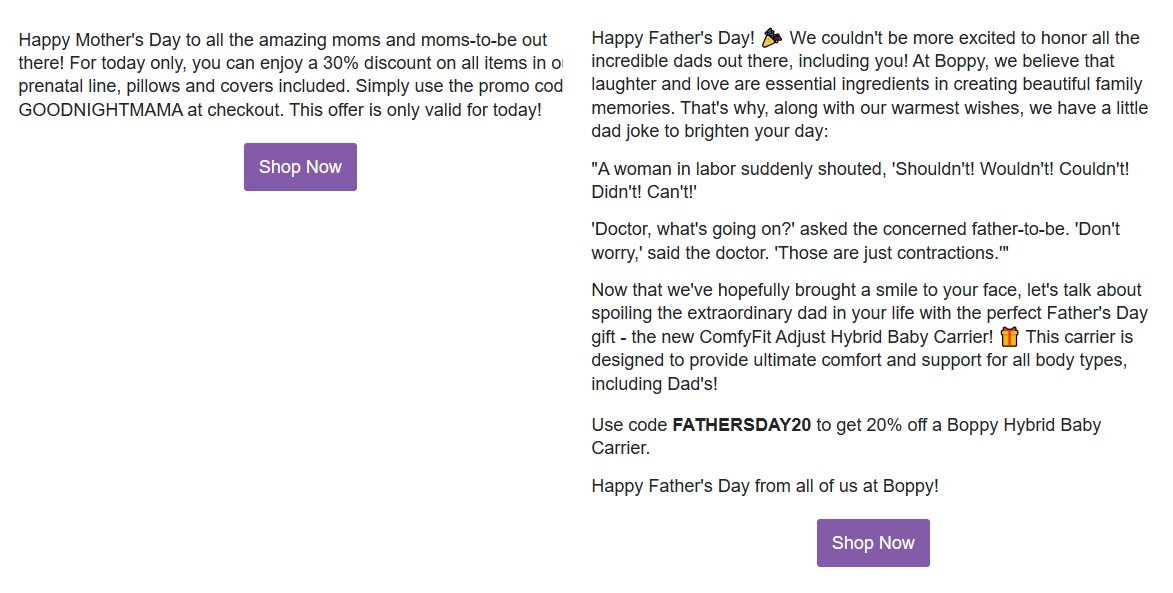
Boppy is one of many who employ the dad joke every June. It’s all well-intentioned, of course, but the schtick is getting old. Actually, it’s beyond old – it’s tired, threadbare and worn out. Dads are indeed funny, yet they’re also loving, sacrificial, nurturing, thoughtful, involved, compassionate, empathetic, hopeful, hard working and successful. The ways to describe a father are endless, and humor isn’t the only way to connect with them. Yet marketers continue use the same stereotype. Every. Single. Year.
Plenty of text here, and two items stick out. First, the use of “To all the dads” has the feel of something like, Happy Family normally creates messages for moms, so here we’re making sure everyone knows this one is ‘for the dads.’ If you’re a dad, it also has a secondary feel, as opposed to the mom message. Such a sentiment is reinforced in the bottom header, where “celebrating you” and a “to you” is included in the Mother’s Day ad. And, Happy Family just had to mention the dad joke. [sigh]
It’s interesting how Midwestern sporting goods store Dunham’s included a sweet photo of three generations in its Mother’s Day ad. As for the dad ad? Funny-nose-and-glasses.
Love the consistency in style and messaging from these Vintage Brand ads. Well done.
Chipotle lookalike, Qdoba, offers some curious wording in its holiday ads. Note the top of the mom ad which exclaims in an old-fashioned manner, “Mom makes the rules.” Then it includes two jokes about dad’s cost-saving nature and, what else, the dad joke. Qdoba isn’t laughing with dads, it’s laughing at them. Next year, do better, Qdoba.
There’s a lot to like about JcPenney’s uniformity in approach, basic design and letting the picture – rather than unnecessary words – do the talking.
Flowers vs. grill tools. Sure, they’re time-tested symbols of May and June, respectively, but isn’t there more to mom and dad than these overdone images? Kroger also wants to make dad shopping “quick and easy.” Yes, that’s something we can all appreciate, though doesn’t it make his shopping feel like a nuisance you’d like to be over with as soon as possible? An unintended consequence, for sure. However, you know what they say about perception and reality.
“Love” is used twice in the ad on the left, not once on the right. Why is it so hard to use that word in marketing in relation to dads? And the cakes look amazing – though beer, grilling and ties are outdated symbols of Father’s Day. C’mon Baskin-Robbins marketers, let’s see some fresh creativity by next June.
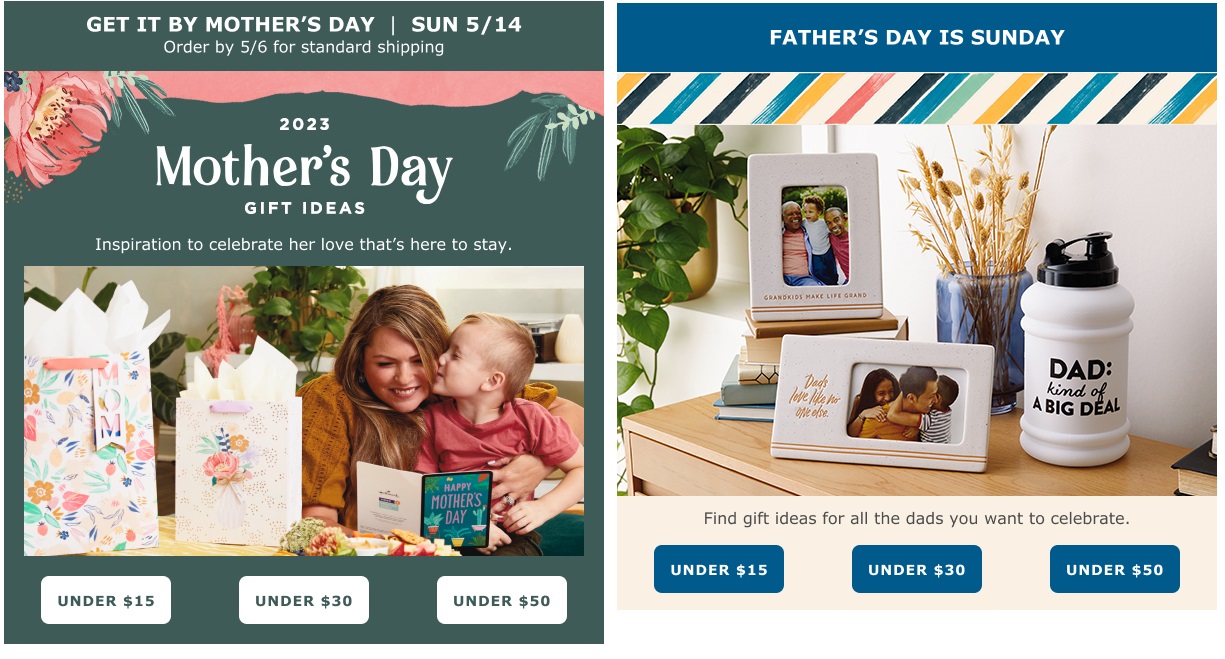
Hallmark took different approaches with each, and the result is surprisingly satisfying. No tropes or nonsense, no overdone or overbearing pink and blue – just quality gifts with simple, strong messaging (though, it would have been nice to see an affectionate dad/child).
The omission on CanvasChamp’s site is so glaring you can’t help but wonder if it was intentional. For a company whose product resolves solely around images (its tagline is “memories on canvas”) it’s hard to imagine why it couldn’t show the same loving product photos on the Father’s Day ad. If a picture is worth a thousand words, a visible sample must be worth at least one lead. Alas, a missed opportunity.
Dictionary.com used a heartwarming message on Mother’s Day to which all moms can relate. For Father’s Day, another dad joke. By now, no one’s laughing.
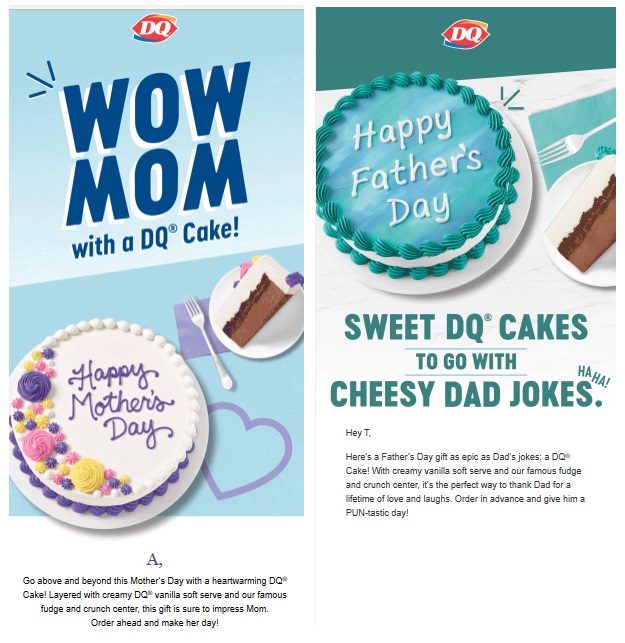
At least Dairy Queen took a novel Father’s Day approach with … um, scratch that.
Another mom-does-it-all message, this time from Cinemark, but nothing even remotely comparable for dads. In fact, note the midly subliminal jab about dad’s saving nature (honestly, as if that’s a bad thing). Movies are such a universally loved way to spend time as a family, so let that sentiment spill into ad copy, Cinemark.
You wouldn’t know Netgear even acknowledged Father’s Day were it not for the small shield on its ad, which almost seems like an afterthought. In a way, it is. That’s because Netgear coupled Father’s Day – in an oft-used, rhyming move – with the graduation season. Disappointing.
Mom does it all, mom gives kisses, yada, yada. At least Samsung didn’t use a you-know-what joke.
The saying, “World’s Greatest Dad” is a most curious one. For those fortunate to know that saying to be true – can everyone be right?
On one hand, it’s not literally possible. A more accurate classification might be, “One of the World’s Greatest Dads.” We haven’t met every dad on earth in order to accurately make this claim. And we also know that “greatness” is in the eye of the beholder. There is no quantifiable measuring stick for the significance of a person.
On the other hand, there can be no debating such a declaration. If you know this to be true, you know you were graced with the Greatest Dad, hands down. He never stops validating it, and there are conclusive examples of his love nonstop from birth to present day.
The funny thing is, whenever you make this claim, no arguments ensue. If one were to make other proclamations, such as the greatest pizza, NHL forward, or president – disagreements would arise. Yet you could hear someone else tell you his dad is the greatest, and you’d merely nod and smile while acknowledging he’s right, and knowing that you are, too.
And if there’s so many great dads, why do we need national institutions and its billboards insisting that there’s a fatherhood crisis? That we need to “Take time to be a dad today”? We don’t see these exhortations for moms. So why perpetuate an unfair stigma about dads? Both parents need support. The truth is that the responsible, active dads far out-number the negligent ones.
The entertainment and media industry are often responsible for this misrepresentation of fatherhood. Even today, a dad who takes care of the children alone or handles household chores is referred to as Mr. Mom. Yet he’s not a mom, nor a replacement for mom; he’s an equal, competent parent who’s simply a dad.
A few years ago, there was a news story titled, “Dads are wired to ‘mother’ too.” The awkward and inappropriate headline left dads both laughing and furious: no, dads are not wired to ‘mother’; they’re wired to ‘father.’
Being a dad is difficult work. Societal expectations still suggest dads need to provide monetarily, though today’s dads want to be present and not miss a thing. Pulling them off equally – trying to be the provider and caretaker – makes today’s dads all the greater.
So, no, there’s no fatherhood crisis. Fatherhood is alive and well, and there are a lot of great dads out there.
Something wonderful happens every May in schools – when school children bring home decorated cards, homemade gifts and adorable crafts for Mother’s Day.
The presents are as much fun to make as they are to receive. Think about how this simple gesture unfolds: teachers give a portion of their schedule to devising a game plan, class periods are devoted to the creations, and kids learn a valuable lesson about expressing love to their moms. They all give their time – arguably the best gift of all.
In June, however, history does not repeat itself. That’s no fault of anyone’s, of course – most schools are closed by mid-June. Alas, Father’s Day is overlooked. It’s a missed school opportunity beyond measure.
But here’s an open plea to teachers: it’s time to do something to honor fathers.
Who says classrooms can’t create a craft before school lets out? Teachers could easily conduct the same exercise for Father’s Day with a little preparation.
Sure, there may be several days between the end of school and Father’s Day, increasing the chance the gift could get lost or forgotten by the time the holiday arrives. However, nothing would be lost on the chance for kids to articulate love for their dads.
And who’s to say teachers can’t do something outside-the-box? How about conducting an in-school activity before school lets out that involves dads and kids making it together? It could even be conducted at a non-traditional time of year, such as in the fall.
Ideas are aplenty but make no mistake – society is missing a grand chance to convey love to fathers in a meaningful way. It’s high time for schools to take the step and show appreciation for the other equally important piece of the parenting equation.
Doing so would make June even more special for dads who tend to be underappreciated in culture.
Every dad wants that homemade, tear-inducing gift as much as mom does. Let’s make it happen in schools. Society will be the better for it.
Already eight times this year, Carnation Breakfast Essentials has posted to social media some sort of mom-only message.
Once could be excused as a mistake. Twice an oversight. But eight times? That’s a pattern.
However, if you want to dig deeper into the true nature of Carnation, look at how it interacts on social. There you’ll discover only a smattering of fan comments, but Carnation takes the time to respond to nearly all of them.
We’ve left comments regarding its imbalanced messaging along with polite requests to be more inclusive – only to receive nothing in response.
Imagine sharing your thoughts at a meeting and not only being met with total silence but being ignored and not even looked at. Dads feel like this all the time.
Carnation is part of Nestlé, the multinational food and drink conglomerate headquartered in Switzerland. It is the largest publicly held food company in the world.
If Nestlé’s purpose really is – as its website states – “to unlock the power of food to enhance quality of life for everyone,” then everyone means everyone.
But that’s not all Nestlé believes. Check out what it writes under, our values: At Nestlé, respect has a special and powerful meaning. It has a huge impact on the way we work and run our business. Our values are rooted in respect. A respect for ourselves. For others. For diversity. And for the generations who will follow in our footsteps. Setting out our values is crucial – but living by them makes the difference.
Respect. It means due regard for the feelings, wishes, rights, or traditions of others. If that’s true, Nestlé has some work to do.
It’s time for Nestlé to live its values, because generations who will follow in its footsteps just might be customers for life if it treats them as such.
While it may be a mother – as in, Mother Earth – who gets most of the attention related to outdoors and nature, there’s a lot fathers can do to play their part.
Oddly enough, old stereotypes behold mom’s domain is inside the home, while dad’s is everything outside of it. But it doesn’t have to be that way. The truth is, any parent can foster a child’s love of growing plants and gardening.
Many dads are fervent champions of growing fruits and vegetables, and using the land to make food instead of paying grocery stores top dollar for it.
But no matter the impetus, there’s great value in creating a garden with children regardless of how much space you have. Here’s a suggestion – start small. Like, really small. There are a lot of fun micro terrariums and fairy garden kits in stores, and they all grow fast. Receiving that instant gratification can spark a child’s interest immediately, and you can start those kits in any season.
If you’d like to get a little more serious with gardening that involves seed packets, dirt and weeding, potted plants fit just about anywhere. Any flower will do, but sunflowers are particularly fun. And tomatoes and potatoes are also good pot dwellers.
Beyond the obvious benefits of eating healthy, gardening offers dads and kids a lot more. One of those is bonding. It will give you and your children an opportunity to work on a project together while talking. That’s right, actual conversation! If you’re looking for a chance to lessen screen time, this is it.
Gardening is also a great workout. Digging, weeding, bending, stretching – sure, it burns calories but there’s also the spinoff perks of lowering blood pressure, reducing stress and more. So not only are you growing healthy, natural food, you’re doing plenty for your mind, body and soul.
Nurturing a green thumb in your child can also turn him from anti-vegetable to all-in. There’s nothing quite as satisfying as seeing what you have planted flourish to life. You might even get your kids to eat, say, radishes; bring them from the store and they’ll scoff, but your kids are far more likely to eat something they’ve grown.
It also gives kids some much-needed independence. You can plant items together, but consider giving them a section or pots all to themselves. Let them be totally responsible for water, weeding and ensuring sunlight. They can even mark their seeds with fun signs and give them pet names, too.
Many like to start kids very young with other extracurriculars (music and sports come to mind), so why not do the same with gardening? Like anything we do in life, the point is to have fun, and gardening offers the uniqueness of parents and kids working side-by-side.
For as long as Jif peddled peanut butter, it seems, it rode a sexist, old-fashioned motto along the way. In fact, it was from 1966 to 2016 whereby “Choosy Moms Choose Jif” wasn’t just a saying, it was a deliberate message alienating half of its customers. It also cemented the widespread meaning that it was mom’s job to shop, prepare meals, pack lunches and essentially, maintain the house.
It took exactly 50 years until Jif decided enough was enough. It shelved the backwards slogan after realizing that dads were offended. But did it also make the change because it affected profit?
We’ve heard from numerous parents who refused to purchase a product for the way it treats customers. Some refuse to buy the product and remain silent in their act. Others take to the Internet or use word of mouth to rally for change.
Take, for instance, Ragú, where scores of parents regularly criticize the long-time sauce maker on social media for its retrograde headline.
Before that there was Ban Kix cereal Slogan, a Facebook page urging General Mills to end its outdated “Kid-Tested, Mother-Approved” saying. Its activism ended, of course, after Kix revamped the saying in 2018.
Even earlier, an at-home father successfully petitioned Huggies to drop its demeaning ad campaign in 2012 which portrayed men as incapable of changing diapers. His change.org petition riled over 1,000 people to vent and sign his request.
Boycotts have historically played an important role in social change and have often proved successful.
Have you ever boycotted a product or company over its treatment of you as a customer? We’d love to hear from you.
The tagline for Playtex Baby is three simple words: We Know Babies.
But does it know parents? As in, all parents. Visit its website and you’ll find a special section titled, Mommy & Baby, where there are a handful of useful, yet one-sided stories such as:
• Mom-to-Be’s Guide to PlaytexBaby.com • Playtex Innovations • The Love Connection: 5 Ways to Bond with Baby • Be Ready for Baby’s Arrival with Eight Must-Have Registry Items
The first story makes you believe its content might be focused on breastfeeding or pregnancy. Alas, it’s a sales pitch for its primary products – bottles, Diaper Genies, pacifiers and sippies. Of course, none of these are specifically mom-centric items. Playtex Baby proves as much by using a photo of a dad with this Mommy section’s “love connection” story.
Enjoy that photo of the dad – it’s the only one you’ll find on its entire website. It’s a classic case of misrepresenting families and biting the hand of the person whose salary likely helps to pay for every Playtex item purchased.
Playtex Baby serves as another example of a company who ignores half of its customers. Doing so demeans and ignores the irreplaceable need for dads.
Do better, Playtex. There are a lot of options for baby products, and customers are watching.
There are plenty of parents who denounce shopping with kids – the begging, the meltdowns, spilled food, bickering, maybe even lost children – but the truth is that kids want their parents’ time.
Dads seek the same thing moms do during their shopping experience, and that’s building a closer connection with their kids.
So, fear not fellow shoppers – with a little bit of preparation, organization and well-established, realistic expectations, a visit to the store can strengthen bonds between parents and children. As for the products you buy, it can even increase product and brand loyalty.
Behavioral issues result in stores mostly because children are bored. Kids end up not being invested in the task at hand the way adults are: completing the to-buy list, watching the budget and reading nutrition labels.
No matter how young they may be, children can have an active role in shopping, even if it means playing a shopping game, helping to find items on the shelf, or simply weighing the items on the produce scales. It’s those actions that can make children feel a valid part of contributing to a family through problem solving. It teaches them to be patient during those times in life while forced to wait or do things they’d rather not. It delays instant gratification and builds self-control when things don’t always go one’s way – all essential life skills, particularly ones used later as parents.
Simply put, shopping as a family with the children can make a simple chore an event. And if you’re still not convinced that taking children to the store is your idea of fun, consider this: you certainly don’t remember all of the meals your parents cooked for you as children, but you do know that the food provided you with nourishment, contentment, energy and nutrition. It helped you grow, and you treasure the memories of sharing mealtime together.
The same can be said for shopping with children. Yes, it’s a menial task that could bring out the worst in you, but examined with a different perspective, that same task can become one of many fond experiences for your kids. Besides, if you are inflicted with that added guilty feeling that you might not be spending enough quality time with your kids, shopping creates another opportunity to strengthen and enhance the parent-child relationship.
These shopping experiences strengthen bonds with parents and siblings, but believe it or not, it also builds product and brand loyalty with kids. For those of us who grew up using a certain product or brand there’s great comfort in using the same products of our youth. It affords a dependable, trustworthy feeling to enjoy the same products once used as children. But imagine the stronger allegiance to a brand that one purposely chooses at a very young age – and then continues using it for life.
There’s a lot to like about that unique scenario if you’re a marketer. It makes reaching those young children-turned-adults much easier, and they’re far more bankable as lifelong customers. After all, numerous studies have shown that children wield heavy influence on their parents’ purchasing activity, and dads, in particular, have a propensity to purchase treats for rewards, to indulge loved ones, or yes, even to avoid in-store meltdowns. Marketers who can accurately target and influence dads as well as the children who accompany them will have much better odds at keeping them as customers for a lifetime.
So the next time you head out to the store, bring the kids along, and someday they’ll pass on those fun memories to their children.























 dadmarketing