Let’s Abolish the ‘Dad Joke’ in Father’s Day Ads

Marketers tend to be a creative bunch. Just look at the Super Bowl commercials we enjoy every year. Or the clever ads we enjoy before movies. Or those ingenious jingles stuck in your head.

But then comes June and things tend to get rote.

That’s because Father’s Day – in all its grandeur, distinction and variability – gets treated the same whether a company is marketing clothes, ice cream, or (sigh) grilling tools.

Behold, the dad joke. It’s the go-to schtick for advertisers of all ages. It’s a surefire way to check the box and let the world know you’ve got this holiday covered in a fun way.

Make ‘em laugh, right?

More like, make ‘em gag. It’s all well-intentioned, of course, but It’s. Getting. Old.

Mother’s Day ads contain feeling and heart. And Father’s Day ads? Usually, some mention of the dad joke. It’s become so commonplace we’re not sure if marketers are laughing with dads, or at them.

Think of the words employed throughout Mother’s Day ads, and you’ll discover dads are hardly getting their fair share of sentimentality.

Dads are funny, yet they’re also loving, patient, caring, sacrificial, nurturing, supportive, wise, thoughtful, involved, compassionate, hard-working, empathetic, hopeful and loyal. The adjectives are infinite, and humor isn’t the only way to connect with dads. Yet marketers continue to use the same stereotype every June.

This Father’s Day let’s incorporate some meaning into our ads. Let’s get the creative juices flowing while showing dads how much they matter.

Please don’t reference the dad joke. By now, no one’s laughing.

Unnecessary Post Leaves Dad in the Dust

When radio was still a thing, shock jocks ruled the airwaves. These were provocative hosts known for exaggeration and aimed to offend. It’s how they got noticed and improved ratings.

Of course, radio is hardly what it was but the formula for attention remains the same: say anything you want for ratings – or clicks.

Which is exactly what websites do today. And you’ll find no better example than this post at What To Expect’s site. Here the commenter – yellow01 – poses a situation that shouldn’t be up for discussion: “Letting dad take baby alone to his parents house.”

Yellow01’s thoughts radiate a sexist, demeaning and controlling vibe:

  • “…I still don’t feel comfortable going out alone and leaving baby” (with dad, implied)
  • “…I said you’re not taking him alone anywhere till he’s older”
  • “…I don’t trust anyone but my mom”
  • “…I never said his parents couldn’t see the baby I just said no to him taking him alone”

There’s no point in arguing the unacceptable nature of these comments. We all know they’re off the mark, as validated by the numerous commenters who politely suggest yellow01 is out of line.

What’s equally wrong is how What To Expect allowed this post to appear in the first place. Every forum has a moderator, and permitting this one to go live is like letting a shock jock’s poorly trained tongue say anything in the name of ratings.

But as you can imagine, What To Expect absolves itself from any offense with the convenient disclaimer, “The views expressed in community are solely the opinions of participants, and do not reflect those of What to Expect” (plus the handy omission that it may make commissions from links on that page).

It’s all evocative of the adage, just because you can say something doesn’t mean you should.

For most shock jocks, things don’t end well. As they push the envelope of decency, they show a lack of regard for others. Many have been fired, censored, created social outrage, or caused their employers to be fined.

They’re the equivalent of tabloid newspapers, and we know how those are regarded in society.

Dads deserve better. Show empathy.

You Know Dads Aren’t Being Treated on Equal Plane When a Story About Progress References a Sexist Movie Title

Not long ago, a New York Times piece heralded the growth of stay-at-home dads. (Forget the fact that in recent years there hasn’t been printed – as far as we can tell – a story on the growth of work-outside-the-home moms.) The story discussed how, more and more, men are erasing stigmas and normalizing the fact that fathers do indeed stay at home to care for the family.

But clouded by its very message of normalization was the reference of a sexist movie title that detracted from an otherwise supportive piece.

A headline is intended to summarize a story and draw readers in. This one merely reinforced an old-fashioned, prejudiced trope.

It’s disappointing how anytime the topic of stay-at-home dads arise, it’s often accompanied by a reference to this highly sexist, badly outdated film – which is a shame because the movie is filled with more than a few likable and notable actors.

In a world of #MeToo, Quiet on Set, problematic racist movies, and notable social movements, writers, media and marketers would do well to stop referencing a movie that has aged poorly and does fathers no favors.

Stop talking about it, citing it and quoting it – except only in the sense of learning from its frustrating premise and, thus, offering better entertainment that builds up families and society.

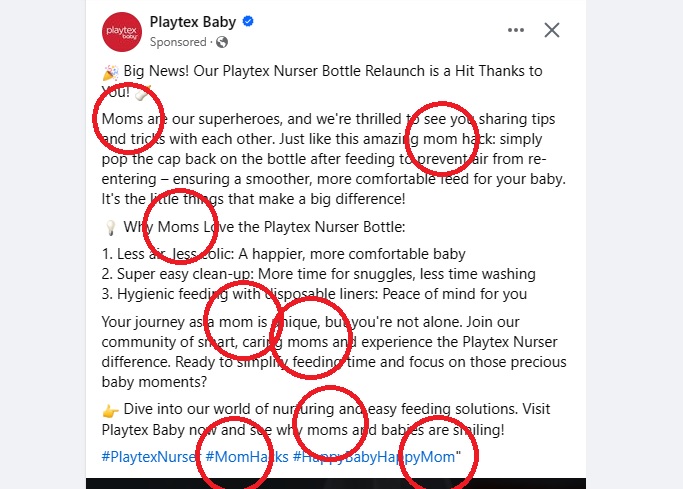
What’s With This Ad From Playtex Baby?

Playtex Baby is a brand specializing in baby care products, including feeding bottles, nipples, sippy cups, pacifiers, and diaper disposal systems. It is known for providing innovative and practical solutions to make parenting easier and more convenient.

That’s right, parenting.

So why is it minimizing dad to virtually nothing in its latest social media ad? Why does it make eight references to moms while ignoring the indispensable contribution of fathers to families?

The exclusion or marginalization of dads in advertising can stem from various factors – none of which are right.

Addressing this exclusion requires a shift in mindset among marketers, a commitment to challenging stereotypes, and a recognition of the diverse roles that fathers play in modern families. By embracing inclusive portrayals of fatherhood, advertisers can better resonate with their audience and reflect the realities of contemporary family dynamics.

It’s essential for companies like Playtex Baby to recognize the importance of inclusivity in their advertising and strive to represent diverse family dynamics. By acknowledging and portraying the involvement of dads in parenting and caregiving, they can better resonate with a broader audience and reflect the realities of modern families.

Social media ads can be edited quickly and easily. In a world that demands equality, Playtex Baby’s only response is to do the right thing – and do it fast.

Why Dads Feel the Hurt Over Parentheses

parenthesispa·ren·the·sis /pəˈrenTHəsəs/ noun
plural noun: parentheses; a word, clause, or sentence inserted as an explanation or afterthought into a passage that is grammatically complete without it, in writing usually marked off by curved brackets, dashes, or commas.

The key word in this definition – at least in terms of dads – is afterthought. And when you consider a few headlines and slogans over the years and what that does to a person – it can be demoralizing.

Marketers often have misplaced agendas when using parentheses, or perhaps misguided thoughts via long-held stereotypes and media. The media should know better. Its job is to deliver unbiased news guided by fact-checking and self-regulatory mechanisms, and semantically speaking, makes no sense to leave dads out of messages related to families and parenting.

Words do indeed matter, which makes it hard to explain why this Syracuse, N.Y. television station used parentheses in the first place. Same for Jesben, which has been employing them for over a decade.

Dads are equal, competent parents – not afterthoughts, digressions or asides.

When something is parenthetical in nature, it means that it can be removed without damaging the structure of the sentence.

While that may be true, it is damaging to the very structure of families when you reduce dads to an afterthought.

Deciding When to Have Kids – and How Many?

If you give your girlfriend a ring, she’s going to ask for a wedding. When you give her a wedding, she’s probably going to ask for a home. When you move into the home, you’ll both see an empty room. Seeing the empty room will remind you about having a baby…

[Record scratch]

Wait a minute – you’ve heard this before. That’s because when you and your spouse knew you wanted to spend your lives together, it was probably a foregone conclusion that you’d welcome kids along the way. The only question became when and how many?

Of course, no one can answer those questions but you and your spouse, but here are some factors to consider when deciding to have kids.

Space

If your digs are tight, you need to think about how an addition will make things even tighter. Remember, it’s not just the extra person (however tiny they may be – initially), but all the trappings of babyhood: bassinets, cribs, playpens, changing tables, swings, dressers, etc. You also must be prepared for anything, like – surprise – the possibility of more than one baby.

Finances

You can’t put a price tag on a human life, but you certainly can on diapers, wipes, formula, clothes and baby furniture. No, it’s not cheap having a baby, but neither is anything else in life, so it’s all about priorities. Be sure to consider what your budget can handle, because you don’t need extra strife when undertaking something new.

Jobs

You also need to consider your work situation. Some employers aren’t so family-friendly and may not make it easy for both mom and dad to transition into this new lifestyle. Be ready for anything career-wise, even if that means that one of you suddenly decides to quit work and stay home with the baby. It could also mean transitioning into a remote gig for one of you. If none of that is an option, figure out how much childcare will cost for you to keep your current job.

Ages

Having a baby at age 25 is a lot different than having one at 45 no matter whether you’re male or female. The challenges are different for each gender, but proper consideration remains important for each. You’ll also need to discuss how many kids you hope to have, and by when. Planning for future additions is a lot like planning your financial future – it takes a lot of thoughtful joint discussion.

Lifestyles

This category offers a lot of intangibles that could sway you in either direction. Are you so active in a hobby or passion that it could prevent you from raising a child as it deserves? Do you have a solid support network nearby? Are you planning a major career change or dramatic move across the country? Consider all those factors that influence how you function in life.

Viewpoints

If one of you is ready and the other isn’t, that’s going to take some heartfelt and meaningful conversation. It’s not like you’ll be able to resolve your difference of opinion overnight. But remember, you got into this relationship for a reason, you’re committed, and you can work this out. Something this important deserves a lot of loving empathy, as well as give-and-take.

Of course, there’s another factor not examined here – and that’s your heart. You know you love each other, and you want that love to grow even more. So, you could stop thinking about it, over-analyzing it and just get on with it.

Then one day when you have a baby, you’ll lay her down for a nap. While she’s sleeping, you’ll look around your home and realize there’s an empty room. And chances are if you have an empty room…

Jingle Dads

Dashing through the stores, in a marketing parade,
In search of gifts that make, family spirits cascade.
The deals indeed are on, we’ll shop all day with glee,
Marketing to dads, a major brand decree.

Jingle bells, wallets swell,
Sales signs all the way,
Oh, what fun it is to shop,
With dads for Christmas Day!
Jingle bells, wallets swell,
Sales signs all the way,
Oh, what fun it is to shop,
With dads for Christmas Day!

In the stores we go, checking our list twice,
To find the perfect gift, at the bestest price.
You have to realize dads, love to shop it’s true,
Marketing’s the dance, the deals they will pursue.

Jingle bells, wallets swell,
Sales signs all the way,
Oh, what fun it is to shop,
With dads for Christmas Day!
Jingle bells, wallets swell,
Sales signs all the way,
Oh, what fun it is to shop,
With dads for Christmas Day!

Picking toys and food, decorations bright,
Marketing to dads, is a festive sight,
For they are parents too, executives do say,
Let’s market to them day and night, in a jolly way!

Jingle bells, wallets swell,
Sales signs all the way,
Oh, what fun it is to shop,
With dads for Christmas Day!
Jingle bells, wallets swell,
Sales signs all the way,
Oh, what fun it is to shop,
With dads for Christmas Day!

I Pity the Fool Who Doesn’t Learn from Others’ Mistakes

What do Jif, Cheerios, Disney, Kix, Huggies, Similac, Boppy, Walmart and Amazon all have in common?

They listened to our plea.

Through activism and denouncing exclusionary marketing practices, they responded to our appeals and changed their ways. They realized that omitting dads is not only detrimental to the family, but it affects their bottom line. They discovered that dads shop, consume, have money in their pockets – and most of all – parent.

Yes, at one time these revered brands offered ads, slogans, or programs aimed specifically at mothers, thus excluding dads in word and deed. Each company was approached by our team, and all made changes to their marketing efforts.

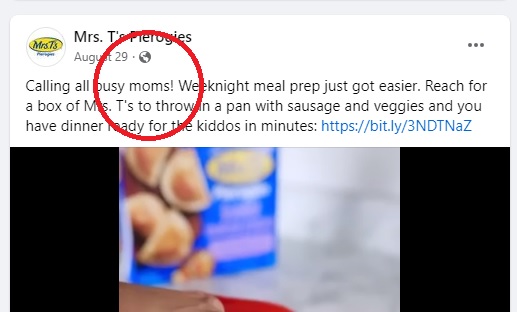
So, why can’t Mrs. T’s Pierogies?

On social media it issues messages such as, “Calling all busy moms!” or talk about a “mom-life balance.” It also ran a program this year titled, “All-Star Moms.”

We pointed out these misgivings on social media and received no response from Mrs. T’s, nor Hunter Public Relations, which is responsible for its social media.

(Side note: Hunter’s website curiously insists that “helping brands ‘relate’ to their ‘public’ will always be at the heart of what we do…”)

All of which is sad, because dads, like anyone, want to feel welcome. They want accompaniment. They want to feel included. They want to be treated like an equal parent. They want to know they matter. They want to be with.

General Mills, upon righting its long-standing discriminatory Kix slogan, issued an equality-seeking manifesto after its 2018 reboot.

“Kix is excited to announce that we have updated our slogan to ‘Kid-Tested. Parent-Approved,’” said Mike Siemienas, General Mills spokesperson. “This new slogan is more inclusive as the word ‘parent’ applies to the individuals raising children.”

General Mills finally realized the error of its ways.

Will Mrs. T’s?

Daddy-Daughter Relationships Are Important

The saying goes something like this: “there’s nothing quite as special as a love between a father and his daughter,” or “…between a mother and her son.” Or vice versa.

Any proud parent of each gender can attest that those sayings are only partially true. While you probably possess a deep love for your children, you probably don’t have any extra special bond with, say, your daughter that makes it superior to that of the relationship with your son. Hopefully, you love them all equally, and there is no unspoken or unexplainable sparkle that makes the daddy-daughter dynamic superior to another.

But if you’re a dad, you can say this: you and your daughter share a distinction that you and a son can never replicate. It doesn’t make your relationship more special. It only makes it different.

And that obvious distinction is that you’re not female, and your daughter is not male. Men offer certain characteristics by way of their gender, and you can never experience the other – except through each other. That makes a daddy-daughter relationship unique, to be sure.

As a dad, you likely appreciate the feminine traits that a girl brings to your family. You notice that femininity in your wife, your mother and in any sisters with whom you grew up. But to witness your daughter moving from different stages of play, styles in clothes and probably someday to new relationships that may shape their lives – it’s all new to you.

Men’s and women’s basketball essentially look the same, but any coach from kids to the pros will tell you that they coach male and female players a little differently. Their players’ attitudes are different. The locker room has a different vibe. Even the game is different. So it goes with the daddy-daughter relationship.

The bond is also unique is because a dad is the first male his girl will meet, and hopefully admire.

When we meet anyone of the opposite sex, we encounter humanity. We see life through a different lens.

A boy can certainly look up to and emulate his dad, but he’s also male and probably shares some of the same masculine characteristics that will be fully developed someday.

A daddy-daughter relationship is almost like a dress rehearsal for life. She’s getting to relate to the opposite sex from the get-go. That’s valuable experience and makes any dad’s job an important one.

If you’re lucky and blessed to have a daughter, you get to witness the feminine side of child rearing, and she gets to witness you as a male father figure. It’s so obvious, but a wonder to behold when you reflect upon it.

So while you can’t say a daddy-daughter relationship is any more special, you can say it’s unique. Here’s to all the dads and daughters that make the world go ‘round.

How Media Shapes Our Opinion of Fathers

Once upon a time, the media delivered news to the public. It was true journalism in its purest form, which involved the reporting and informing of events around us – delivering fact and objectivity were the name of the game. Journalism later became investigative with an intent on serving as a public watchdog and exposing corrupt government officials, business leaders, or even celebrities. Opinion journalism then worked its way into media, which as we know, features a subjective viewpoint. These were usually labeled as columns, editorials, op-eds and so on.

Today those lines have blurred, and there is no one serving as an overseer for the media. It is hard to know what is fact or opinion. This can have an influence on everyday topics, including fatherhood.

What is the news?

As the Internet took a stronghold and replaced the once dominant ways we consumed news, it ramped up society’s ravenous appetite for information. Despite the decline of newspaper, TV and radio, we still want the news more than ever. However, the Internet can also make anyone the media. Whenever someone publishes a blog, posts on social media, raises awareness on crowdfunding sites – they become a part of the media enterprise.

Now, not only is it hard to know what’s fact or opinion, but who is the authority?

Opinion vs. reality

Earlier this summer a story appeared on NPR’s website, “Dads may want to do more caretaking — but then face barriers, one study finds.”

Look at the story’s first three sentences. These opening lines serve as blanket, arbitrary statements coming across as fact. Instead of reporting the news, the writer, in effect, is creating it.

Now look at each sentence and consider your own circle of life. You know full well that dads cook meals for the family. Dads clean the house. Dads take relatives to the doctor. And this is the same type of unpaid labor – just as with moms – which many dads do every year. The writer chose to ignore these facts and craft an opening that aligns with old stereotypes. The writer also chose to surmise that, “there’s still a long way to go.”

The rest of the story

The heart of the NPR story is centered upon a study by Equimundo, which promotes gender equality. The writer included much about the study’s results, but much more wasn’t included.

Such as, how dads and moms have different priorities when it comes to the time they spend with their kids. How more dads work outside the home than moms, leaving much less possibility – and time – for completing chores inside the home. Neither approach to parenting is wrong, they’re just different.

Different priorities and roles within the family (e.g., dad provides the primary income) doesn’t mean that a dad doesn’t care, and a mom is more caring. It doesn’t mean that a dad is neglecting chores, thus leaving moms stuck with more domestic chores. It means most dads are at work during the week and have less time to complete tasks inside and outside the home.

If gender equality is sought, we all need to consider how everyone is depicted – differently and fairly.

Be careful what you say

Public figures also play a part in shaping this stigma, too. The late U.S. Supreme Court Associate Justice Ruth Bader Ginsberg once said, “Women will only have true equality when men share with them the responsibility of bringing up the next generation.” Her advocating of women’s equality is admirable, but it comes as the expense of fathers through a message implying that men aren’t currently doing their part.

Now let’s move to the end of the NPR column. While the writer tried to present factual statistics throughout, she finished with the following excerpts:

So, what now?

  • Changing the minds of men means changing how we teach our boys. The study recommends teaching boys from childhood the importance of housework the same way girls are.
  • While the study found that both men and women say care leave policies are important to them, women are still more likely than men to prioritize those policies, as well as health care and gender equality policies.

Rather than arbitrarily calling out men as the problem, have we ever considered calling out the marketing around us, which also shapes our attitudes. For decades, consumers have been led down a path to believe that household work is a mother’s domain. This stigma is unfair to moms and creates perceptions that aren’t true.

That story’s ending is another classic example of the lines between reporting and opinion being blurred. A writer came up with subjective conclusions, therefore shaping our opinion of the world.

Erasing the blur, changing with society

While companies create slogans to market their products, or only use women in cleaning ads, for example, society remains convinced that dads haven’t changed, and so the simple solution is to keep the communication the same. The message never changes.

Therein lies the problem: society has changed, as today’s dad is an involved parent. He’s an active parent. With that brings a vocational conviction that stretches beyond serving merely as a breadwinner and secondary parent. Dad is an equivalent family player and meaningful parent in every way, shape, form and instinct – every bit as mom.

The media has great power, and with that comes a great responsibility to choose words carefully and report how the world sees something – not merely one person.