Dreft’s Checklist: Why Is Dad Left Out?

When it comes to preparing for a new baby, brands love to be part of the journey. They offer checklists, guides, and must-have products to make the transition smoother. But sometimes they miss a crucial part of the equation: dad.

Take Dreft, the well-known baby laundry detergent brand. On their website, they offer a guide titled “Hospital Bag Checklist for Mom and Baby.” Sounds helpful, right? Except for one glaring omission – dad isn’t mentioned.

Why does this matter?

The title alone sends a message: preparing for birth is a two-person job, but only one person matters. While moms undeniably do the heavy lifting by way of pregnancy and birth, dads are deeply involved in the preparation, support and care. Whether it’s packing essentials, coaching through labor, or being the first to snuggle their newborn, dads aren’t just background characters in this story.

By excluding dads, brands reinforce outdated narratives – ones where fathers are either optional or unprepared. But in reality, modern dads are alive, active and well. They’re hands-on, and they deserve recognition for their role as equal parents.

How brands can do better

Dreft, and brands like it, have an opportunity to shift the narrative. Instead of assuming dads don’t need a hospital checklist, why not include them? A simple “Hospital Bag Checklist for Parents and Baby” would be a step in the right direction.

In the section about support people, they don’t employ the words “dad” or “father” anywhere on the page. By making small tweaks to their messaging, brands can embrace the fact that parenting isn’t just a mom thing – it’s a dad thing, too. Better yet, it’s a team effort.

Dads are ready. Are brands?

Dreft’s exclusion of dads in something as simple as a hospital bag checklist is a small but telling sign of a bigger problem. Fathers are competent, involved parents, and it’s time for brands to acknowledge it.

So, Dreft – how about a quick edit? Because in 2025, dad shouldn’t be an afterthought.

All things being equal, some campaigns aren’t

There’s a lot of talk about equality these days, and with good reason. Exclusion is on the rise. People are being left out. Groups are ignored.p&g11.jpg

It’s no wonder that the mega, multi-national consumer goods corporation P&G started a #WeSeeEqual campaign, a push well-timed in today’s society of #MeToo and #TimesUp.

The campaign aims for a world free of gender bias that offers equal representation and voices for both women and men. It’s a powerful message that deserves praise and attention. Frankly, it’s hard to argue with or dispute any of its pleas. You can debate a lot of things in life, but equality isn’t one of them – it’s necessary and needed in a world filled with exclusion.

p&g8.jpgBut the campaign runs a bit contradictory when compared to another P&G effort, “Thank You Mom,” which resurfaces during each Olympics, as it did again during last month’s Winter Games. In it, we see an effort aimed at celebrating just one half of the parenting duo.
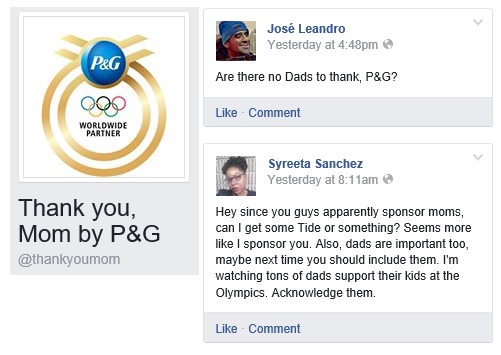
It’s one thing to market to a certain segment – as it’s doing with the “Mom” promotion – but another to want it both ways, as P&G emphatically implores us that “a world free from gender bias is a better world for all.”

Imagine what sports-loving dads were thinking when they watched regular nightly exclusion during the 17-day PyeongChang Games, as only mothers were thanked for helping athletes achieve their dreams. Meanwhile, these same dads would simultaneously encounter the #WeSeeEqual declaration, and another occasional P&G effort, #LoveOverBias – both exhorting humanity to treat everyone equally. Everyone, that is, except customers.p&g3.jpg

These conflicting messages aren’t just confusing, they’re actually illogical; it’s impossible to pair the word “equality” with brands that concurrently exclude fathers, but P&G has indeed done the impossible.

Media writers have praised the effort of #WeSeeEqual – and rightly so. On its own, it’s an incredibly commendable campaign and well-executed. But there’s no denying the mixed message it sends to dads and the parenting community.

If equality is going to mean something, the corporate world needs a genuine effort with a real, authentic backing – in word and in deed.

Otherwise a company is just selling products on a shelf, not a mission.